RPE vs Percentage-Based Training: Which Builds More Strength?
Autoregulation, by a margin small enough that it should not decide anything. Picking each session’s weight from how hard the set felt, or from how fast the bar moved, beat running fixed percentages of a tested max by about 2 kg on a one-rep max — roughly 1% on a 400 lb (181 kg) deadlift and roughly 4% on a 120 lb (54 kg) bench press. Both ways of picking the weight built strength — how much you can lift. Run whichever one you will keep running, and put the attention you save into weekly volume, which does more to change the outcome than either loading method does.
That comes from a 2022 systematic review in Sports Medicine - Open, which pooled the six training studies running the two methods head to head with sets matched between groups — twelve lift-by-lift comparisons over six to twelve weeks. Its second half, on when to end a set, is where the choice mattered more.
Table of Contents
- What the six studies compared
- What RPE vs percentage-based training means in the gym
- Where the method did change the result: when you end the set
- What this evidence cannot tell you
- Where this sits in the wider evidence
- What to do with this in your training
- Common Questions About Autoregulated Training
- How Pick It Up Helps
- Further Reading & References
What the six studies compared
A hundred and thirty-three people, six studies, six to twelve weeks each, two or three sessions a week. Every study matched the number of sets between groups and four matched the reps too, so what was under test was the method of choosing the weight rather than the amount of work.
Five of the studies recruited men between about 17 and 28 years old with at least two years of training behind them. The sixth recruited female athletes around 16 with at least a year.
The comparison group in each case ran percentage-based training: a max is tested, and the program is written as percentages of it for the weeks that follow. The autoregulated groups came in two flavours — three studies moved the load off the lifter’s own report of how many reps were left in the tank (RIR, reps in reserve, the scale behind most RPE systems), and three moved it off a device reading bar speed.
The outcome was a one-rep max: back squat in six comparisons, bench press in three, and one each of deadlift, front squat and overhead press.
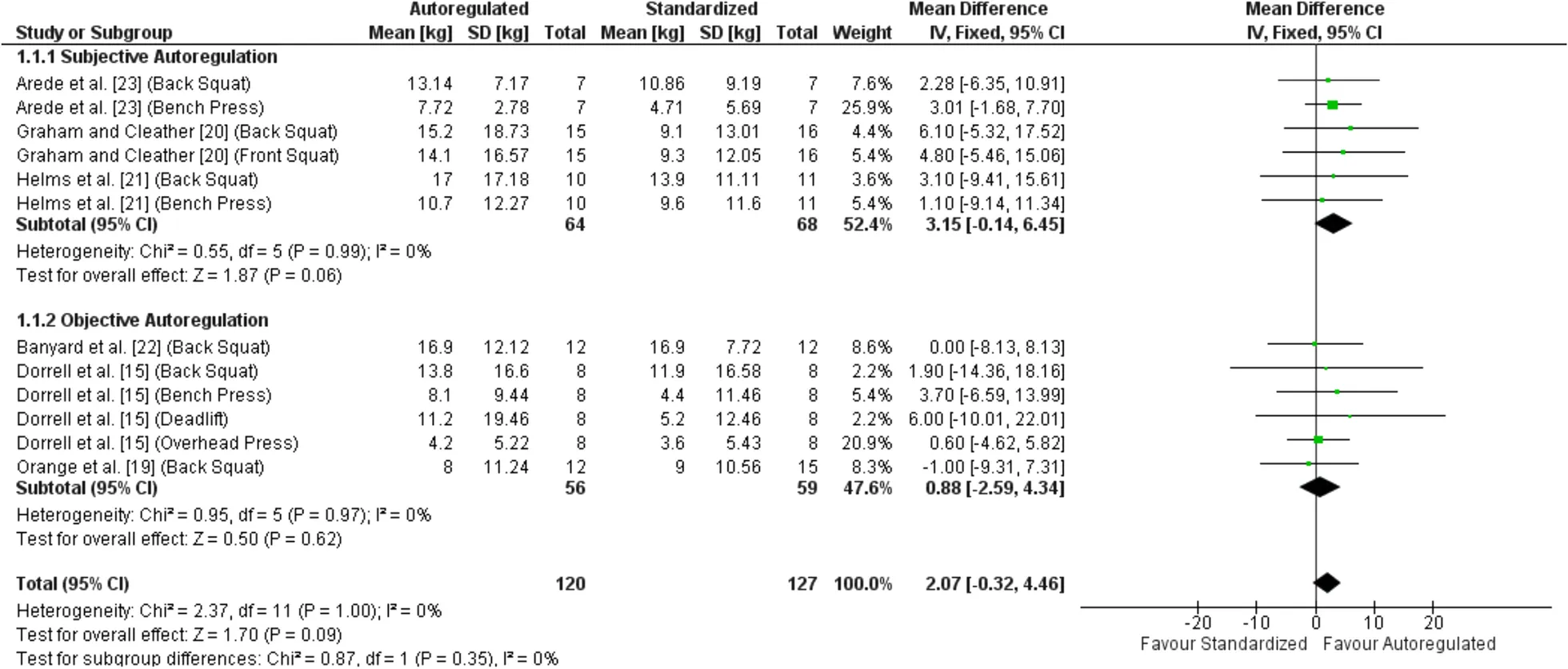
Every comparison in the review, and the pooled result underneath. Hickmott, Chilibeck, Shaw and Butcher (2022), Figure 2, Sports Medicine - Open, CC BY 4.0.
What RPE vs percentage-based training means in the gym
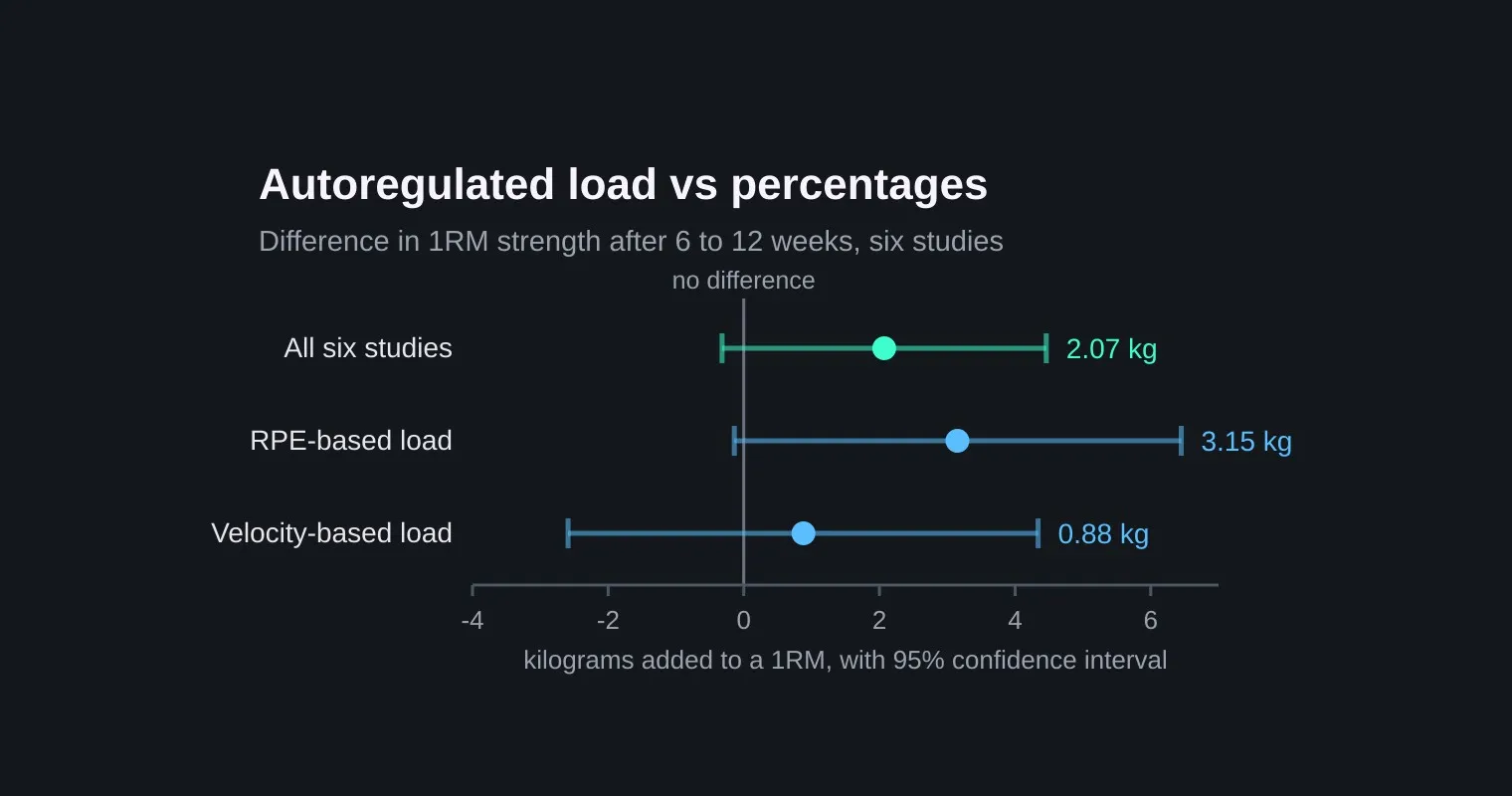
Both flavours of autoregulation beat fixed percentages, and both beat it by a little: RPE-based loading by 3.15 kg, bar-speed loading by 0.88 kg, pooling to 2.07 kg with a 95% confidence interval from 0.32 kg behind to 4.46 kg ahead. The interval crosses zero, so the review could not rule out the two approaches being identical. That is the plot above: three diamonds, all right of the line, all touching it.
What the advantage tracks, where there is one, is how heavy people ended up training. The review’s sub-analysis found the small effect in autoregulation’s favour in the studies where the autoregulated group worked at a higher percentage of its max — and in all three bar-speed studies, where the two groups landed on the same relative intensity, the gap shrank to 0.88 kg. So autoregulation is a way of setting the dial rather than a stimulus of its own: it earns its 2 kg when it puts a heavier bar on the rack than the chart would have, and returns nothing when it lands on the same weight.
The gap between the two flavours is the less interesting comparison — the review tested it directly and could not separate them, and the RPE studies also ran longer, which is time for strength to accumulate regardless of method. What the numbers do not support is paying for hardware to make the loading decision, which is roughly where the evidence on bar-speed feedback lands as well.
Where the method did change the result: when you end the set
The same review has a second half. Nine studies, 308 lifters, five to eight weeks, all of them resistance-trained and nearly all men in their twenties. Here the sets were matched but the reps were not: each set ended when bar speed had dropped by a set percentage from the first rep — a velocity loss threshold. Stop at 10% and the set is short. Let it run to 40% and you are close to failure.
For one-rep max strength, stopping at 25% velocity loss or less beat going past it by 2.32 kg, with an interval from 0.33 to 4.31 kg. That advantage came from the studies whose lifters were also training outside the protocol; where the protocol was the whole of their training, the two thresholds were not separable. So the threshold moved the result only when it sat on top of other work — which is the shape you would expect if total weekly volume is doing the driving and the stopping rule is mostly a way of setting it.
Muscle size went the other way. Across the three studies that measured cross-sectional area, thresholds above 25% produced 0.61 cm² more than thresholds at or below it, with an interval from 0.05 to 1.16 cm². Going past 25% was no better than stopping at 20–25%, though, and the authors attribute the size result to volume rather than to fatigue: with sets matched and reps free, the high-threshold groups simply did more reps — volume again, not fatigue.
Both halves point at the same window: ending sets at around a 20–25% drop in bar speed served strength and hypertrophy — muscle growth — about equally well. Reaching it needs something measuring the bar, which is what this finding costs.
What this evidence cannot tell you
The load half rests on 133 people, almost all young men with at least two years of training, plus one study in teenage female athletes. Nobody was followed past twelve weeks.
It says nothing about muscle growth: only one of the six studies measured it, so no pooled comparison could be run.
Every included study carried some risk of bias on the Cochrane tool the authors applied.
RPE’s weak point is in the review’s own discussion. Lifters taking a squat set to failure at 70% of their max called out when they believed they had reached an RPE of 5, 7 and 9; the review reports their true values sitting about 5, 4 and 2 repetitions below those calls. Every call was further from failure than the lifter thought, and the calls got closer to correct nearer to failure.
Velocity loss has the mirror-image problem: in the back squat, thresholds of 10%, 20% and 30% produced spreads of 2–11, 4–19 and 4–24 reps across lifters. A percentage drop in bar speed measures fatigue inside the set, not how close to failure the set finished.
One strategy is missing entirely: stopping each set at a nominated RPE, the obvious way to autoregulate volume without a device, had no long-term study behind it when this review was written.
Where this sits in the wider evidence
This is the only meta-analysis we could find that puts autoregulated and percentage-based loading side by side, and the authors describe it as the first. The question is not settled and this review does not settle it. It provides some evidence that training with autoregulation could provide some relatively small benefit over training based on set percentages of calculated one rep maxes alone.
Where it lands is where the surrounding evidence already sat. The review’s own framing is that one-rep max strength is driven mostly by how heavy you train relative to your max. Thus methods that vary how close you train to your one rep max are more effective in moving it, compared to methods that keep you consistently far from your max. The bar-speed studies are the clean demonstration: they landed on the same relative intensity as the percentage groups, and they landed on the same result.
Our post on how close to failure to train cites this review’s velocity-loss half for the same 20–25% band, reached from a different direction.
The case for autoregulation was never that the method is magic. It is that a percentage chart is anchored to a single test, and that test moves: two 1RM attempts by the same lifter a week apart land about 3% apart for people with training experience. Autoregulation is an answer to that drift, and this review sizes the answer at 2.07 kg over six to twelve weeks — 1.1% of a 181 kg (400 lb) deadlift, 3.8% of a 54 kg (120 lb) bench press. Which of those a lifter should picture depends on their own bar.
What to do with this in your training
- Run whichever method you will keep running. Both added strength in every study here, and the gap was about 2 kg — a percent or two on most bars. The tie-break is what you will stick to, not physiology.
- If you train on percentages, refresh the max underneath them. Re-estimate it from your logged work at the end of each block rather than riding one test for months.
- If you call RPE, expect to be further from failure than you called. In the study the review cites, a called 9 sat about two repetitions short of a real one, and the gap was wider at lower calls. Take a set to failure occasionally to recalibrate yourself.
- If you measure bar speed, end sets at around a 20–25% drop. That window sat at the top for strength and no worse than anything higher for size.
- Do not buy hardware for the loading decision. Programming from bar speed beat fixed reps at a fixed percentage, but only slightly — 0.88 kg, on an interval running well into negative territory — and RPE-based programming came out further ahead than bar speed did here. Nothing supports the cost of a measurement device for choosing the weight; if one earns its place it is for the velocity-loss cut-off above.
Common Questions About Autoregulated Training
Does autoregulating the load build more muscle? There is no answer in this review. One of the six load studies measured muscle size, which is not enough to pool, so the comparison was left unrun.
Does this hold for a program longer than twelve weeks? Untested. The longest study ran twelve weeks. The gap favoured autoregulation a little more clearly in the studies of eight weeks and over, which is a hint that a longer trial might read differently rather than evidence that it would. While hypertrophy — muscle growth — was inconclusive, in the longer studies included strength — how much you can lift — did show improvement.
Is a velocity device more accurate than calling RPE? The one study that pitted them against each other favoured the device, which the authors flag as conflicting with their own pooled result. Neither is strong enough to settle it.
Does this mean a percentage chart is safe to trust? For the load, on this evidence, yes. The rep target beside it is separate: how many reps a given percentage allows varies by two to three reps between lifters, so a chart that prescribes 80% for 8 is firmer about the 80% than about the 8.
How Pick It Up Helps
Autoregulation is a two-step job: measure, then adjust. Pick It Up does the second step for you. Every set arrives with a target weight, a target rep count and a target difficulty on a simplified RPE and RIR scale; you report what you hit, and the targets for the next set move in response, during the session when necessary. No velocity device and no percentage chart: the measurement is the report you already make when you log a set. At the end of a block it re-reads the whole block and updates your 1RMs before writing the next one, so the number your programming sits on is never one afternoon old. Build the body you want. In the hours you have. $5 a month. Start a free trial.
Further Reading & References
- The Effect of Load and Volume Autoregulation on Muscular Strength and Hypertrophy: A Systematic Review and Meta-Analysis — Hickmott LM, Chilibeck PD, Shaw KA, Butcher SJ. Sports Medicine - Open 2022; 8(1): 9. PubMed. The sole source for every number in this post, including the RPE-accuracy and velocity-loss figures it reports from the studies it reviewed.
- How Accurate Is a 1 Rep Max Test? What 32 Studies Found — the test-retest evidence behind the drift that autoregulation is meant to answer.
- Does Tracking Bar Speed Make You Stronger? — the separate question of what a velocity number does when a lifter sees it.
- How Many Reps at 80% of 1RM? The Chart Is Only an Average — the spread around the rep half of a percentage prescription.
- How Close to Failure Should You Train for Muscle Growth? — what the evidence says about proximity to failure, which velocity loss does not measure.