How accurate is a 1 rep max test? The short answer
A max is a measurement, and every measurement wobbles. To answer the question of how much, a 2020 systematic review in Sports Medicine - Open pooled 32 studies that had the same people take the same 1RM test twice, one to ten days apart, and compared the pairs. The two scores landed an average of 4.2% apart, though training experience mattered: for untrained lifters, the average difference was 5.5%. For lifters with training experience, the average difference was 3.3% between tests.
To put percentages into kg and pounds, 4% of a 100 kg (220 lb) bench press is 4.2 kg, a shade over 9 lbs of difference from test to test.
Table of Contents
- What this review pooled
- How accurate is a 1 rep max test, lift by lift
- What it means in the gym
- What this evidence cannot tell you
- Where this sits in the wider evidence
- What to do with this in your training
- Common Questions About 1 Rep Max Testing
- How Pick It Up Helps
- Further Reading & References
What this review pooled
Thirty-two studies, 1,595 people between them, with individual studies running from 10 participants to 376. Twenty-two of the studies recruited people with no resistance training behind them; fourteen recruited people with some. Men and women, young adults through to older adults, plus two studies in clinical populations.
Every study ran the same design: test, wait one to ten days, test again, and see how far the second score sat from the first. The lifts were a mix of barbell work and machines — bench press, back squat and power clean alongside chest press, leg press and knee extension. Warm-ups were one to three submaximal sets somewhere between 40% and 80% of an estimated max, then three to eight attempts at the top with one to five minutes between them.
That design measures consistency: whether the test gives the same answer twice. Consistency is the property a number needs if it is going to be compared against itself in twelve weeks. It is not the same as truth — whether the weight on the bar was the most you could ever have lifted is something a single test cannot establish.
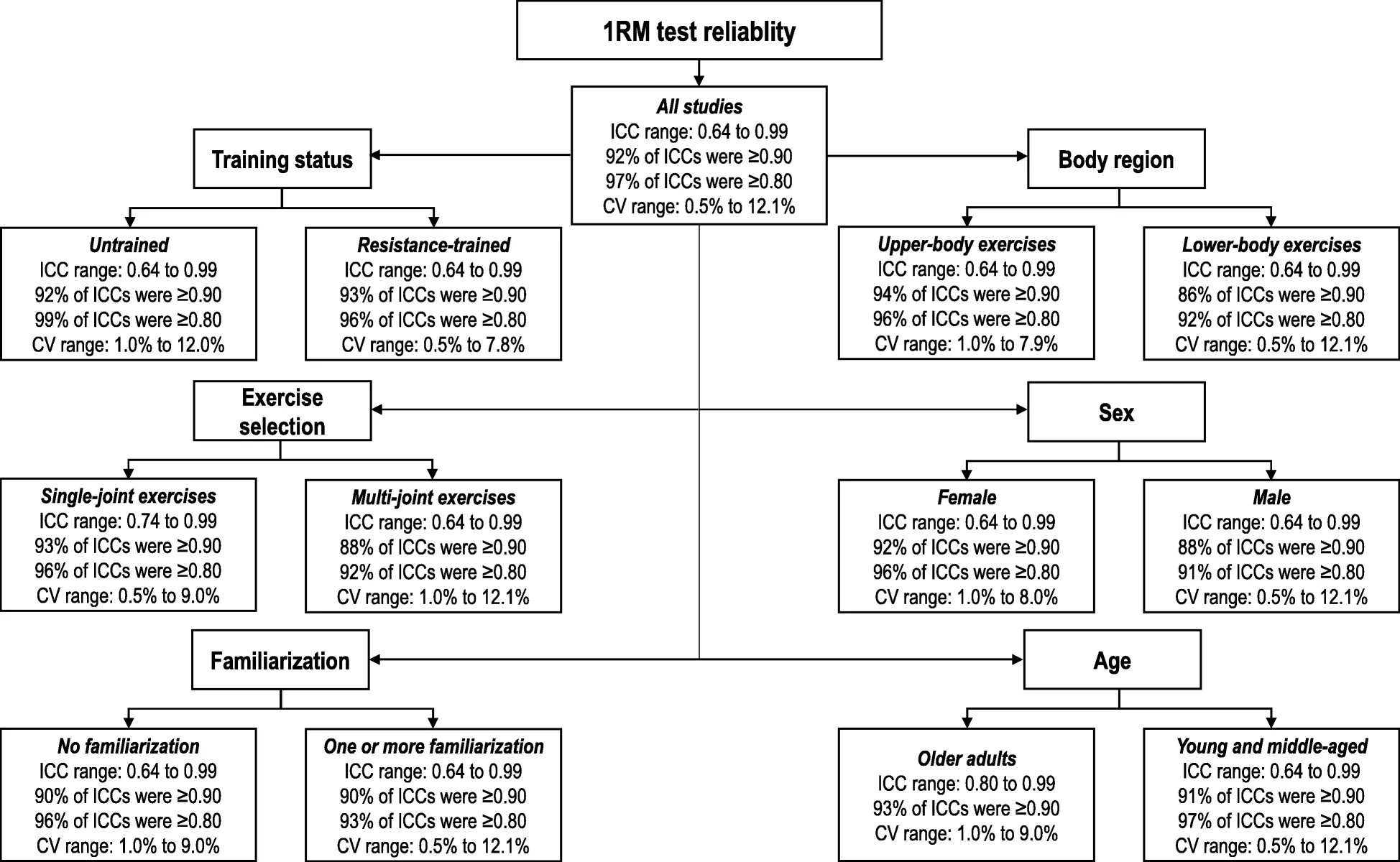
The review’s own summary of 1RM test-retest reliability across every subgroup it examined. Grgic, Lazinica, Schoenfeld and Pedisic (2020), Figure 2, Sports Medicine - Open, CC BY 4.0.
How accurate is a 1 rep max test, lift by lift
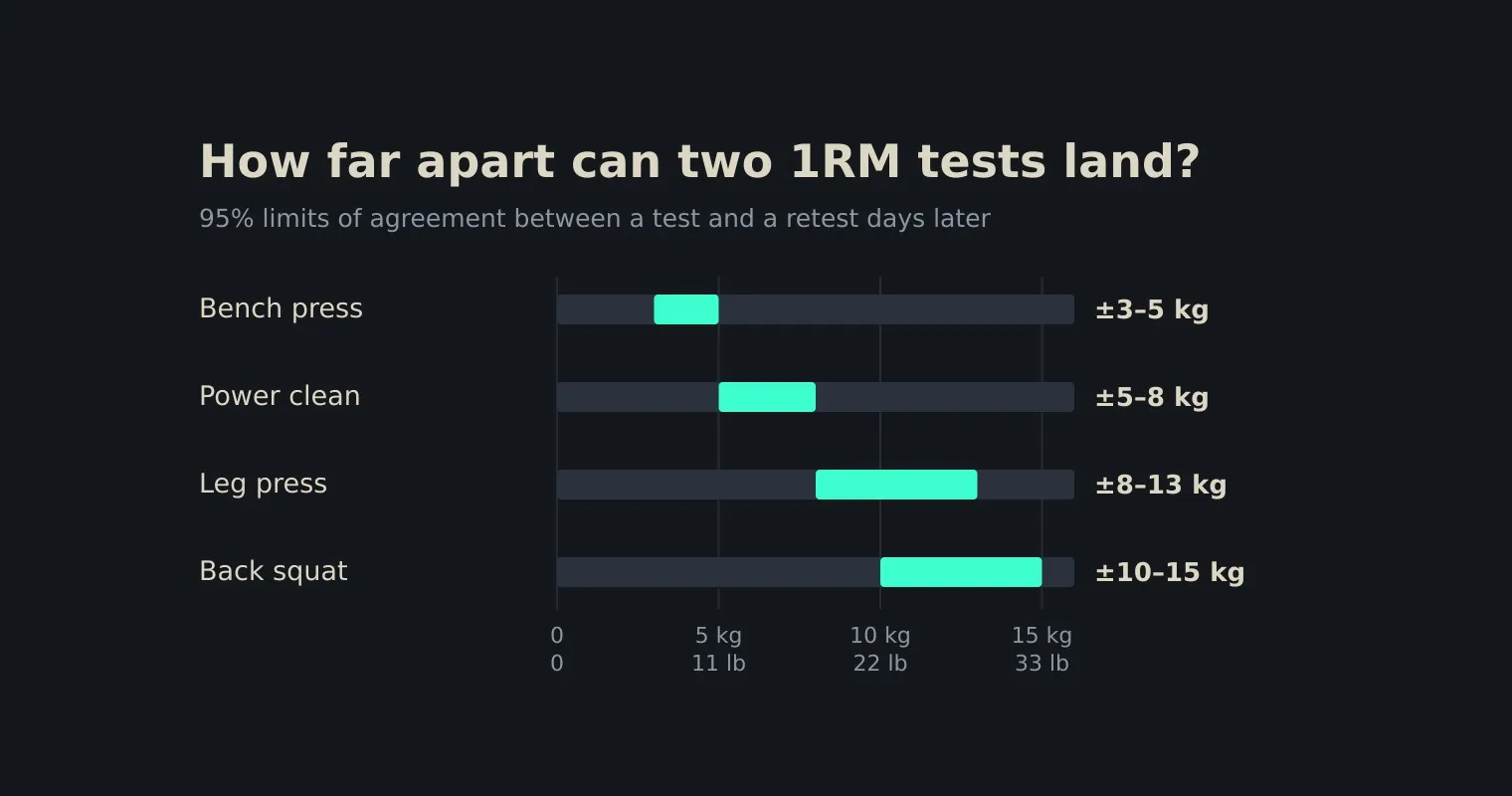
Twelve of the studies reported limits of agreement — the band inside which two tests of the same person land 95% of the time.
| Lift | Two tests landed within |
|---|---|
| Bench press | ±3–5 kg (7–11 lb) |
| Power clean | ±5–8 kg (11–18 lb) |
| Leg press | ±8–13 kg (18–29 lb) |
| Back squat | ±10–15 kg (22–33 lb) |
Upper body is tighter than lower body, and that pattern holds across the whole review rather than just these four lifts: the typical gap was 4.1% on upper-body tests and 4.7% on lower-body ones.
Training experience narrowed it. In the fourteen studies that recruited people with resistance training behind them the typical gap was 3.3%; in the twenty-two that recruited untrained people it was 5.5%.
What it means in the gym
Set the noise floor before reading the max. A back squat that goes from 140 kg to 145 kg between two test days is inside the band two tests occupy anyway. The same 5 kg on a bench press sits at the edge of that band. The squat needs a bigger jump than the bench before the jump counts as evidence of strength — how much you can lift — rather than as measurement.
It cuts the other way too. A max that comes back flat after a block is not proof the block failed. Flat is what a small improvement looks like through a ±10 kg window on the squat.
Testing also looks cheap in injury terms. Across 32 studies and 1,595 people the reported adverse events were mostly muscle soreness, with a handful of sore joints and two aggravated pre-existing back injuries. The caveat is that these were supervised sessions with a controlled warm-up and a capped number of attempts, which is not the same thing as working up to a single in an empty gym.
What this evidence cannot tell you
Twenty-two of the 32 studies used untrained participants, so the review sits on its strongest ground for people early in training and on thinner ground for anyone with years behind them. The trained subgroup was fourteen studies, and it pointed to tighter agreement rather than looser, but it is the smaller half of the evidence.
The gaps between tests ran one to ten days. Nothing here speaks to how a max drifts across the eight or twelve weeks a training block runs.
Only 15 of the 32 studies reported the percentage figures quoted above, and the authors flag a problem with the correlation statistic the rest leaned on: there are ten versions of it, most studies did not say which one they used, and one paper that ran six versions on a single dataset got answers from 0.51 to 0.87.
And the whole review is about consistency. It does not compare a tested max against a max estimated from a rep-max chart, it does not say how often to test, and it does not measure what a test day costs in fatigue or in training time.
Where this sits in the wider evidence
This is the broadest pooling of 1RM test-retest data we could find, and it lands where the field already stood. The review’s own introduction notes that many researchers treat the 1RM as the gold-standard test of dynamic strength, and its conclusion is that the treatment is earned. The one thing it revises is the familiarisation claim above, which came from a single earlier study and does not survive contact with the other 31.
It also fills in the half that our piece on the rep-max chart left open. Percentage-based programming has two error bars, not one: the max itself, which this review shows is steady, and how many reps a given percentage of it allows, which across 269 studies varies between lifters by two to three reps. The load you write down is firmer than the rep target beside it.
What to do with this in your training
- Give each lift its own threshold before you call a PR. On the evidence here expect what you can do day-to-day to vary by a few percent. Give yourself at least a 4% increase in your one rep max before calling it a PR rather than a test variation.
- Read a flat retest as flat, not as failure. On the flip side, a block that added strength can still return the same max, because the improvement is smaller than the window the test measures in. Don’t be too concerned if you’ve been training and your one-rep max looks like it’s stayed flat. Especially later in your training journey, a 3% increase in strength is a great outcome for a monthly block, but won’t necessarily show up in your test.
- Keep the test protocol identical. Same warm-up, same rest between attempts, same equipment. The numbers above come from supervised tests run the same way twice; changing the protocol adds spread nobody measured.
- A first-ever max on a lift can read low. Two thirds of the comparisons found no systematic change between a test and a retest; in the third that did, the retest came in higher, by a median of 1.8 kg on an upper-body lift and 5.5 kg on a lower-body one. Do not read that second-attempt jump as progress.
Common Questions About 1 Rep Max Testing
Is an estimated 1RM from a rep-max calculator as good as a tested one? This review cannot answer that; it only compared tests against other tests. What we do know is that the chart those calculators run on describes an average lifter with a two-to-three-rep spread around it, so an estimate inherits that spread on top of the test’s own.
Does the squat’s bigger window mean the squat test is worse? No: the same percentage attaches to a heavier bar. A 4.7% spread on a 180 kg squat is 8.5 kg; on a 90 kg bench the same percentage is 4.2 kg. The test is no less consistent, the number is larger.
Do women need a different threshold? Nothing in the review suggests so. The typical spread was 4.4% in studies with female participants and 4.0% in studies with male ones, which is the same answer twice. The comparison is across different studies with different protocols, so treat it as an absence of evidence for a difference rather than proof of none.
What about older lifters? Twelve studies included older adults, and the reliability held: every subgroup the review examined by age landed in the same place. The typical spread was slightly wider at 5.4%, so the threshold for treating a change as more than measurement is a little higher.
How long should I wait between the two tests? The studies waited one to ten days and the review did not find that interval mattered within that range. Beyond ten days you are no longer measuring the test — you are measuring the test plus whatever your training did in between.
How Pick It Up Helps
A max test tells you where you are; it does not tell you what to lift on Thursday. Pick It Up handles that second job for you. At the end of every training block it re-evaluates your 1RMs from the whole block of sets you logged — weight, reps and reported difficulty across weeks of training — rather than from one attempt on one afternoon, then builds the next block’s targets from the updated numbers. More data points means less of the single-session wobble this review measured. Build the body you want. In the hours you have. $5 a month. Start a free trial.
Further Reading & References
- Test–Retest Reliability of the One-Repetition Maximum (1RM) Strength Assessment: a Systematic Review — Grgic J, Lazinica B, Schoenfeld BJ, Pedisic Z. Sports Medicine - Open 2020; 6(1): 31. PubMed. The sole source for every number in this post, and the source of the earlier familiarisation finding it reports and revises.
- How Many Reps at 80% of 1RM? The Chart Is Only an Average — our summary of the pooled rep-max data, and the other half of the error attached to percentage-based programming.
- How Heavy Should You Lift to Build Muscle? — what the load you set from that max is buying, for size and for strength.
- How to Break Through Plateaus in Weightlifting and Strength Training — what to do when a retest has not moved.