Does tracking bar speed make you stronger? The short answer
About 8% faster bar speed, immediately. A 2023 systematic review in Sports Medicine pooled the studies that showed lifters a number after every rep — bar speed on a screen, or the same figure read out loud — and compared them against the same lifters doing the same work with no number. Concentric bar speed came out roughly 8.4% higher with the number than without, on matched loads, with both conditions told to give maximal effort. Whether that compounds into strength — how much you can lift — over a training block is a separate and much thinner question: the review’s seven training studies ran four to six weeks, mostly in team-sport athletes, and measured sprint and jump rather than the squat.
Table of Contents
- What the review pooled
- What tracking bar speed changes inside a session
- Does tracking bar speed make you stronger over a training block?
- What it means in the gym
- What this evidence cannot tell you
- Where this sits in the wider evidence
- What to do with this in your training
- Common Questions About Bar Speed Feedback
- How Pick It Up Helps
- Further Reading & References
What the review pooled
Twenty studies. Thirteen looked at what happens inside a single session, seven at what happens across a training programme.
The thing being tested has a name in the literature — augmented feedback — and a plain description: information about the rep you just did, arriving from outside your own body. In these studies that was bar speed shown on a screen, bar speed called out by a researcher, a power figure after each rep, or a force trace drawn live as the lifter pulled.
The single-session studies were built on squat and bench press variants, with leg extension, leg curl, the Nordic hamstring curl and the leg press also represented. Loads ran from 30% of a one-rep max up to 85%. The groups were small: most held fewer than 20 people, several fewer than 10.
The seven training studies all ran four to six weeks, and recruited collegiate and professional rugby union players, Australian football players and NCAA athletes. Six of the seven applied feedback to a single exercise rather than the whole session. Fifteen of the twenty studies overall recruited only men, two only women, two both, and one did not report it.
What tracking bar speed changes inside a session
All thirteen single-session studies reported a benefit. Seven of them measured bar speed in a form that could be pooled, and across those seven — fifteen separate comparisons — feedback produced about 8.4% more concentric bar speed. That held across heavy and light loads and across upper and lower body lifts.
In one small study, eight lifters squatting at 85% of their max reached a peak bar speed of 0.55 m/s with no feedback and 0.76 m/s when a velocity readout followed every rep. The pooled effect is smaller than that single result.
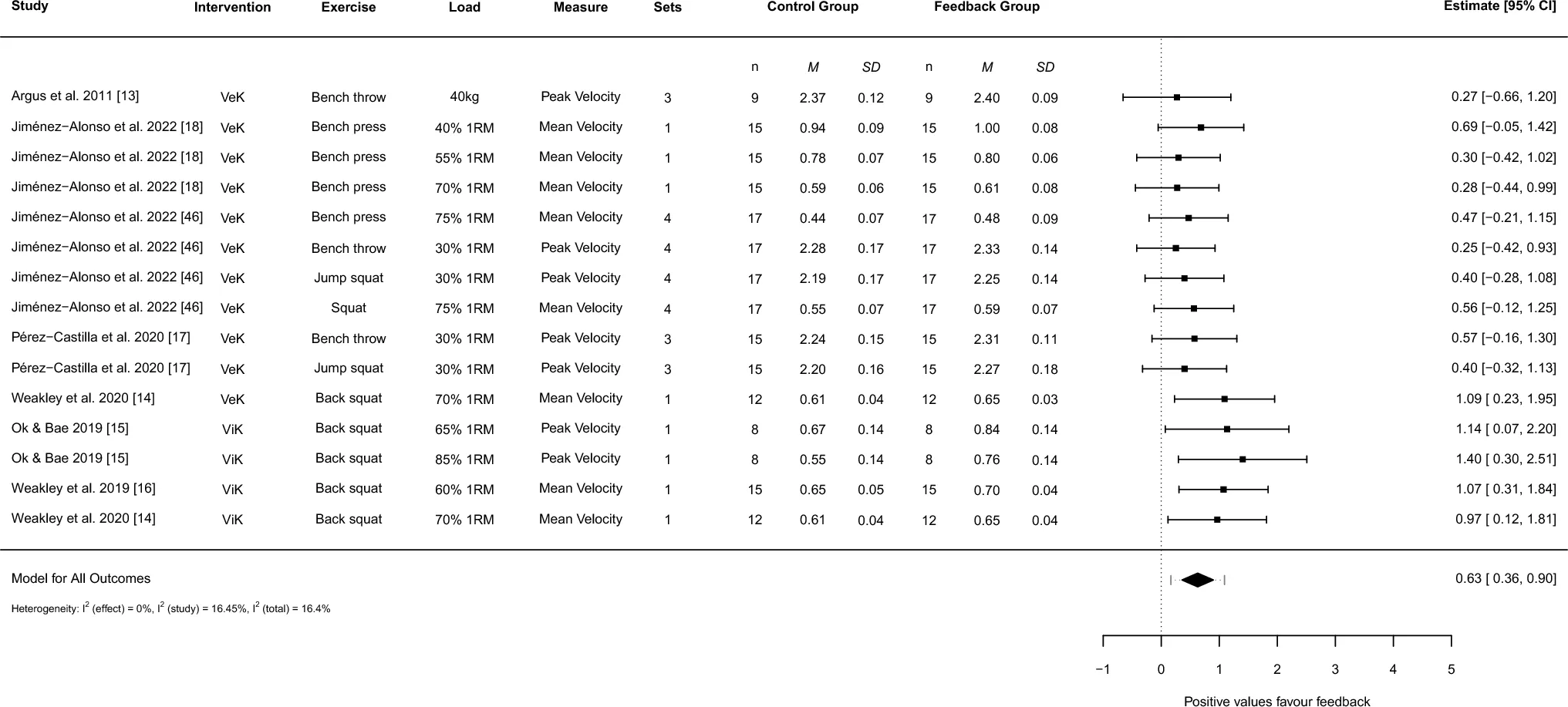
Every comparison the review pooled for the immediate effect of feedback on bar speed. Weakley, Cowley, Schoenfeld, Read, Timmins, García-Ramos and McGuckian (2023), Figure 2, Sports Medicine, CC BY 4.0.
Seeing the number beat hearing it. Visual feedback produced more than twice the effect of verbal feedback, and the gap between the two was large enough to clear statistical significance.
Every rep beat less often. Feedback delivered after each repetition was more effective than feedback given halfway through a set or averaged at the end of one.
Encouragement on top added nothing. The two studies that compared a visual readout against the same readout plus verbal encouragement found no additional benefit from the encouragement.
The effect leaves when the number does. In the studies that withdrew feedback, performance returned to pre-feedback levels immediately. This is not a skill the lifter keeps.
Several things made no difference at all. Load above or below 50% of a one-rep max, upper body against lower body, mean velocity against peak velocity, and one set against several all came out statistically indistinguishable.
The authors’ explanation is psychological rather than mechanical. Studies within the review reported that motivation and competitiveness rose when a visual readout was provided, and that the perceived physical demand of the set fell. In one study that combination let lifters complete more repetitions before reaching concentric failure.
Does tracking bar speed make you stronger over a training block?
Across the training studies, short sprint performance — anything up to 50 m — improved more in the feedback groups than in the control groups, and the pooled estimate stayed clear of no-difference. Jump performance leaned the same way but the range of plausible values still included no difference at all.
Maximum strength was never pooled, because too few studies measured the same thing. Two measured a three-rep max back squat, and both favoured the feedback group. The authors report that every physical quality assessed anywhere in the review improved more with feedback than without, and that no study found feedback made any outcome worse.
What it means in the gym
If you already have something that reports bar speed, put the readout where you can see it and read it after every rep of your main lift. Not at the end of the set, and not as a number someone tells you. That is the version of this the review found largest, and it costs nothing you are not already spending.
Treat it as a permanent fixture rather than an occasional one. Because the effect disappears the moment the number does, a device used for one session a month is buying one session a month.
Keep it identical between testing and training, or your test will flatter you. The authors make this point sharply: the improvement feedback produces is usually larger than the ordinary day-to-day variation in performance, so a lifter given a readout on test day but not on training days will look like they gained more than they did. The same trap sits under a max attempt — our post on how accurate a 1 rep max test is covers the measurement noise that is already there before feedback moves it.
Do not read it as a replacement for the things that drive the adaptation. Nothing here changes what load or how many sets to run; it changes how much you get out of the sets you were already doing.
What this evidence cannot tell you
Muscle size was never measured. Not one of the twenty studies looked at hypertrophy — muscle growth. Anything you read about feedback building more muscle is not coming from here.
The training half is small, short and narrow. Seven studies, four to six weeks each, almost entirely team-sport athletes, with sprint and jump as the pooled outcomes. Six of the seven fed back on one exercise only.
The jump result could not be separated from no effect, and one study was removed from that analysis as an outlier before it was run.
The sample was mostly young men. Fifteen of the twenty studies recruited men only, and the authors themselves flag that further work in women and in older participants is needed before the chronic findings can be generalised.
Where this sits in the wider evidence
This is the only pooled analysis of feedback during resistance training we could find, and the authors describe it as the first. That means the direction is consistent — every study in it favoured feedback — but that consistency rests on twenty mostly small studies rather than on a body of replicated work. One meta-analysis is evidence, not a settled field.
Where it does have company is in the wider work on training intent that the authors cite: higher force and velocity outputs during training have been linked to better strength and power adaptations, which is the mechanism this review is proposing for its own chronic results.
It also does not sit against anything in our own archive. The within-set effort lever most of the research has concentrated on is how close you stop to failure, which we covered in how close to failure you should train; feedback is a different lever on the same quantity, and the two are asking different questions rather than competing answers. Neither displaces the dose itself — how many sets per week remains the variable with the largest and best-replicated evidence behind it.
What to do with this in your training
- Show the number, don’t say it. If you own a velocity or power device, the screen goes where you can see it. Visual beat verbal by more than double.
- After every rep, on your main lift. Per-rep beat per-set and beat end-of-set averages. Six of the seven training studies fed back on a single exercise, so this need not cover the whole session.
- Skip the hype-man. Verbal encouragement stacked on top of a readout added nothing measurable in the studies that tested it.
- Use it every session or accept you get nothing between them. Removal returned performance to baseline immediately.
- Standardise it for testing. Whatever you do on training days, do on test days, or the retest is measuring the readout rather than you.
- Expect about 8% more bar speed, not 8% more weight on the bar. The pooled number is a velocity figure on submaximal loads, and the strength evidence behind it is two studies deep.
Common Questions About Bar Speed Feedback
Do I need a velocity tracker to get this?
The studies used linear position transducers, isokinetic dynamometers and video equipment — research hardware, not phone apps, which were not tested. One training programme did use simpler measures, feeding back distance jumped and sprint times, and it produced results alongside the device-based ones. What the review cannot tell you is whether a consumer app estimating bar speed from a phone camera produces the same effect.
Does this apply to building muscle?
The review cannot say. No study in it measured muscle size. The nearest thing is a single study in which lifters given feedback completed more repetitions before hitting concentric failure, which is more volume in that session — but one small study reporting extra reps is a long way from a hypertrophy finding.
Should my training partner call out my bar speed?
Verbal feedback did beat no feedback, so the answer is not no. It was the weaker of the two forms, though, and the people delivering it in these studies were researchers and coaches reading a device, not partners estimating by eye. The review did not test training partners.
Why did jump performance not reach statistical significance?
Only four studies measured it, and one was removed as an outlier during sensitivity analysis because it was causing most of the variation between studies. The authors note that with that study included, the effect on jump performance looked larger rather than smaller.
How Pick It Up Helps
As of September 2026, Pick It Up does not measure bar speed. There is no velocity tracking in the app, and nothing in it will show you the number this review is about — if that is what you want, you want a device.
What the app does is the job next to it: every set arrives with a target before you start it — a target weight, a target rep count, and a target difficulty on a simplified RPE scale — and as you report the weight and reps you hit against it, the targets for the following sets update during the session rather than at the end of the block. That is a prescription rather than a measurement of the rep you just did, so it is not the intervention this review tested. It is the part of the problem a readout does not solve: what the number should have been. Build the body you want. In the hours you have. $5 a month. Start a free trial.
Further Reading & References
- The Effect of Feedback on Resistance Training Performance and Adaptations: A Systematic Review and Meta-analysis — Weakley J, Cowley N, Schoenfeld BJ, Read DB, Timmins RG, García-Ramos A, McGuckian TB. Sports Medicine 2023; 53(9): 1789–1803. PubMed. The sole source for every number in this post.
- How Accurate Is a 1 Rep Max Test? — the measurement noise already sitting under a max attempt, before feedback is added to one side of the comparison.
- How Close to Failure Should You Train for Muscle Growth? — the other lever on how much effort a set carries.
- How Many Sets Per Week for Hypertrophy? — the dose this does not replace.