Does creatine make you stronger? The short answer
Yes, by about 4 kg on an upper-body max and about 11 kg on a lower-body max, over four to twelve weeks of the same training a placebo group was doing. On a 100 kg (220 lb) bench press, 4 kg is a little over 4%; on a 140 kg (310 lb) squat, 11 kg is a little over 8%. Every daily dose the trials used, from 2 g to 10 g, produced the gain, and skipping the loading week did not measurably cost anything.
A 2024 meta-analysis in Nutrients pooled 23 randomised trials that put one group on creatine and one on a placebo while both ran the same resistance training program, then reported the gap between them in kilograms rather than in statistical units.
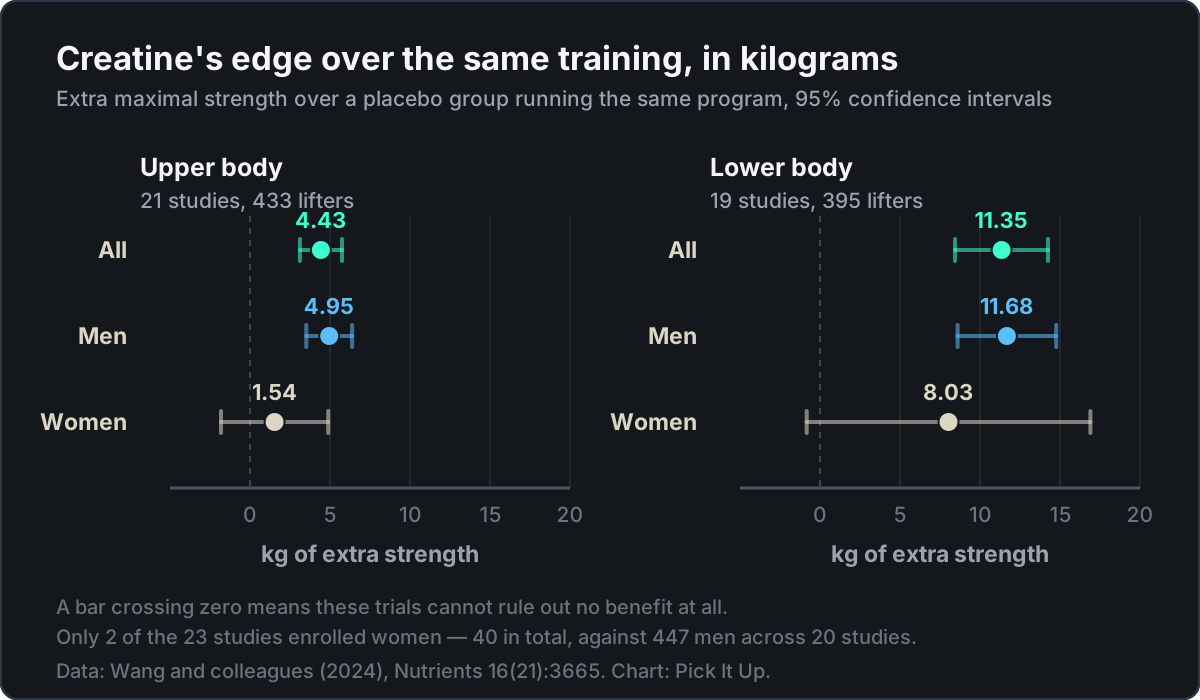
Our chart of the pooled estimates and 95% confidence intervals reported by Wang and colleagues (2024). The numbers are theirs.
Table of Contents
- Does creatine make you stronger? The short answer
- What the 23 trials tested
- How much stronger, upper body and lower body
- Does creatine make you stronger in the gym, or only in the pooled data?
- Dose, loading, and everything that changed nothing
- What this study does not show
- Where this sits in the wider evidence
- What to do with this in your training
- Common Questions About Creatine and Strength
- How Pick It Up Helps
- Further Reading & References
What the 23 trials tested
Wang and colleagues searched four databases up to May 2024 for randomised trials that compared creatine plus resistance training against a placebo plus the same resistance training, in healthy people under 50. Twenty-three qualified, and the participants across them come to a little over 500.
The programs ran 4 to 12 weeks, at two to five sessions a week. Daily creatine ran from 2 g to 10 g after any loading phase, with loading weeks of 15 g to 25 g a day in the trials that used one. The outcome was maximal strength, measured before and after, mostly by one-rep max tests.
- Almost all of them were men. Twenty trials enrolled only men, 447 in total. Two enrolled only women, 40 in total. One enrolled 13 men and 9 women.
- Almost all of them were young. The group averages run from 17 to 27 years old. “Under 50” was the inclusion rule, not a description of who turned up.
Eighteen of the 23 trials recruited people with resistance training experience and five recruited people with none. On the PEDro scale, which scores how well a trial was run, two came out excellent and the other 21 good.
How much stronger, upper body and lower body
Across the 21 trials that measured an upper-body max, the creatine group’s strength rose 4.43 kg more than the placebo group’s. Across the 19 that measured a lower-body max, 11.35 kg more. Both results were a long way clear of chance, and the trials agreed with each other closely: the review found no measurable heterogeneity in either pool, which means the individual studies were not pulling in opposite directions and then averaging out to something tidy.
Put those against a bar. On a 100 kg (220 lb) bench press, 4.43 kg is 4.4%. On a 140 kg (310 lb) squat, 11.35 kg is 8.1%. Those bars are illustrations rather than the lifts the trials tested, but the arithmetic holds for any bar you want to substitute: divide the kilograms by the weight you lift.
The lower body gained more, both in kilograms and in proportion. And these are one group average against another, over a specific four-to-twelve-week window.
Does creatine make you stronger in the gym, or only in the pooled data?
In the gym, but you may not be able to see it on yourself. A one-rep max test repeated on the same person a week later lands an average of 3.3% away from the first test for lifters with training experience. On that same 100 kg bench, 3.3% is 3.3 kg. Creatine’s upper-body edge of 4.43 kg is barely bigger than the measurement’s own wobble.
That is not an argument against the finding. Pooling 433 people is precisely what cancels random test noise, which is how a 4.43 kg average gets measured confidently when a single pair of tests cannot resolve it. It is an argument against the experiment you might be tempted to run on yourself: max out, take creatine for eight weeks, max out again, decide. The difference you would be looking for is about the size of the error bar on your own instrument.
The lower body is an easier read. Against a 3.3% wobble on a 140 kg squat, which comes to 4.6 kg, an 11.35 kg gap is roughly twice the size of the noise.
Dose, loading, and everything that changed nothing
The review ran six subgroup comparisons. Five of them came back with no significant difference.
- Dose. Trials using 5 g a day or less averaged 4.17 kg on upper-body strength; trials using more averaged 6.11 kg. Not significant. On lower-body strength the gap was wider, 9.90 kg against 16.43 kg, and came close to significance without reaching it.
- Loading. Trials with a loading week averaged 6.57 kg upper body and 14.82 kg lower body. Trials without averaged 4.07 kg and 10.44 kg. Not significant either. The authors read this as loading not being needed for strength on a program of four weeks or more, while leaving it open for a shorter one.
- Training status. Whether a trial recruited people with lifting experience or people with none made no measurable difference to creatine’s edge.
- Session frequency. Three sessions a week or fewer against four or more: 4.44 kg against 4.42 kg on upper-body strength.
- Program length. Under eight weeks against eight weeks and over: no measurable difference.
The sixth comparison was sex.
What this study does not show
The women’s result is an evidence gap, not a finding. In the trials with women in them, creatine’s edge came to 1.54 kg on upper-body strength and 8.03 kg on lower-body strength, and neither reached statistical significance. Both estimates point the same way as the men’s. Both rest on 40 women in two trials, plus nine more in a third. The intervals around them are wide enough to cover a small loss and a large gain alike. On lower-body strength the review compared men against women directly and found no significant difference between them. What this review found is almost no trials in women, which is not the same as finding that creatine failed for them.
The upper-body number may be a little high. The review’s own publication-bias check flagged asymmetry in the upper-body results, the pattern you get when small trials that found nothing never reach print. Correcting for it moved the estimate from 4.43 kg down to 3.60 kg. The lower-body results showed no such asymmetry.
Nothing past 12 weeks. That was the longest program, so whether the gap widens, holds or closes after three months is untested here. The authors call for trials that run longer.
Nothing about older lifters. Under 50 was the inclusion rule and the oldest group average was 27.
Nothing about timing or pairing. When creatine was taken, and what it was taken with, were not analysed. The authors list both as open.
Strength only. Muscle size was not an outcome in this review.
Where this sits in the wider evidence
This study sits with the consensus rather than against it. The authors’ own framing is that their results support earlier meta-analyses of creatine and strength. What they added was the unit — kilograms rather than standard deviations — and a sample restricted to people under 50.
The less settled half is muscle size. Strength, meaning how much you can lift, is a different outcome from hypertrophy, meaning muscle growth, and creatine’s record on the second is thinner. A separate 2023 meta-analysis pooled 10 trials that measured muscle size directly by MRI, CT or ultrasound and found a very small advantage for creatine, small enough that its interval still included no difference at all. So of the two claims, the strength one rests on firmer ground.
What to do with this in your training
- Expect about 4 kg on an upper-body max and about 11 kg on a lower-body max over two to three months, on top of what the training gives you. That is the size of the prize in these trials.
- Any daily dose from 2 g to 10 g produced gains. The trials using 5 g a day or less did not finish measurably behind the ones using more, and the authors suggest scaling the dose to body weight rather than chasing a bigger number.
- Skip the loading week if you want to. Across programs of four weeks or more it made no measurable difference to where people finished.
- Do not try to read the result off one before-and-after max, at least not on an upper-body lift, where the effect is about the size of the test’s own error. Judge it across a training block, on several lifts, or not at all.
- Keep the programming decisions where they belong. A supplement is an addition to a program, not a substitute for one — how many sets you run each week and how much protein you eat are decisions with their own evidence behind them.
Common Questions About Creatine and Strength
Does it matter whether you take creatine before or after training?
This review cannot say. Timing was not one of the variables analysed, and the authors list it among the things future trials should settle, along with what creatine is taken alongside.
Should a heavier lifter take more?
The authors think so. Nine of the 23 trials set the dose by body mass rather than as a flat number, and the discussion recommends adjusting by body weight, pointing to evidence that heavier people may need 5 g to 10 g a day to keep muscle stores topped up. The only hint of a dose effect in the data was on lower-body strength, and it did not reach significance.
Does creatine still work past 50?
This review excluded anyone over 50 deliberately, to keep age-related muscle loss out of the comparison. The authors point to separate reviews in older adults and note that creatine may be more effective above 50, not less. That is their reading of other papers, not a result from this one.
Does a bigger max mean more muscle?
Not necessarily, and this review does not speak to it. Maximal strength was the only outcome. The meta-analysis that measured muscle size directly found a much smaller advantage, so the strength case and the size case are not the same case.
How Pick It Up Helps
As of September 2026, Pick It Up does not track supplements and has no opinion on what you take. What it does is the part this post ran into: telling whether something changed.
At the end of a training block the app evaluates performance across the whole block, updates every one of your 1RMs from the sets you logged rather than from a single test day, and builds the next block from the revised numbers. A several-week read across many sets is a steadier instrument than one max attempt, which is the measurement problem a 4 kg difference runs into.
Start a free trial and see what the next block says.
Further Reading & References
- Wang Z, Qiu B, Li R, Han Y, Petersen C, Liu S, Zhang Y, Liu C, Candow DG, Del Coso J. “Effects of Creatine Supplementation and Resistance Training on Muscle Strength Gains in Adults <50 Years of Age: A Systematic Review and Meta-Analysis.” Nutrients, 2024;16(21):3665. doi:10.3390/nu16213665 · PMID 39519498
- Burke R, Piñero A, Coleman M, Mohan A, Sapuppo M, Augustin F, Aragon AA, Candow DG, Forbes SC, Swinton P, Schoenfeld BJ. “The Effects of Creatine Supplementation Combined with Resistance Training on Regional Measures of Muscle Hypertrophy: A Systematic Review with Meta-Analysis.” Nutrients, 2023;15(9):2116. doi:10.3390/nu15092116 · PMID 37432300
- Our own summary of the test-retest evidence on maximal strength testing: How accurate is a 1 rep max test?