Plant protein vs animal protein for muscle growth: the short answer
The gap is small enough that you would struggle to see it on a person.
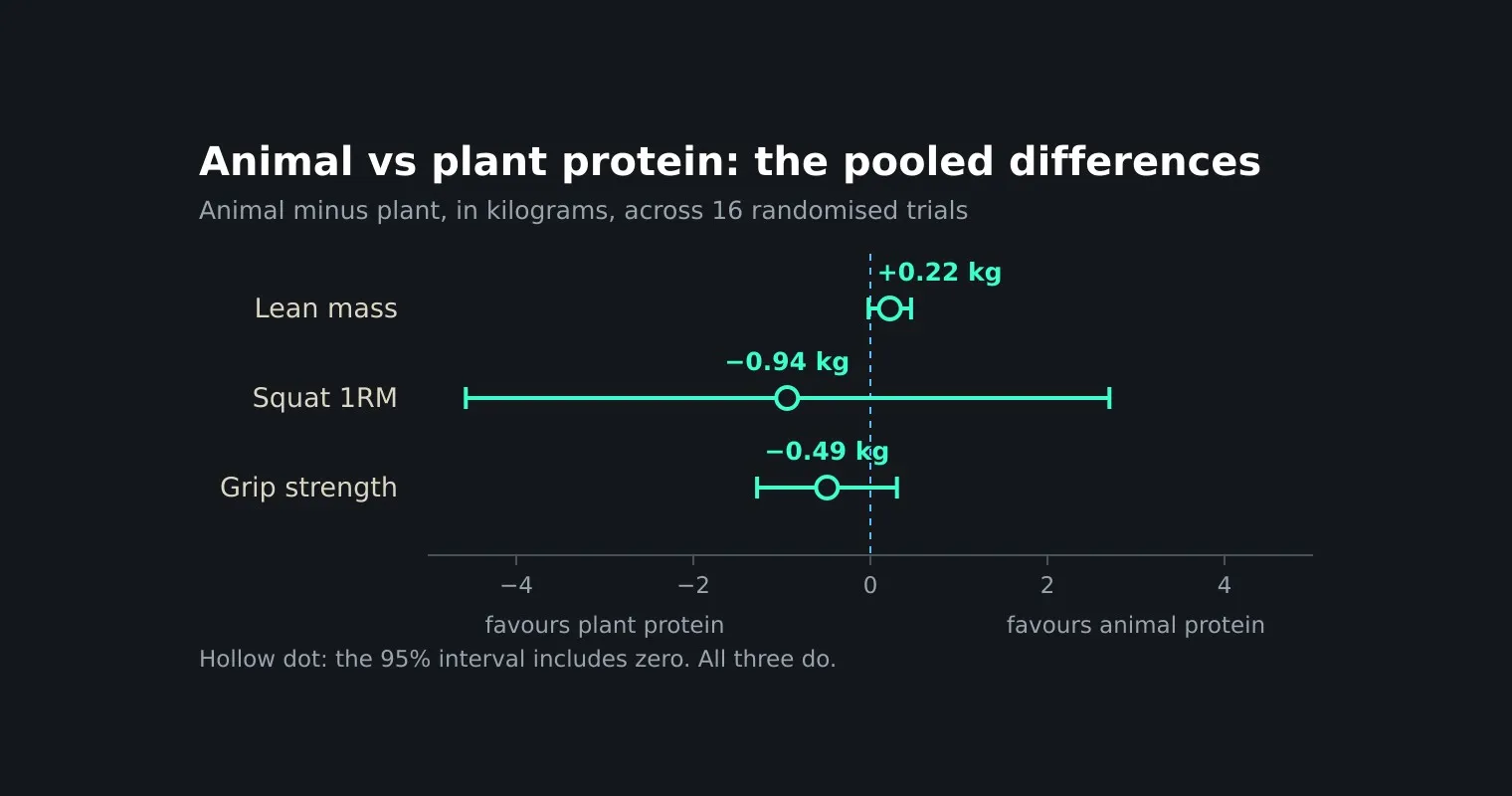
A 2021 systematic review and meta-analysis in Nutrients pulled together every randomised trial it could find that put one group on animal protein, another on plant protein, and then measured lean mass or strength. On plant protein vs animal protein for muscle growth, sixteen trials pooled to 0.22 kg in animal protein’s favour — about half a pound — with a confidence interval from −0.02 to 0.46 kg, so no difference sits inside the range.
Strength did not separate at all. One-rep max squat came out 0.94 kg in plant protein’s favour, on an interval from −4.57 to 2.70 kg. Grip strength, knee extension and knee flexion did the same thing, which is to say nothing.
One outcome did clear significance: lean mass expressed as a percentage of body weight, where animal protein gained 0.50% (95% CI 0.05 to 0.95). It is also the number that held up worst when the authors stress-tested it.
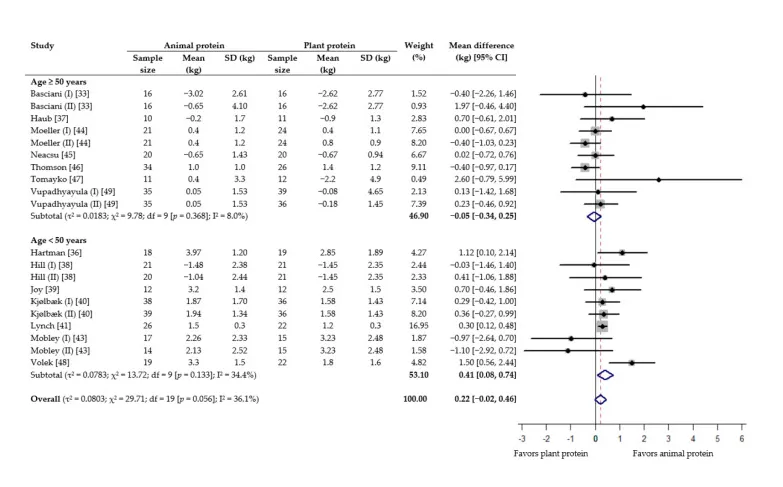
Figure 2 from Lim and colleagues (2021), reproduced under CC BY 4.0. Each row is one comparison; the diamonds are the pooled estimates. The under-50 subtotal sits off the zero line, the over-50 subtotal sits on it.
Table of Contents
- Plant protein vs animal protein for muscle growth: the short answer
- What this review pooled
- Plant protein vs animal protein for muscle growth: what the lean mass numbers show
- Strength came out level
- What this study does not settle
- Where this sits in the wider evidence
- What to do with this in your training
- Common Questions About Protein Source and Muscle
- How Pick It Up Helps
- Further Reading & References
What this review pooled
Lim and colleagues searched PubMed, Embase, Scopus and CINAHL Plus to January 2020, with an update in June, for randomised controlled trials that assigned adults to an animal-protein group and a plant-protein group and tracked lean mass or strength for longer than a single meal. Three thousand and eighty-one articles were screened; 18 survived, and 16 carried enough numbers to pool.
The animal protein was mostly dairy — whey isolate, concentrate and hydrolysate, casein, milk, one beef trial. The plant protein was mostly soy, with one pea and one rice trial. Mixed blends were rejected at screening, so every comparison here is one source against the other.
Eleven of the 18 trials had people lift. The other seven changed the protein and nothing else. Two trials recruited people who already trained; the rest started with people for whom the program was new, or who were not training at all. And everybody in every arm was eating enough protein — baseline intakes were already above the 0.8 g/kg/day recommended dietary allowance, and by the end of the interventions every group was estimated at 1.0 g/kg/day or more, the highest reported at 3.1.
So this is not a comparison of plant protein against animal protein at the edge of a shortfall. It is a comparison of two adequate diets.
Plant protein vs animal protein for muscle growth: what the lean mass numbers show
Both sides worked: across the 18 trials the median change in lean mass was positive for animal protein and positive for plant protein. The review’s question was only which was further ahead.
Pooled, animal protein led by 0.22 kg, on an interval of −0.02 to 0.46 kg. Split by age, the under-50s gained 0.41 kg with animal protein (0.08 to 0.74) and the over-50s gained nothing either way (−0.05, −0.34 to 0.25). The authors read the age split as anabolic resistance — the blunted muscle-building response to a protein feed that they describe as generally recognised in older adults — leaving a source richer in essential amino acids more room to matter in younger muscle. That is their explanation of a subgroup finding, not something the meta-analysis tested.
Percent lean mass is where the review’s one significant headline lives: 0.50% (0.05 to 0.95). It is also the number to hold most loosely, and the authors say why. Percent lean mass is lean mass divided by body weight, so it moves when either does — they note it is plausible that the animal-protein groups simply lost more weight, or gained less, rather than building more muscle.
Splitting by whether people lifted changed nothing. With training or without, the difference in lean mass between the two protein sources did not reach significance. Whatever the animal-protein edge is, this review did not find it concentrated in the people doing resistance training.
Strength came out level
Four strength outcomes were pooled, and all four intervals span zero:
| Outcome | Animal minus plant | 95% interval |
|---|---|---|
| Squat 1RM | −0.94 kg | −4.57 to 2.70 |
| Grip strength | −0.49 kg | −1.28 to 0.30 |
| Knee extension | −3.01 Nm | −19.25 to 13.23 |
| Knee flexion | +2.93 Nm | −1.70 to 7.56 |
Three of the four point the wrong way for animal protein.
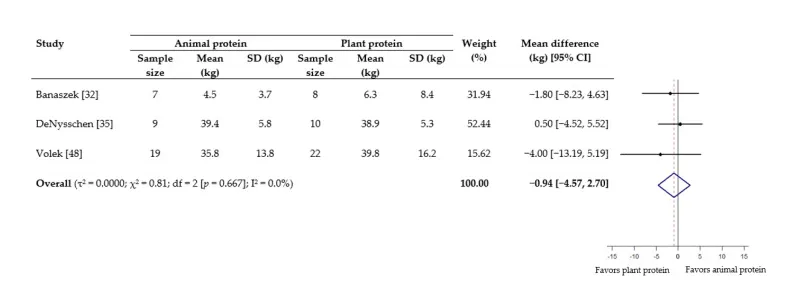
Figure 4 from Lim and colleagues (2021), reproduced under CC BY 4.0. Three trials, and an interval more than seven kilos wide — this is the whole randomised evidence the review could pool on squat strength.
Their six groups held 7 and 8, 9 and 10, and 19 and 22 people — 75 in total, across an interval wide enough to hold a meaningful advantage for either source. This is not a strong null; it is a thin one, and the authors flag that the small number of strength trials limits what can be concluded.
The one strength result that did separate was knee extension in the under-50s, where animal protein gained 12.00 Nm (2.04 to 21.96) — a single subgroup of a single outcome, in a pooled set where the same measure showed heterogeneity of 86% across studies.
What this study does not settle
The lean mass findings did not survive the authors’ own stability check. Both were run through a leave-one-out analysis, dropping one trial at a time. The 0.22 kg lean mass difference became significant when any of three particular trials was removed, rising to between 0.25 and 0.29 kg. The 0.50% difference in percent lean mass stopped being significant when any of four was removed. A result that flips on the removal of one study out of sixteen is a result to quote with the caveat attached.
It is mostly whey against soy. Dairy on one side, soy on the other, with one pea trial and one rice trial in the whole set. Pea and rice protein are what a lot of plant powders are now made of, and this review cannot separate them from soy.
Nobody checked what people ate around the supplement. The authors raise this themselves: for the 15 trials that supplemented rather than fed whole diets, someone assigned to plant protein could have been eating meat at every meal. The analysis assumes group assignment moved the overall diet, and cannot show that it did.
Bench press was never pooled. The review lists it as an outcome and reports median changes across five trials, but produces no pooled estimate for it, so this paper says nothing quantitative about upper-body pressing strength.
The population is not lifters. Two of the 18 trials recruited people who already trained. Eight had a mean or median age of 50 or over, and four recruited people with chronic kidney disease, hyperlipidemia, insulin resistance or metabolic syndrome. Trials ran from 14 days to two years.
The size of the difference has no agreed meaning. The authors note there is no consensus on what counts as a minimal clinically important difference in lean mass, so 0.22 kg has no threshold to be measured against.
Where this sits in the wider evidence
This study sits with the consensus around it rather than against it, and the consensus is firmer than this paper alone.
Messina and colleagues pooled nine trials and 266 participants in 2018, comparing soy supplementation against animal protein alongside resistance training, and found strength and lean body mass rose in both arms with no difference between them — the same answer this review gives on strength.
Two controlled trials test the whole diet rather than a supplement. Hevia-Larraín and colleagues put 19 habitual vegans and 19 omnivores — untrained young men — through 12 weeks of supervised resistance training with total protein matched at 1.6 g/kg/day, soy isolate for the vegans and whey for the omnivores. Leg lean mass rose 1.2 kg in both groups. Muscle and muscle-fibre cross-sectional area rose in both. Leg-press 1RM rose in both. Nothing separated them. Martini and colleagues then ran 25 strict vegetarian and 20 non-vegetarian women through 16 weeks of training with no supplement at all, and found the same: thigh muscle thickness and maximal strength climbed in both groups, with no difference between them, even though the vegetarians averaged 1.0 g/kg/day of protein against the non-vegetarians’ 1.3.
Read together, the line through all four papers is that total protein is the variable that moves, and source is the variable that mostly does not — a picture that matches what the dose-response evidence says about how much protein to eat, where the number climbs to about 1.5 g/kg/day and stops. Protein source is a smaller lever than protein quantity, and both are smaller levers than how many hard sets you do each week.
What to do with this in your training
- If you already hit your protein number, the source is not your bottleneck. Every group in every trial here was at 1.0 g/kg/day or above, and that is the condition under which the two sources came out level on strength and within half a pound on lean mass.
- If you eat plant protein, this is not a reason to change. The largest gap the review found in the direction of animal protein was 0.46 kg of lean mass at the top of its interval, in a pooled result that was not stable to dropping one study.
- Pick the source you will hit the number with. Soy, pea, rice, whey, casein, milk, beef — all of them appear in trials here where lean mass and strength went up. Digestibility, cost and whether you will drink it twice a day are better grounds for choosing than 0.22 kg.
- The mechanism the authors name is amino acids, not the food. Animal protein carries more essential amino acids per gram and digests more readily, and that is what they credit for the small edge they found. Whether a larger gram total of plant protein closes it is not something this review tested.
- Judge it over a block, not a week. The differences these trials chased are fractions of a kilogram, across programs running from two weeks to two years.
Common Questions About Protein Source and Muscle
Is pea or rice protein as good as soy? This review cannot say. Soy is nearly all of the plant side — one pea trial and one rice trial in eighteen — so the plant-protein result here is close to a soy result, and pea and rice are not separately tested.
What about protein blends? Excluded on purpose. Any trial whose supplement mixed animal and plant protein was rejected at screening, regardless of the proportion, so this paper has nothing to say about them in either direction.
I’m cutting. Does source matter more when calories are low? Not answered here. No trial in this set was built around an energy deficit, and the review does not report calorie intake as a moderator. What a deficit costs your lean mass is a separate question with its own evidence.
How Pick It Up Helps
Nothing in this paper asks you to change what you eat. It asks you to clear a daily total.
Pick It Up’s nutrition side gives you a protein floor in grams: a number to clear each day, whatever you clear it with. You set a goal — cut, maintain, bulk or recomp — weigh in each morning and answer two questions about sleep and hunger, which takes under 30 seconds, and the app compares the day against your weekly averages rather than reacting to one morning’s reading. There is no macro counting and no calorie counting. It also reads your training log, so when the scale barely moves while your lifts keep climbing it tells you the plan is working instead of prescribing a bigger deficit. Start a free trial.
Further Reading & References
- Lim MT, Pan BJ, Toh DWK, Sutanto CN, Kim JE. Animal protein versus plant protein in supporting lean mass and muscle strength: a systematic review and meta-analysis of randomized controlled trials. Nutrients, 2021;13(2):661. PMID 33670701. Open access under CC BY 4.0; the subject of this post and the source of every number above except where noted.
- Messina M, Lynch H, Dickinson JM, Reed KE. No difference between the effects of supplementing with soy protein versus animal protein on gains in muscle mass and strength in response to resistance exercise. International Journal of Sport Nutrition and Exercise Metabolism, 2018;28(6):674–685. PMID 29722584. Cited for where the wider evidence sits; read from its abstract only.
- Hevia-Larraín V, Gualano B, Longobardi I, Gil S, Fernandes AL, Costa LAR, Pereira RMR, Artioli GG, Phillips SM, Roschel H. High-protein plant-based diet versus a protein-matched omnivorous diet to support resistance training adaptations: a comparison between habitual vegans and omnivores. Sports Medicine, 2021;51(6):1317–1330. PMID 33599941. Cited for where the wider evidence sits; read from its abstract only.
- Martini GL, Schemes MB, Strey B, Schneider CD, de Souza CG, Pinto RS. No differences in muscular adaptations to long-term resistance training between young strict vegetarian and non-vegetarian women. Scandinavian Journal of Medicine & Science in Sports, 2026;36(2):e70224. PMID 41684167. Cited for where the wider evidence sits; read from its abstract only.