How much protein to get stronger: the short answer
Somewhere above your current protein intake is a point where more of it stops adding strength.
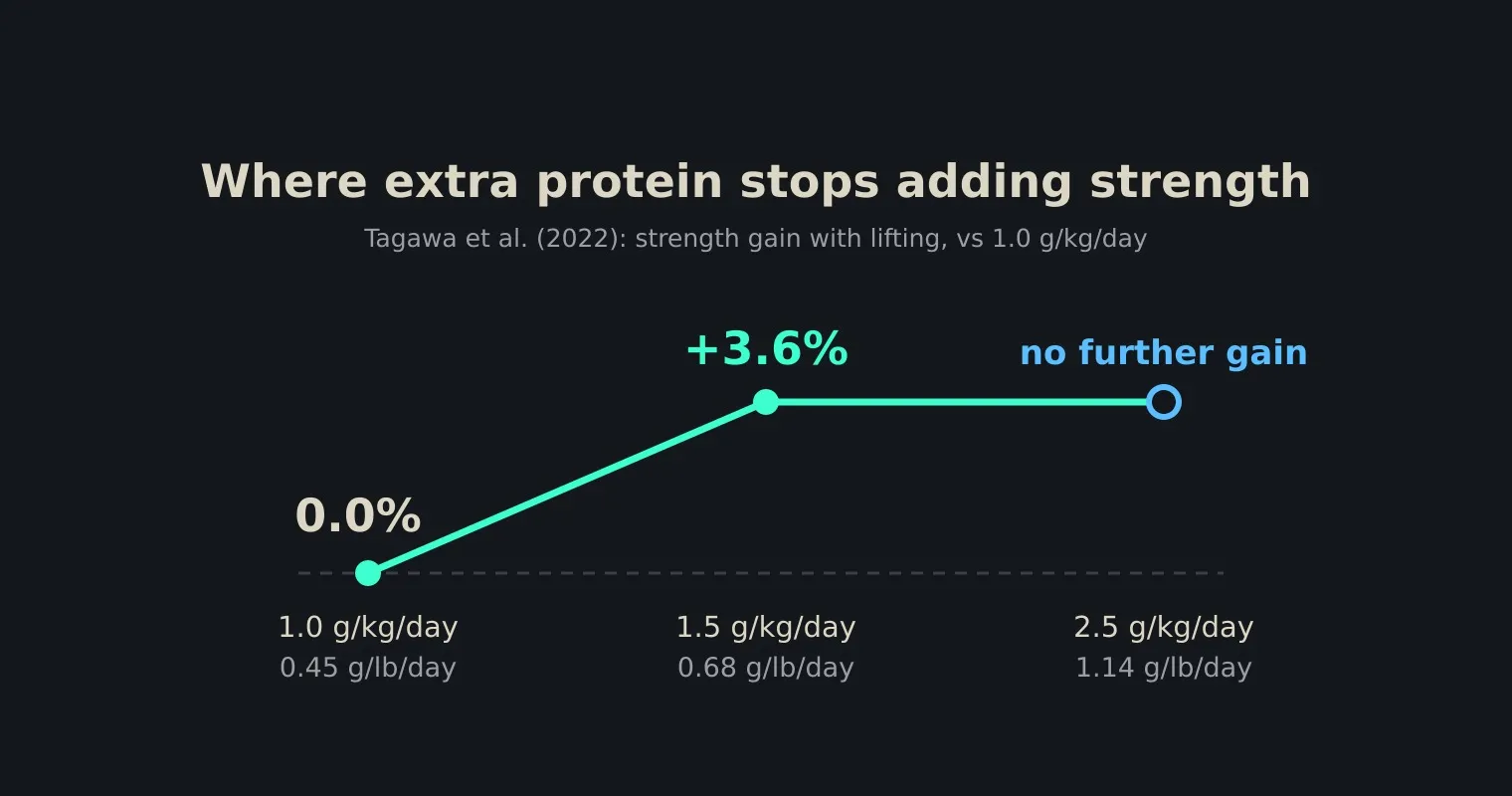
A 2022 meta-analysis in Sports Medicine – Open pooled 82 randomised trials and modelled strength gain against total daily protein intake. On how much protein to get stronger, it puts the number at roughly 1.5 g per kg of body weight per day, or 0.68 g per lb — for an 80 kg / 176 lb lifter, 80 × 1.5 = 120 g. Below that line, each extra 0.1 g/kg (0.05 g/lb) was worth another 0.72% of strength. Above it, the curve stopped climbing.
The second finding sets the condition on the first. Protein raised strength only in the trials that also had people lift. In the trials with no training program, the same extra protein moved strength by 0.13%, an estimate whose confidence interval sits on both sides of zero.
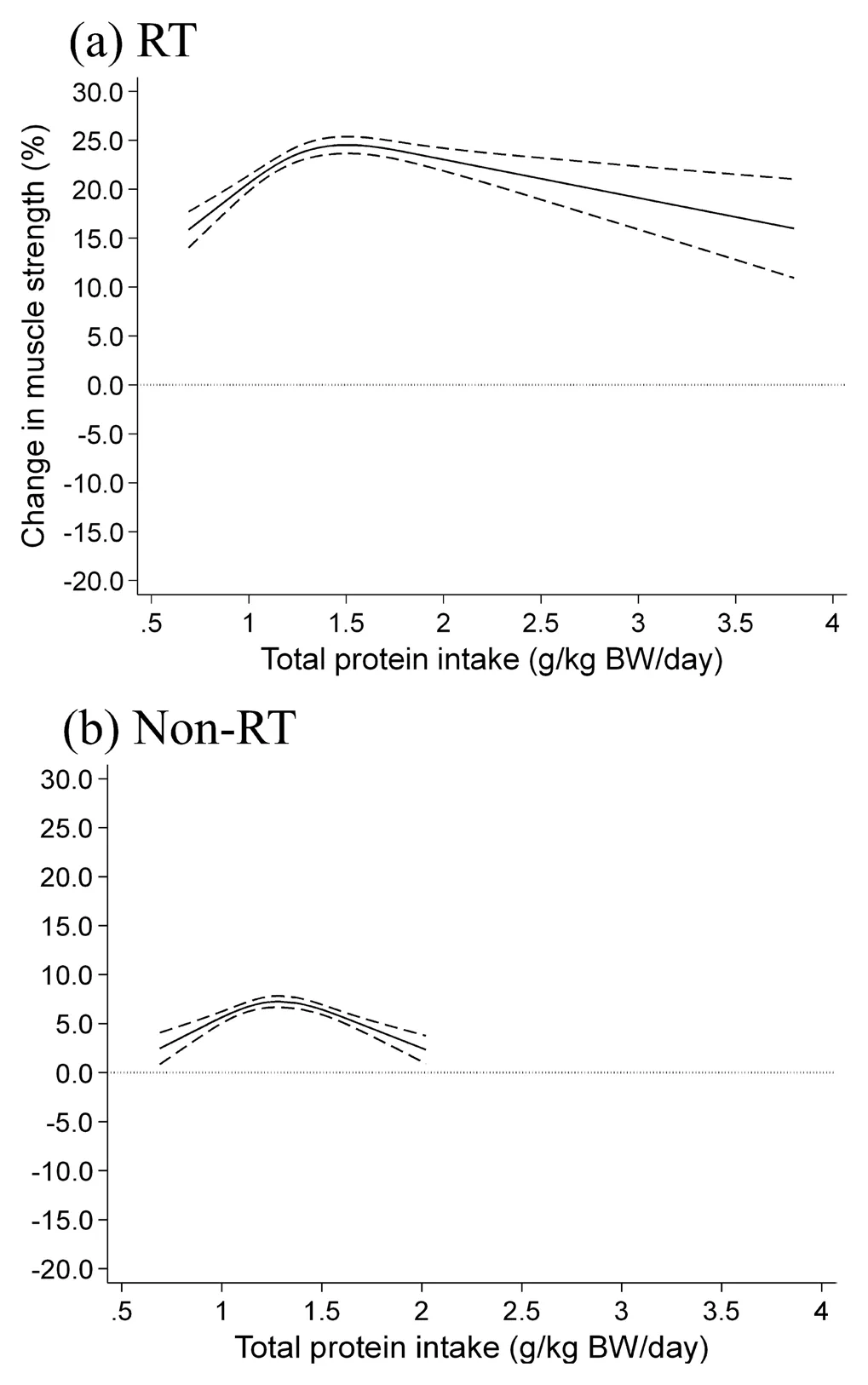
Figure 2 from Tagawa and colleagues (2022), reproduced under CC BY 4.0 with the two panels stacked rather than side by side so the axis labels survive at this width. Panel (a) is the trials that trained; panel (b) is the trials that did not.
Table of Contents
- How much protein to get stronger: the short answer
- What this meta-analysis pooled
- How much protein to get stronger: what the curve shows
- Protein without lifting did not raise strength
- What this study does not settle
- Where this sits in the wider evidence
- What to do with this in your training
- Common Questions About Protein and Strength
- How Pick It Up Helps
- Further Reading & References
What this meta-analysis pooled
Tagawa and colleagues searched PubMed and Ichushi-Web, a Japanese medical database, up to March 2022 for randomised controlled trials in which groups differed in how much protein they ate and someone measured strength — how much you can lift. Eighty-two articles qualified, covering 112 intervention groups and 3,940 participants.
Fifty-nine of those studies, with 2,440 participants, ran a resistance-training program alongside the protein. Twenty-four, with 1,500 participants, did not.
Intervention groups averaged 1.49 g/kg/day of total protein (0.68 g/lb), ranging from 0.79 to 3.80 g/kg (0.36 to 1.72 g/lb). Control groups averaged 1.09 g/kg (0.49 g/lb), from 0.69 to 2.00 g/kg (0.31 to 0.91 g/lb). In 78 of the 82 trials the extra protein came as a supplement on top of normal meals rather than as a change to the meals themselves. The training studies ran about 15 weeks on average.
The average age across the pool was 55.6 years, and 45.5 in the training studies. 13% of the participants in the training studies were habitual trainers — the other 87% were people for whom the program was new.
How much protein to get stronger: what the curve shows
The randomised comparison sets one number: protein group against control group, everybody lifting. That came out at 2.01% more strength (95% CI 1.09 to 2.93). Across all 82 trials, training or not, it was 1.40% (0.55 to 2.24). The protein was what got assigned at random, so these are the estimates the design supports.
The dose-response curve sets the other. Fitting 69 of the studies against total protein intake, strength gain rose by 0.72% (0.40 to 1.04) for every extra 0.1 g/kg/day — 0.05 g/lb — up to 1.5 g/kg/day (0.68 g/lb), and no further. Five of those steps carries you from 1.0 to 1.5 g/kg, or 0.45 to 0.68 g/lb: 5 × 0.72% = 3.6% more strength over a few months of training. Past 1.5 g/kg the fitted line turns downward, but the band around it widens as the studies thin out, and the authors describe the shape as no further gains rather than as a penalty. This curve compares studies against each other rather than randomising a dose inside one, so the trials feeding more protein differed in other ways too.
How much you add on top changes the size of the effect. Trials that added less than 0.5 g/kg/day (0.23 g/lb) on top of habitual intake gained 1.22% (0.41 to 2.03). Trials that added 0.5 or more gained 4.29% (1.99 to 6.60) — three and a half times as much, in the authors’ own comparison.
It also worked on people who were not short of protein to begin with. Groups starting below 1.0 g/kg/day (0.45 g/lb) gained 1.46%; groups already at or above 1.0 gained 2.11%. Sitting at 1.0 g/kg was not a reason the extra did nothing.
Protein without lifting did not raise strength
In the 24 trials with 1,500 participants and no training program, extra protein produced a 0.13% change in strength, with an interval running from −1.53 to 1.79. Panel (b) of the figure above is that result drawn out: a small hump that fades by 1.3 g/kg/day (0.59 g/lb) and never approaches the curve above it.
The authors’ explanation is that strength comes from three things — muscle growing, the nervous system learning to recruit it, and metabolic changes inside the muscle — and that protein feeds the first while playing little part in the other two. Training drives all three. This is their reading of the mechanism rather than something the meta-analysis measured.
What this study does not settle
It measured strength, not size. Hypertrophy — muscle growth — is a separate outcome and this paper did not pool it. Do not read 1.5 g/kg (0.68 g/lb) as a number for growing, only for getting stronger.
Data is mostly from middle-aged, untrained lifters. Only 13% of participants in the training studies already trained, and the average age was 45.5 in those studies and 55.6 overall. Three years into a program is the edge of what this data covers.
The longer trials came out flat. Split by duration, trials under three months gained 2.27% (1.23 to 3.30) with training, while trials of three months or longer gained 0.66% (−1.22 to 2.54) — an interval spanning zero. The paper does not resolve whether that is protein’s effect fading or longer studies being harder to run.
Only one kind of strength moved. Isotonic strength — lifting a load through a range, which is what a squat or a bench press is — gained 2.30% (1.25 to 3.36). Isometric strength gained 0.92% and isokinetic 0.71%, neither clearing zero. Lower-body strength gained 2.77% against 1.39% for the upper body, and the leg press on its own gained 4.43% (2.27 to 6.58).
Five of the seven authors work for a food company. Meiji Co., Ltd. employs them, and it sells protein products. The paper declares it, the risk-of-bias and GRADE assessments were run as normal, and the evidence for the training analyses was graded high quality — but who paid for the question to be asked is worth knowing.
The authors also flag that they searched two databases and only English and Japanese publications, that the included studies were diverse enough to make pooling awkward, and that the spline curve is fitted to data rather than derived from any physiology.
Where this sits in the wider evidence
This study sits with the consensus rather than against it. The most cited pooled analysis of the same question, Morton and colleagues in 2018, ran 49 studies and 1,863 participants and found that protein supplementation added 2.49 kg to 1RM strength and stopped adding fat-free mass beyond about 1.62 g/kg/day (0.74 g/lb). Two independent teams, two outcomes, and a ceiling within 0.1 g/kg of each other.
Morton’s analysis also answers the limitation this one carries. It reported that protein supplementation was more effective in resistance-trained people, and less effective as age rose. If that moderator holds, a trained lifter reading Tagawa’s 2% is reading a floor rather than a ceiling. That is one paper’s subgroup finding and not a settled number, so treat it as a direction rather than a figure to plan from.
Protein sets the raw material. How many sets you do each week, how close to failure you take them and how heavy you load them are what asks for it.
What to do with this in your training
- Work out your own number: kg × 1.5, or lb × 0.68. That is 105 g at 70 kg / 154 lb, 120 g at 80 kg / 176 lb, 135 g at 90 kg / 198 lb. A 180 lb lifter lands near 122 g.
- Above 1.5 g/kg (0.68 g/lb), this paper gives you no reason to add more. The curve stopped climbing there, and the studies feeding 3 g/kg (1.36 g/lb) and up did not do better for it.
- Below 1.0 g/kg (0.45 g/lb), the move is worth more than a program change. Going from 1.0 to 1.5 g/kg — 0.45 to 0.68 g/lb — was 3.6% of strength in this data, and the trials that added at least 0.5 g/kg/day (0.23 g/lb) gained three and a half times what the smaller additions did.
- Do not expect protein to do anything on its own. Twenty-four trials and 1,500 people say it does not. In a week off, protein holds the material in place; it does not move the number.
- Count total protein, not supplement protein. Every figure here is total daily intake from food and powder together. Someone eating 1.4 g/kg (0.64 g/lb) from meals is near the top of this curve already and a shaker adds little.
- Give it a block, not a week. The training studies ran about 15 weeks, and the effect is a few percent on a lift — the size of change you see across a training block, not across a session.
Common Questions About Protein and Strength
Does 1.5 g/kg (0.68 g/lb) apply if I am cutting? This paper has nothing to say about it: trials using energy restriction or overfeeding were excluded at the screening stage, so every number here comes from people eating roughly to maintenance. Eating in a deficit is its own question, and we have covered what a deficit costs your lean mass separately.
Does the protein have to come from a powder? Nothing here tests one source against another. In 78 of the 82 trials the extra protein arrived as a supplemental food or drink on top of normal meals, and in four the meals themselves were changed — the analysis pools both and never compares them. What was measured is the total, however it got there.
What about timing — around the session, or spread through the day? Not addressed. Every trial in this pool was categorised by how much total protein people ate per day, not when they ate it, so this paper cannot rank timing strategies in either direction.
Is more than 1.5 g/kg (0.68 g/lb) harmful? The authors raise the question and do not answer it from their own data. They point to reported risks in pregnancy and to conflicting evidence on kidney function in people with existing impairment, and recommend moderation for those groups. For everyone else the finding here is that extra protein stops paying, not that it starts costing.
Does this tell me how much protein to eat for muscle size? No. This paper pooled strength outcomes only. Morton’s 2018 analysis is the one that modelled fat-free mass, and it put that ceiling at about 1.62 g/kg/day, or 0.74 g/lb.
How Pick It Up Helps
The number this paper lands on is per kilogram or pound of body weight, so it moves as you do — and it buys nothing without training asking for the protein. Both halves have to be right.
Pick It Up does both. Log a daily weigh-in and the nutrition side recommends a protein floor in grams for your body weight, tracks your weight trend by averaging out the daily noise, and tells you whether your cut, bulk, maintenance or recomp is on track — and what to change when it is not. The training side programs monthly blocks from your equipment and goals, puts a target weight, rep and difficulty on every set, and adjusts the next set’s targets from what you hit. At the end of a block it re-evaluates your 1RMs and builds the next one from them, so the few percent this paper is talking about shows up as a number that moved rather than a feeling that it did. Start a free trial.
Further Reading & References
- Tagawa R, Watanabe D, Ito K, Otsuyama T, Nakayama K, Sanbongi C, Miyachi M. Synergistic effect of increased total protein intake and strength training on muscle strength: a dose-response meta-analysis of randomized controlled trials. Sports Medicine – Open, 2022;8(1):110. PMID 36057893. Open access under CC BY 4.0; the subject of this post and the source of every number above except where noted.
- Morton RW, Murphy KT, McKellar SR, Schoenfeld BJ, Henselmans M, Helms E, Aragon AA, Devries MC, Banfield L, Krieger JW, Phillips SM. A systematic review, meta-analysis and meta-regression of the effect of protein supplementation on resistance training-induced gains in muscle mass and strength in healthy adults. British Journal of Sports Medicine, 2018;52(6):376–384. PMID 28698222. Cited here for where the wider evidence sits; read from its abstract only.