Does lifting weights improve flexibility? The short answer
Ten minutes of stretching at the end of a session is a cheap habit to keep and an easy one to drop, and there has never been much evidence attached to either choice.
A 2023 systematic review and meta-analysis in Sports Medicine put a number on it. Does lifting weights improve flexibility? Across 55 studies, yes: in short, resistance training alone improved flexibility nearly as much as stretching did. Resistance training and then stretching accomplished basically nothing more than stretching alone. Bodyweight resistance training, however, did not provide the same stretching effect.
To put this into numbers, across the seven studies that put lifting and stretching head to head, the gap between them was 0.08 — on the same scale where lifting against doing nothing was 0.73. Across the four studies that added stretching on top of lifting and compared it with stretching alone, the gap was 0.001.
Table of Contents
- What this meta-analysis pooled
- Does lifting weights improve flexibility as well as stretching does
- What it means in the gym
- What this evidence cannot tell you
- Where this sits in the wider evidence
- What to do with this in your training
- Common Questions About Lifting Weights and Flexibility
- How Pick It Up Helps
- Further Reading & References
What this meta-analysis pooled
The review screened 14,851 papers and kept 55, covering 2,756 participants who averaged about 24 years old — with the individual studies running from children to people in their seventies. The programs lasted 4 to 24 weeks, at 2 to 5 sessions a week, with loads from 40% to 110% of a one-rep maximum.
Range of motion was measured at the elbow, hip, knee, shoulder and trunk, with tests ranging from a sit-and-reach box to a single-joint measurement such as supine hip flexion. Every joint tested improved, and no joint improved reliably more than another.
Three separate comparisons were run, and they answer three different questions: lifting against a control group, lifting against stretching, and lifting plus stretching against stretching on its own.
Does lifting weights improve flexibility as well as stretching does
Seven studies compared a lifting program against a stretching program on the same range-of-motion test. Pooled, the difference was 0.084 in favour of stretching, with a confidence interval running from 0.56 on the lifting side to 0.73 on the stretching side — a spread wide enough to contain a decent advantage either way, centred on nothing.
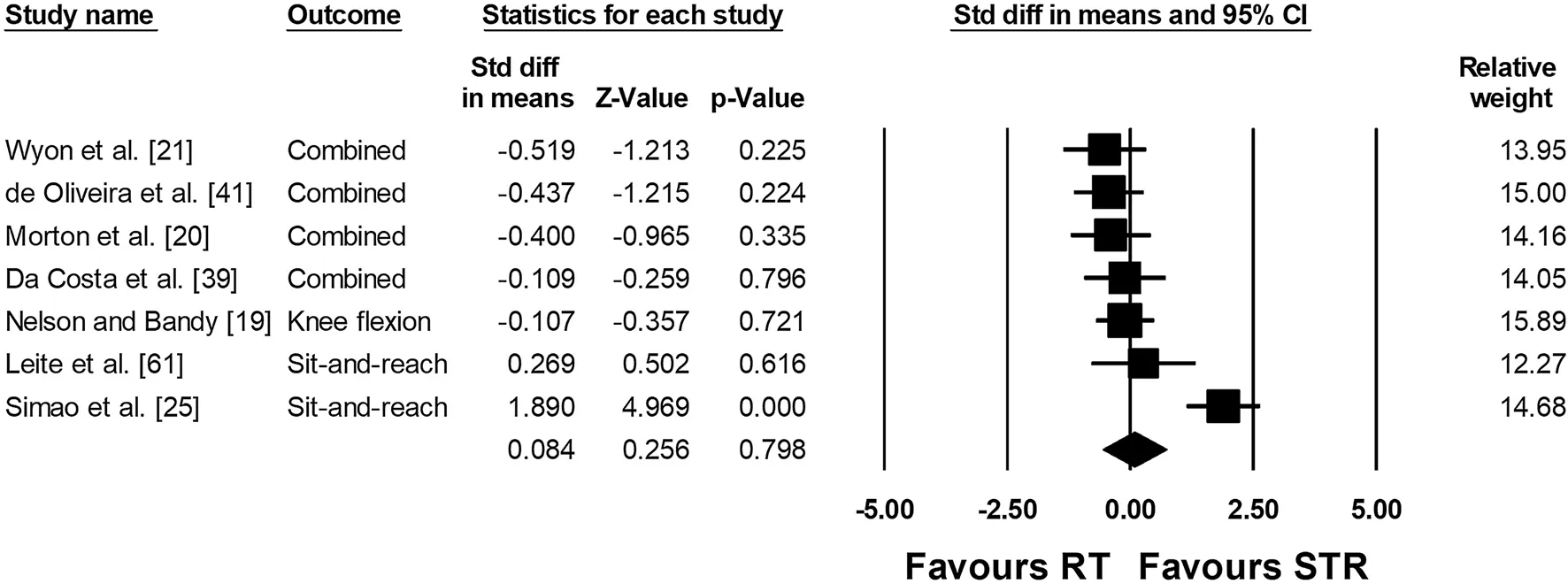
Figure 4 from Alizadeh et al. (2023), reproduced under CC BY 4.0. Negative values favour resistance training, positive values favour stretching; the diamond is the pooled estimate.
In a second comparison, four studies compared lifting plus stretching against stretching alone. The pooled difference was 0.001, and the confidence interval is the narrowest in the paper. In short, lifting then stretching accomplished basically nothing compared to stretching alone.
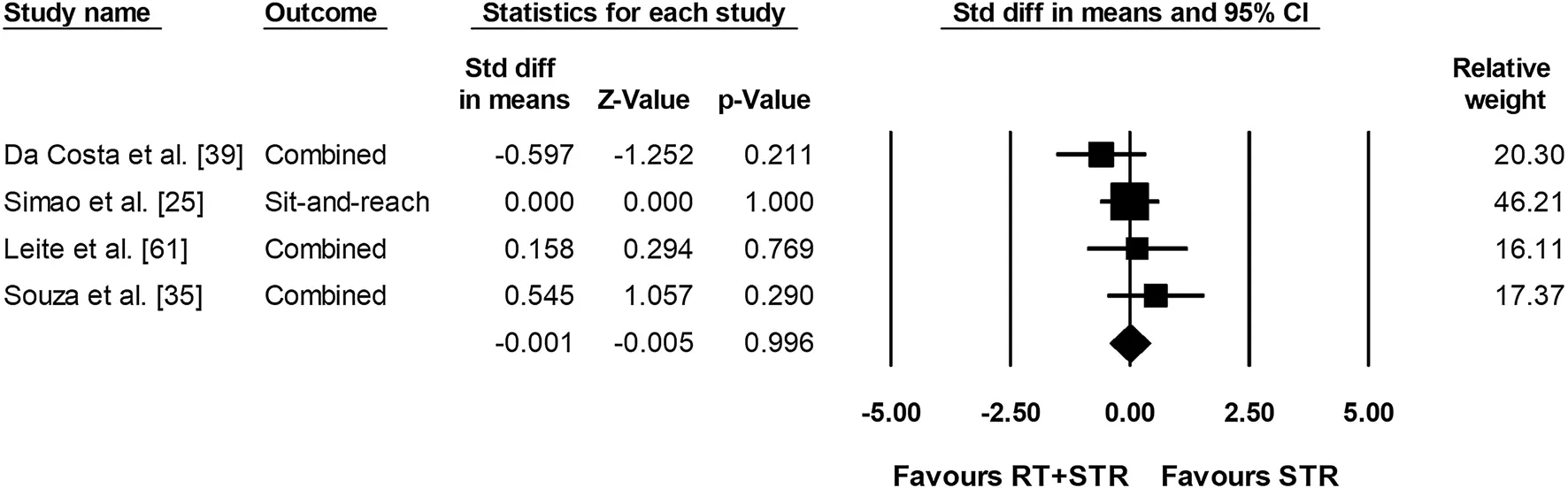
Figure 5 from Alizadeh et al. (2023), reproduced under CC BY 4.0. The pooled estimate sits on zero: adding a lifting program to a stretching program did not change range of motion.
Read them together and the picture is two routes to the same place, and the authors put it in the conclusion: stretching before or after resistance training may not be necessary to enhance flexibility.
What it means in the gym
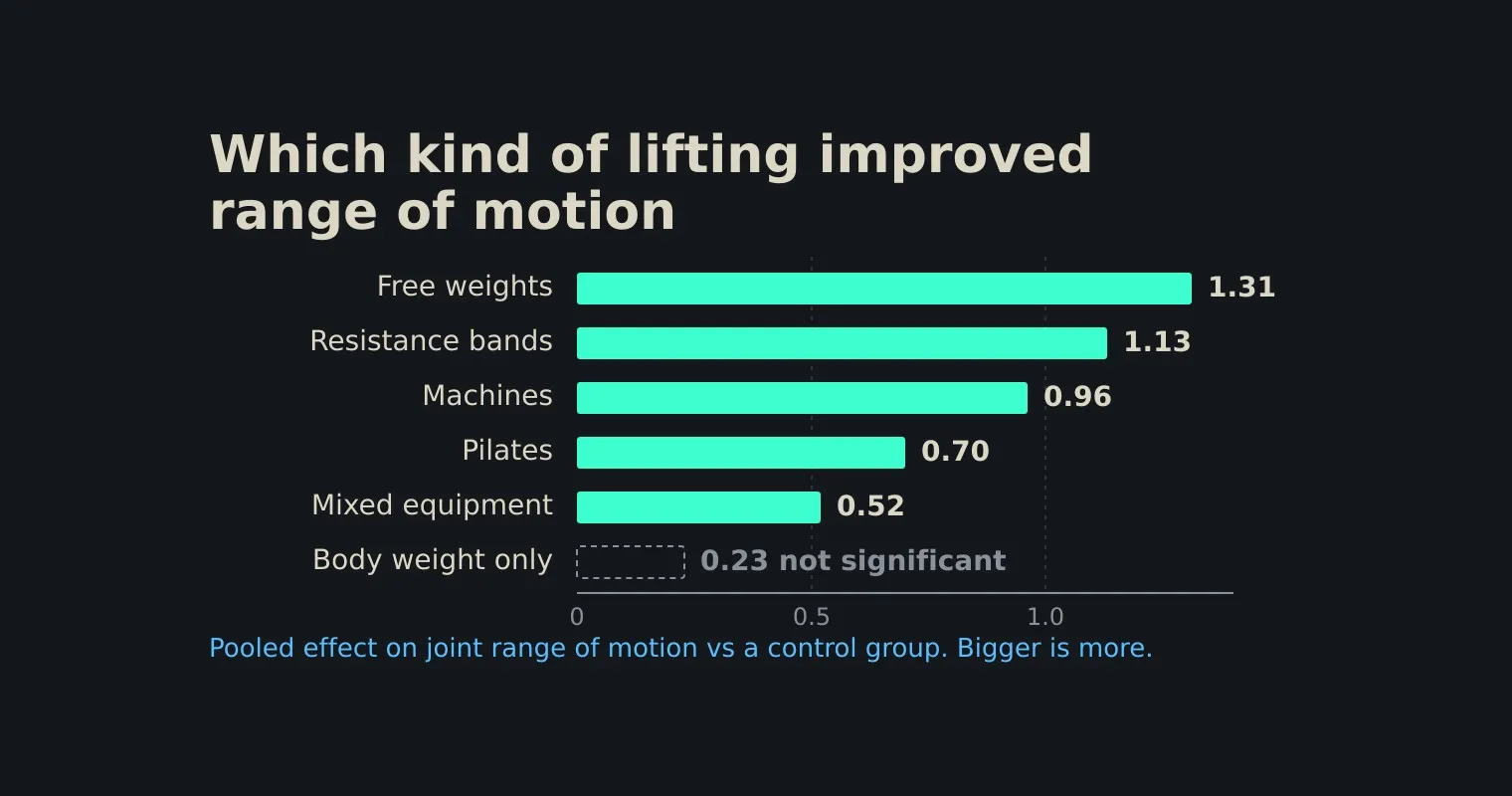
The load is doing the work, and body weight alone did not do it. The review split the training by equipment. Free weights came out at 1.31, resistance bands at 1.13, machines at 0.96, Pilates at 0.70 and mixed equipment at 0.52. Body weight on its own came out at 0.23 and did not reach significance. The authors’ explanation is mechanical: a push-up stops at your chest and the floor, while a dumbbell press lets the shoulder travel past that point. The same logic favours a deep squat over a bodyweight squat and a dumbbell fly over a press-up.
Where you spend the range matters more than what you hold. Lifting improved range of motion in this review because the joints in these programs went through a full range under load. A program trimmed to the middle third of every rep is not the training that produced these numbers, and the authors note there is a dearth of studies comparing partial against full range for range-of-motion outcomes. Our post on full range of motion versus partial reps covers what the range is worth for size and strength.
The size of the effect depends on where a study’s participants started. In the studies that recruited untrained and sedentary people, range of motion moved 1.042. In the studies that recruited people already training or otherwise active, it moved 0.43 — less than half as much, and the difference between the two groups was statistically significant. The direction was the same in both.
The dose that worked was the training itself. The meta-regression found no effect of how many weeks a program ran, how many sessions a week it used, or how old the participants were. Nothing in this review says you need a longer program or an extra session to get the range of motion; it came with the lifting.
What this evidence cannot tell you
The headline comparison is the one with a bias flag on it. The authors ran Egger’s test on all three analyses. The lifting-against-control comparison — the 0.73 — came back indicating reporting bias. The two comparisons against stretching did not. So the number most likely to be inflated is the one about lifting on its own, and the ones about lifting versus stretching, which is where the practical decision sits, are the cleaner pair.
Seven studies is not many, and four is fewer. The head-to-head against stretching rests on seven studies and 23 effect sizes; the lift-plus-stretch comparison on four studies and 14. There is evidence here, but it is not overwhelming.
The body-weight result is thinner than it sounds. It comes from four effect sizes, and the authors say directly that it should not be overemphasised. Read it as an absence of evidence that body-weight training improves range of motion, not as evidence that it does not.
The pooling mixes tests that are not the same test. A sit-and-reach score and a supine hip-flexion measurement were combined into one estimate. The authors call this both a strength and a weakness: it buys breadth and costs sensitivity. Their meta-analysis software also averages multiple effect sizes from one study rather than nesting them, which they say makes the estimates less precise than they appear.
None of this is about warming up. Every program here was chronic training measured over weeks. The authors are explicit that resistance training is not a substitute for a warm-up before competition, and that stretching keeps a role there. The review says nothing about injury risk, soreness, or stretching as a way to wind down.
Where this sits in the wider evidence
This review agrees with what came before it and is the largest version of the answer we could find. In 2020, a Sports Medicine review by James Nuzzo argued that flexibility should be retired as a major component of physical fitness, on the grounds that where range of motion needs improving, resistance training and other modalities can do it. In 2021, a meta-analysis in Healthcare pooled 11 trials and 452 participants and found no difference between strength training and stretching for range of motion, with a small non-significant edge to stretching. Alizadeh and colleagues reach the same conclusion from 55 studies.
Three attempts, one answer — but not a closed question. Nuzzo’s article drew four published comments and replies in the same journal, and the authors here are careful to keep stretching in the picture for warm-ups, for relaxation, and for anyone who cannot load a joint.
Nothing here contradicts what stretching does on its own. Our post on whether stretching builds muscle found that stretching reliably improves flexibility but moves size and strength only a little, at a dose of about 15 minutes a day per muscle. This review adds that lifting gets you the flexibility part as well — so the question is not whether stretching works, but whether you need it if you’re already doing resistance training.
What to do with this in your training
- If your only reason for stretching is range of motion, the lifting is already doing it so long as you’re lifting through a full range of motion on your exercises. Four sessions a week with 10 minutes of stretching tacked on is 40 minutes. Across the seven studies that ran the two against each other, lifting held its own without it. That is the time this evidence frees up.
- Take the reps to the end of the range. The programs here moved joints through full range under load. Depth on a squat, a full stretch at the bottom of a row or a fly, and a controlled lockout are the part doing the work.
- Do not count push-ups, air squats and pull-ups towards this. Body-weight training was the one category that did not produce a significant change. If your program is mostly calisthenics, keep the stretching until better evidence arrives.
- Keep stretching where it does something else. Before competition, after an injury, on a joint you cannot load, or because you like it — none of those uses is what this review measured.
Common Questions About Lifting Weights and Flexibility
Does lifting weights make you muscle-bound and stiff? Nothing in these 55 studies points that way. Every joint tested improved, and the improvement was in the same direction in men, women and mixed groups. The one training type that failed to improve range of motion — body weight alone — is the one with no external load.
Does it matter whether I lower the weight slowly? Not for this outcome. The review split the studies by contraction type and found no significant difference between eccentric-focused training, at 0.89, and conventional concentric training, at 0.72 — both moderate on the scale the authors use, which runs from 0.6 to 1.2.
Will this help my overhead position or my squat depth specifically? This review cannot say. It compared joints and found no joint improved more than another, but it did not test whether training one movement transfers to a position in a different movement. The programs improved the ranges they trained.
Does yoga or Pilates beat lifting for this? Pilates was one of the categories, at 0.70, in the same band as machine training and above mixed equipment. Yoga was not analysed separately. On the evidence here, Pilates is one more loaded, full-range modality rather than a special case. The more important distinction is not whether Yoga or Pilates would be better or worse than lifting for the same joint, but whether there are joints that aren’t stretched at all in a typical lifting program (e.g. specific hip flexors) that are stretched during Yoga or Pilates.
Do I need to keep stretching to hold the range I have? The review only measured programs that ran 4 to 24 weeks and ended there. What happens to range of motion after a program stops, with or without stretching, is not something these studies followed.
How Pick It Up Helps
The range of motion in this review came from the lift itself, which makes exercise selection the lever — a dumbbell press reaches a range a push-up cannot, and a free-weight movement reached further than a machine in the subgroup analysis.
Pick It Up does the exercise selection for you. You enter what equipment you have access to and why you signed up, and it builds the monthly block from there, rather than handing you a blank template to fill in. If your access is a pair of dumbbells and a bench, the program it writes is a loaded, full-range one built around those — which is the kind of training these 55 studies measured.
Pick It Up does not program a separate stretching or mobility block — and on this review, a full-range lifting program does not need one bolted on. Start a free trial and see what it programs for the equipment you have.
Further Reading & References
- Alizadeh S, Daneshjoo A, Zahiri A, Anvar SH, Goudini R, Hicks JP, Konrad A, Behm DG. Resistance Training Induces Improvements in Range of Motion: A Systematic Review and Meta-Analysis. Sports Medicine, 2023;53(3):707–722. PMID 36622555. Open access under CC BY 4.0. The source of every number in this post.
- Nuzzo JL. The Case for Retiring Flexibility as a Major Component of Physical Fitness. Sports Medicine, 2020;50(5):853–870. PMID 31845202. Cited here for where the field sits; read in abstract only.
- Afonso J, Ramirez-Campillo R, Moscão J, Rocha T, Zacca R, Martins A, Milheiro AA, Ferreira J, Sarmento H, Clemente FM. Strength Training versus Stretching for Improving Range of Motion: A Systematic Review and Meta-Analysis. Healthcare, 2021;9(4):427. PMID 33917036. Cited here for where the field sits; read in abstract only.
- Our own post on whether stretching builds muscle, covering what stretching on its own does to size and strength.
- Our own post on full range of motion versus partial reps, covering what the range of a rep is worth for growth.
- Our own post on free weights versus machines, for the equipment question this review touches from a different angle.