Can you build muscle in a calorie deficit? The short answer
At some point you decide to lose some fat, and the question that decides how you run the cut is whether the training you are already doing still buys you anything while you eat less than you burn.
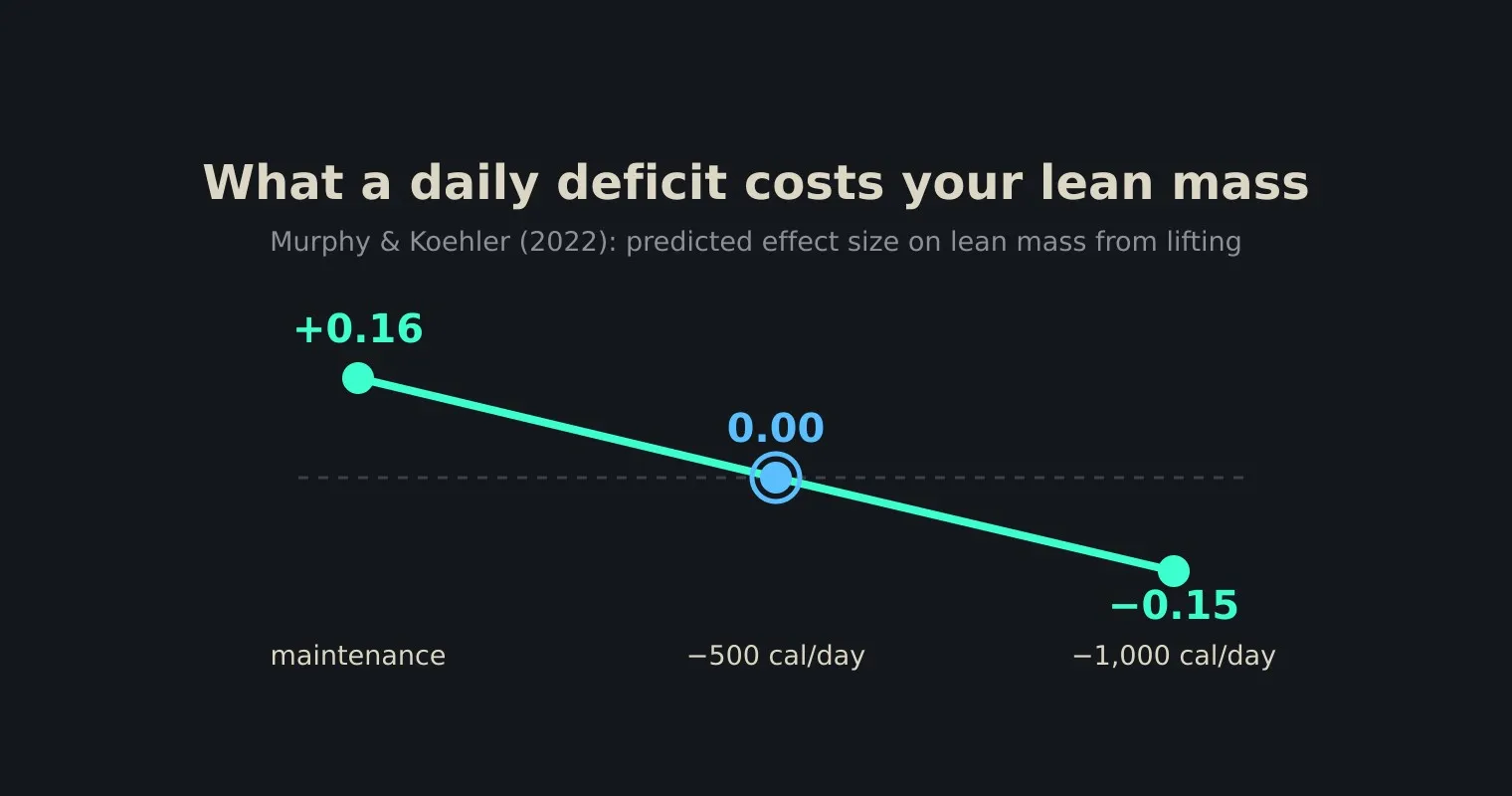
A 2022 meta-analysis in the Scandinavian Journal of Medicine & Science in Sports is the most direct attempt we have found to answer that with a number. Pooling 59 resistance-training studies, it found that an energy deficit takes lean mass gains away and leaves strength gains alone — and that the size of the deficit is what decides how much it takes. So: can you build muscle in a calorie deficit? A deficit around 500 calories a day is where the predicted gain reaches zero; past that, lean mass is part of what you are spending to lose fat. That evidence is almost entirely in previously untrained people, and the caveat is load-bearing.
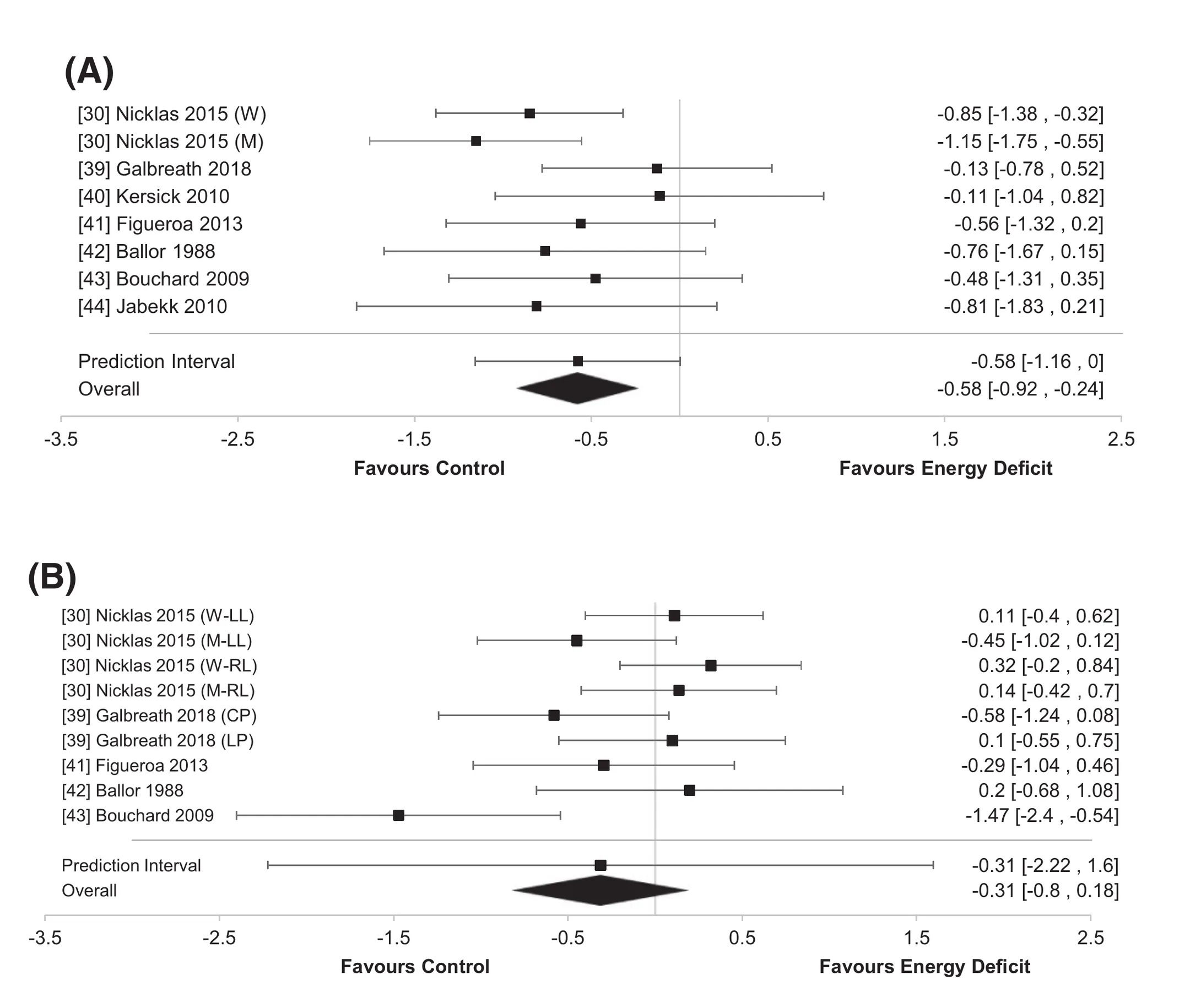
Figure 2 from Murphy and Koehler (2022), panels A and B stacked rather than placed side by side so the labels survive at this width. Reproduced under CC BY-NC-ND 4.0. Top: lean mass. Bottom: strength. The diamond at the bottom of each panel is the pooled result.
Table of Contents
- Can you build muscle in a calorie deficit? The short answer
- What this meta-analysis measured
- Can you build muscle in a calorie deficit: what the numbers say
- The 500-calorie line, and how they got there
- Why strength keeps going when size stops
- Who this was measured on
- What to do with this on your next cut
- Common Questions About Lifting in a Calorie Deficit
- How Pick It Up Helps
- Further Reading & References
What this meta-analysis measured
Murphy and Koehler searched PubMed and SportDiscus for controlled trials in which people lifted for at least three weeks, at least twice a week, while eating at a deficit. Studies that combined lifting with cardio were excluded, so the interference between the two is not part of this picture.
They ran it two ways. Seven studies had a dieting group and a fed group inside the same trial, which is the clean comparison: 282 participants, averaging roughly 50 to 70 years old, six of the seven studies in women only. Because seven studies is thin, they also matched 25 dieting studies against 27 fed studies from separate trials on age, sex, duration and training variables — 52 studies and 1,213 participants in total. Then they pooled everything into one regression against the size of the deficit.
Two terms carry the whole paper. Lean mass is what a DXA scan calls everything that is not fat or bone — mostly muscle, and the closest thing to hypertrophy, muscle growth, that a body-composition scan can measure. Strength is how much you can lift, captured here as a one- or three-rep max or a maximal voluntary contraction. The paper reports both as effect sizes, which put measurements in different units on one scale; the usual reading is that 0.2 is small, 0.5 moderate and 0.8 large.
The deficit was not taken from what participants said they ate. It was worked out backwards from how much fat each group lost, priced at about 9,400 calories per kilogram of fat.
Can you build muscle in a calorie deficit: what the numbers say
In the seven within-trial studies, the dieting groups gained less lean mass than the fed groups by a moderate margin: an effect size of −0.58, with a 95% confidence interval from −0.92 to −0.24. Strength came out at −0.31, and the interval ran from −0.8 to 0.18 — wide enough to include no difference at all, which is how the authors read it.
The matched comparison says the same thing from the other direction. Lifting at a deficit produced a small negative change in lean mass (−0.11); lifting without one produced a small positive change (0.20). On strength, the two were indistinguishable: 0.84 for the dieting groups and 0.81 for the fed groups, both large.
A deficit does not stop the barbell going up. It stops the scan going up.
The 500-calorie line, and how they got there
The dieting groups averaged around 570 calories a day of deficit, with a lot of spread between studies. The fed groups sat near balance.
Regressing lean-mass change on deficit size gives two numbers. At energy balance, the model predicts an effect size of 0.16 — a small gain. Every 1,000 calories a day of deficit takes 0.31 off that. So 500 calories a day takes off about 0.16, which is the whole of the predicted gain: 0.16 − 0.16 = 0, no change in lean mass. That is where the 500 comes from, and it is the number the authors put in their own conclusion.
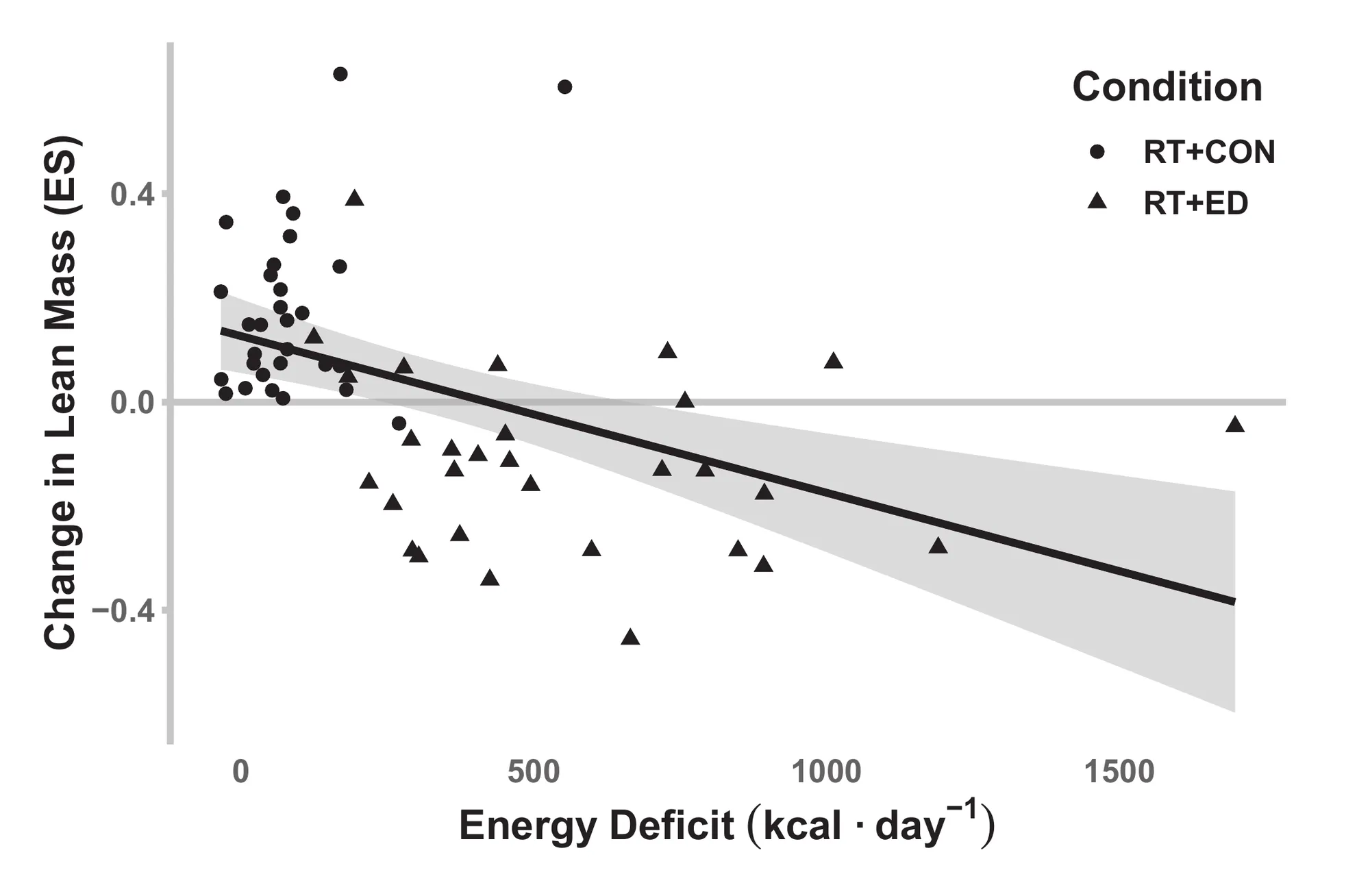
Figure 4 from Murphy and Koehler (2022), reproduced under CC BY-NC-ND 4.0. Circles are groups eating at maintenance, triangles are groups in a deficit. The shaded band is the 95% confidence interval for the regression line.
No study in the pool ran a deficit above 1,000 calories a day, so everything to the right of that is the model extrapolating rather than the evidence speaking. And the authors chose to fit a straight line while saying in the discussion that the relationship probably flattens out somewhere — there is a floor to how fast you can lose lean mass, and a straight line does not know about it.
Body size moved the result too: heavier participants gained less lean mass from lifting. Age pointed the same way without reaching significance — the authors note that a 500-calorie deficit and thirty years of age had about the same effect on the prediction.
Why strength keeps going when size stops
Strength and size come apart, and this is one of the places it happens. The authors’ own explanation is that early strength gains come from the nervous system learning the lift rather than from new muscle, and those adaptations run ahead of anything a scan can see. Our post on how heavy you should lift to build muscle covers the same split from the other side: load drives strength harder than it drives growth.
That explanation carries a warning for anyone who has been training for years. If the strength result is mostly beginners getting better at the movement, a lifter who is already good at the movement has less of that left to collect. The paper cannot tell you how much less. It contains one pair of studies in resistance-trained participants, and one of the two negative strength effects the authors count came from that single study where trained people dieted. They flag it themselves and say the data do not exist to know whether that is normal.
Who this was measured on
Nearly everyone in this paper was untrained before the study started. Across both analyses, two studies did not specify, one pair described their participants as resistance-trained, and every other study described sedentary or physically inactive people. They skewed older — averaging around 60 in the within-trial analysis, around 51 in the matched one — and heavier, with the dieting groups carrying a higher BMI than the fed groups, a gap the authors could not match away.
That gap runs both ways. Untrained people have the most lean mass to add, so a deficit has the most to take; a trained lifter has less on the table either way. And the strength result is measured largely on people who would have got stronger doing almost anything.
Protein is the other absence, and a large one. The regression leaves it out, because most of the included studies prescribed an intake without reporting what anyone ate and there is no objective way to back it out the way they backed out the deficit. So this paper cannot say whether more protein moves the 500-calorie line.
This study sits with the consensus rather than against it: the authors note their result lines up with earlier work showing that the commonly prescribed 500-calorie deficit costs lean mass. The neighbouring evidence adds something on the questions this paper leaves open. A 2022 review by Roth and colleagues looked at the population missing here — resistance-trained athletes cutting — and concluded from 15 studies that the evidence is insufficient to say higher training volume spares lean mass, while noting the data lean that way in female athletes, and lean toward raising volume through a cut rather than cutting it. And a 2014 review by Helms and colleagues recommended 2.3 to 3.1 grams of protein per kilogram of fat-free mass for energy-restricted trained athletes, scaling up with how lean you are and how hard you are cutting. We read those two from their abstracts, not in full.
What to do with this on your next cut
- Treat 500 calories a day as the point where gaining stops, not where losing starts. Below it, this model still predicts a small positive change in lean mass. Above it, you are trading. Whether that trade is worth making is a goal question, not a training one.
- Judge the cut by the bar, not the scan. Lean mass measurement is noisy at the scale of a few weeks; your top set is not. If your working weights are holding across a month of dieting, the training half is doing its job.
- Do not cut training volume because you cut calories. The trained-athlete review above reads its own data as leaning toward raising volume through a deficit rather than dropping it, while saying the evidence is too thin to settle it. Our guide to weekly set volume has what the dose-response looks like when you are eating enough.
- Do not expect to run a growth block and a cut at the same time. If the block is for hypertrophy, this paper is an argument for eating at maintenance and taking the fat loss in a separate stretch.
- A stalled lift during a cut is not automatically the diet’s fault. Strength held up here even where lean mass did not, so work a stall the way you would at maintenance. Our post on breaking through plateaus covers where else to look.
Common Questions About Lifting in a Calorie Deficit
Does adding cardio to the cut change the answer?
It is outside this paper by design — studies combining lifting with aerobic training were excluded, to keep the interference between the two out of the result. That question has its own literature, which we covered in does cardio kill gains.
Does a shorter cut protect lean mass better than a long one?
Study duration was not a significant moderator across interventions running from 3 to 28 weeks, so this evidence gives no support for the idea that a brief aggressive cut is kinder to lean mass than a slow one. Deficit size is what moved the result.
How Pick It Up Helps
The practical problem a cut creates is that your capacity moves week to week while your program does not. A target written three weeks ago, when you were eating 500 calories a day more, is a guess about a different person.
Pick It Up’s targets autoregulate: every set carries a target weight, a target rep count and a target difficulty, and as you log what you hit and how hard it felt, the app updates the next set’s target during the session. At the end of a block it re-evaluates your 1RMs from the whole block and builds the next one from that, so a stretch of dieting shows up as a recalibrated program rather than as a month of missed numbers.
Pick It Up handles the nutrition side too, without a food diary. You set a goal — cut, maintain, bulk or recomp — and then each morning you weigh in and rate last night’s sleep and yesterday’s hunger, in under 30 seconds. The app reads that against your weekly averages, tells you whether the cut is landing where you planned, and gives you a protein floor in grams. No calorie counting, no macro counting.
Having the training data beside it is what changes the reading. Strength held up here even where lean mass did not, so a week where the scale barely moves and your lifts keep climbing is a cut behaving the way this paper says it should. Pick It Up holds both numbers, and treats that week as a cut to leave alone rather than one that needs a deeper deficit. Start a free trial if you want to see what that looks like across a block.
Further Reading & References
- Energy deficiency impairs resistance training gains in lean mass but not strength: A meta-analysis and meta-regression — Murphy C, Koehler K. Scandinavian Journal of Medicine & Science in Sports, 2022;32(1):125–137. doi.org/10.1111/sms.14075 · PMID 34623696
- Lean mass sparing in resistance-trained athletes during caloric restriction: the role of resistance training volume — Roth C, Schoenfeld BJ, Behringer M. European Journal of Applied Physiology, 2022;122(5):1129–1151. doi.org/10.1007/s00421-022-04896-5 · PMID 35146569
- A systematic review of dietary protein during caloric restriction in resistance trained lean athletes: a case for higher intakes — Helms ER, Zinn C, Rowlands DS, Brown SR. International Journal of Sport Nutrition and Exercise Metabolism, 2014;24(2):127–138. doi.org/10.1123/ijsnem.2013-0054 · PMID 24092765