Free weights vs machines for muscle growth: the short answer
The squat rack is taken and the leg press is free. The question is whether that costs you anything.
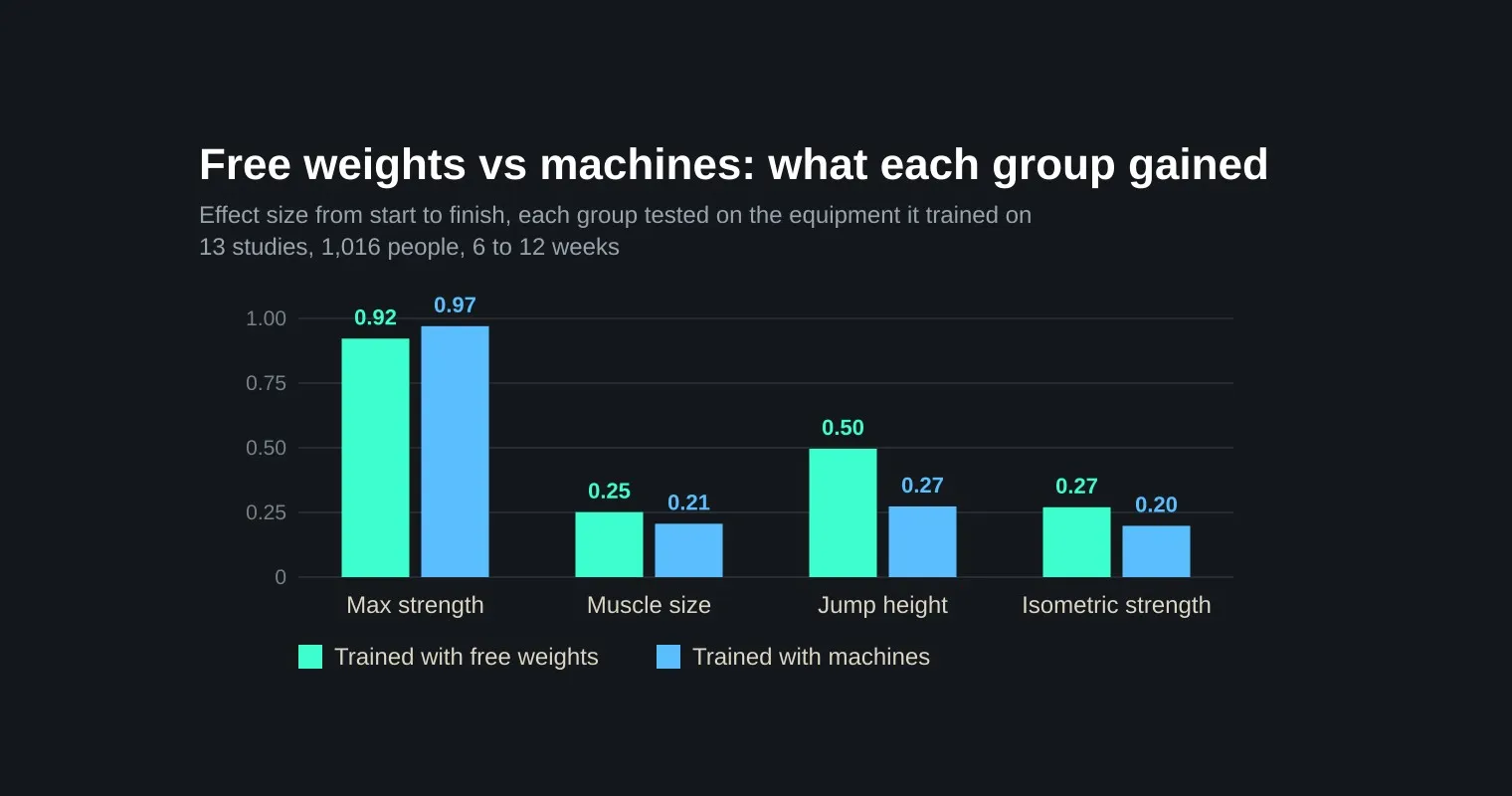
A 2023 meta-analysis in BMC Sports Science, Medicine and Rehabilitation pooled the training studies that have run the comparison head to head. On free weights vs machines for muscle growth it found a tie: across the studies that measured muscle size, neither produced more hypertrophy — muscle growth — than the other. Strength — how much you can lift — split along a different line. Each group got better at the equipment it trained with. Test everyone on a barbell and the barbell group is ahead; test everyone on a machine and the machine group is ahead. Measure each group on its own equipment and the gains are the same size.
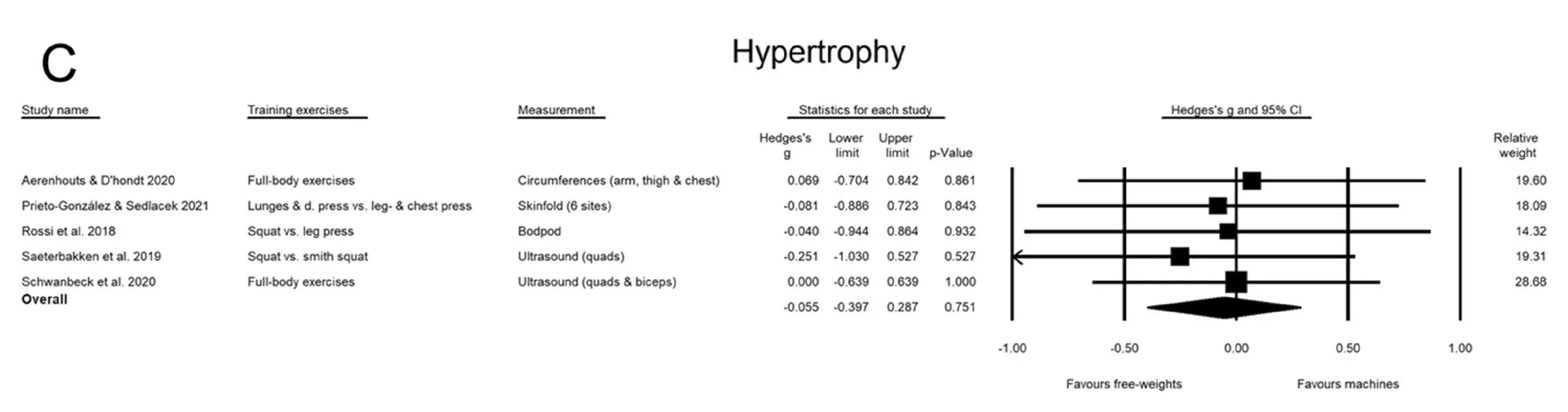
Figure 4C from Haugen and colleagues (2023), the muscle-size analysis, cropped from a three-panel figure. Reproduced under CC BY 4.0. The diamond at the foot is the pooled result.
Table of Contents
- Free weights vs machines for muscle growth: the short answer
- What this meta-analysis compared
- Free weights vs machines for muscle growth: what the numbers say
- Strength followed the equipment each group trained on
- What this study does not settle
- What to do with this in your program
- Common Questions About Free Weights and Machines
- How Pick It Up Helps
- Further Reading & References
What this meta-analysis compared
Haugen and colleagues searched MEDLINE, Embase and SPORTDiscus for studies that put free weights against machines directly, ran at least six weeks, and measured strength, muscle size or jump height in adults aged 18 to 60. Thirteen studies qualified, covering 1,016 participants, 789 of them men. Six studies used lifters the authors classed as trained, seven used untrained participants, and none used competitive athletes.
The programs ran 6 to 12 weeks at two to four sessions a week. “Free weights” meant barbells and dumbbells, most often the back squat and the bench press. “Machines” meant a fixed path and a pin-loaded stack — leg press, hack squat, chest press, Smith machine. Cables, pneumatic and variable resistance were excluded, so none of this is a verdict on the cable stack in the corner.
To count as trained, a group had to clear a bodyweight standard the authors borrowed from an earlier paper: for men, a bench press above bodyweight, a squat above 1.2 times bodyweight and a deadlift above 1.5 times. For women the thresholds were 0.6, 1.0 and 1.2 times bodyweight. That standard is what “trained” means for the rest of this piece.
Free weights vs machines for muscle growth: what the numbers say
Five studies made it into the muscle-size analysis. Pooled, the gap between free weights and machines was −0.055, with a 95% confidence interval from −0.397 to 0.287. On the scale the authors use, anything at or under 0.2 is small; this estimate is a fraction of that, and the interval runs well past zero in both directions.
Both groups grew. Over programs averaging around nine weeks, the free-weight groups gained muscle at an effect size of 0.25 and the machine groups at 0.21. Strength moved much further in the same period — 0.92 for the free-weight groups and 0.97 for the machine groups, tested on their own equipment. Nine weeks buys a lot of strength and a little size, whichever rack you stand at.
How those five studies measured muscle is the soft spot. Two used ultrasound. The other three inferred it — one from a BodPod, one from skinfolds, one from tape-measure circumferences. Circumferences and skinfolds estimate body composition rather than measuring a muscle, and the authors say so themselves.
Strength followed the equipment each group trained on
Tested on free-weight exercises, the free-weight groups were ahead by −0.21, with an interval from −0.39 to −0.03. Tested on machines, the machine groups were ahead by 0.29, but that interval ran from −0.02 to 0.60 and includes no difference at all.
Then the comparison where each group was measured in the exercise it had trained. There the two were indistinguishable — 0.08, interval −0.11 to 0.27. Training status changed nothing; the trained subgroups and the untrained subgroups both landed on no difference.
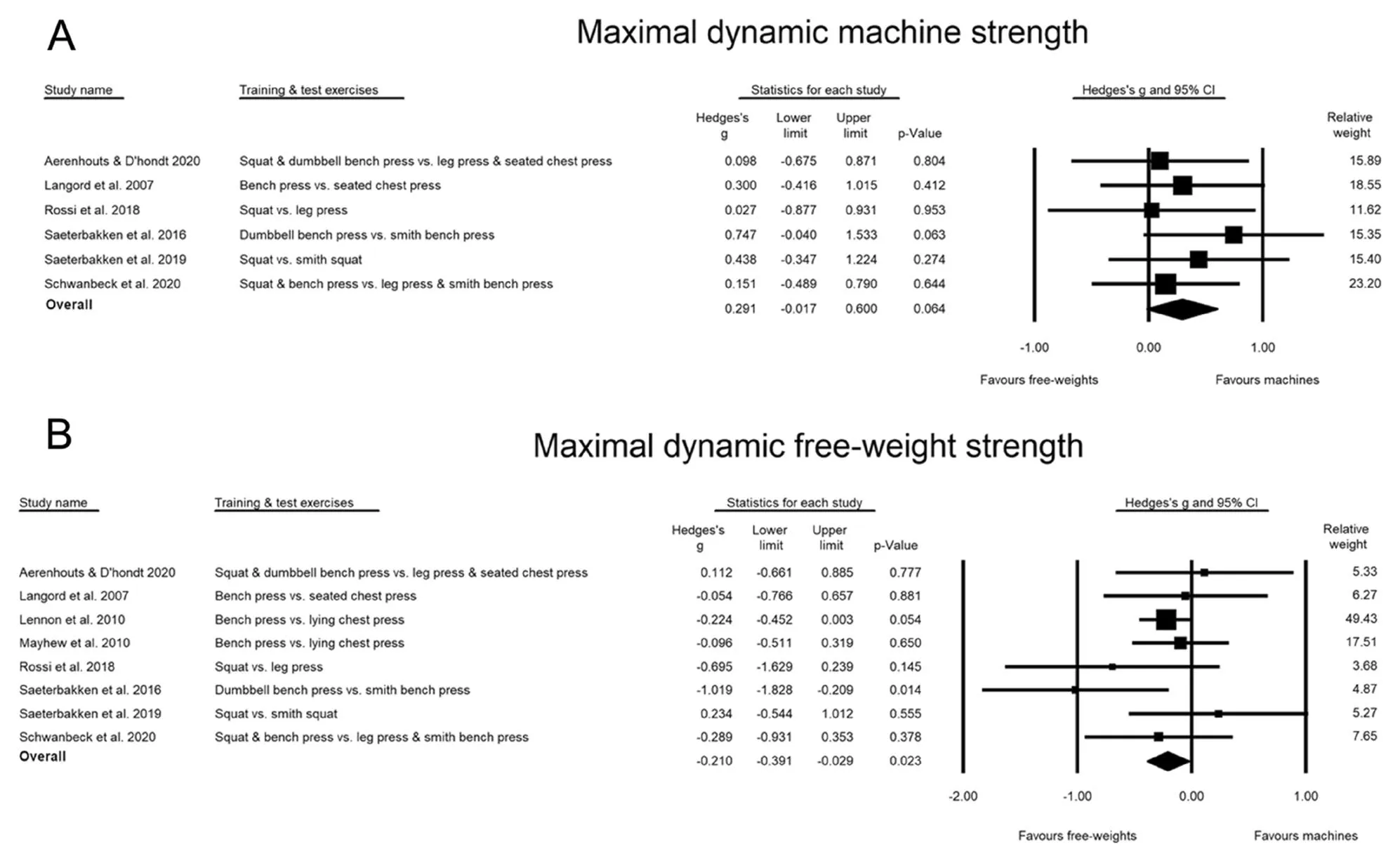
Figure 2 from Haugen and colleagues (2023). Panel A tests every group on machines; panel B tests every group on free weights. Reproduced under CC BY 4.0.
Upper body was the one split
Cut the direct comparison by body part and the upper body leaned to machines: 0.25, interval 0.08 to 0.41. The lower body showed nothing at all, at −0.05 with an interval from −0.37 to 0.27. The upper-body studies were mostly a barbell or dumbbell bench press against a chest press or a Smith machine bench press, so this is one comparison in one movement pattern, not a rule about pressing.
What this study does not settle
The authors list their own weaknesses in three lines. There are few studies here, particularly on muscle size. The measurements are not always the gold standard. And nothing was adjusted for range of motion, load, volume or frequency — the variables that do most of the work in any program.
The strength results are also fragile. Drop one of the thirteen studies and the free-weight advantage on free-weight tests stops clearing statistical significance. Drop a different one — a 1998 trial whose machine group progressed 2.2% while its free-weight group progressed 30.8% — and the tie in the direct comparison tips toward machines. Study quality across the thirteen averaged 8.6 on a 15-point checklist: five rated fair, eight good, none excellent.
Two questions the paper raises and does not answer. It reviews the argument that free weights carry a higher injury rate and concludes the evidence is cross-sectional and the causal link unclear — it ran no analysis of its own. And it discusses regional growth, the idea that a squat and a leg extension build different parts of the same quadriceps, then states that a direct comparison of regional growth between free weights and machines has not been done. The authors’ suggestion that combining both would be the optimal choice is labelled speculation in their own text, and it should stay labelled that way.
This study sits in line with what came before it. The only earlier pooled analysis we could find, Heidel and colleagues in 2022, reported the same shape of result from a smaller set of studies: strength specific to the tested equipment, no difference on a neutral test, and none in power or muscle size. This study adds two hypertrophy trials and the direct comparison, and does not move the answer.
What to do with this in your program
- This is not a reason to change anything. If you like the squat rack, the evidence gives you no reason to leave it, and the same is true in reverse.
- Pick for the lift you want to go up. If your bench press number is the thing you care about, bench. Training a machine version and expecting the barbell number to follow is the one thing these studies say does not transfer cleanly.
- Machines are not a compromise on size. Across the five studies that measured it, muscle growth came out the same. If an injury, a missing rack or a preference points you at machines for a block, that block is not a smaller block.
- Both, if your gym has both. The authors suggest a combination for more complete growth and flag it as speculation, which is where it should sit — but it costs nothing, and swapping a barbell movement for its machine equivalent inside a program is a change with no measured downside.
- Spend the attention elsewhere. The variables this review says it could not control for are the ones with far better evidence behind them: how many sets you do each week, how close to failure you take them, how heavy you load them, and how far you move through the range. Equipment is downstream of all four.
Common Questions About Free Weights and Machines
Does the Smith machine count as a machine here? Yes. Three of the thirteen studies used it as the machine condition — a Smith squat against a barbell squat, and a Smith bench press against a barbell or dumbbell bench press. It has a fixed bar path and a stack, which is the definition the review used.
What about cables and plate-loaded kit that moves freely? Excluded on purpose. Cable and freemotion machines without a fixed path, along with pneumatic and variable-resistance equipment, were screened out at the inclusion stage, so nothing here applies to them either way.
Does this hold for someone who has trained for years? Partly. The trained-versus-untrained subgroups both came out at no difference, so training status did not change the answer inside this data. But the trained groups here cleared a bodyweight-multiple standard rather than a years-of- training one, and no competitive athletes were included, so a lifter ten years in is past the population the review covers.
Will machine training make me jump higher? The jump results came out at no difference across five studies, and that is where the pooled estimate sits. Five studies is thin, and removing one of them flips the result to favour free weights. Four of the five used the barbell squat, which resembles a countermovement jump more than a leg press does.
Is one of them safer? This review cannot tell you. It summarises the argument that free weights carry more injury risk, notes that most of the underlying evidence is cross-sectional, and runs no analysis. Anyone answering that question from this paper is going past what it measured.
How Pick It Up Helps
The finding here is that equipment matters less than what you do with it, which leaves the harder problem: picking exercises that fit the gym you walk into. Pick It Up asks what equipment you have access to when you sign up and does the exercise selection from that, building monthly blocks around what is in front of you — so a rack-and-barbell gym and a machines-and-dumbbells gym produce different programming rather than the same template with substitutions you work out yourself. Start a free trial and see what it builds from your equipment list.
Further Reading & References
- Haugen ME, Vårvik FT, Larsen S, Haugen AS, van den Tillaar R, Bjørnsen T. Effect of free-weight vs. machine-based strength training on maximal strength, hypertrophy and jump performance – a systematic review and meta-analysis. BMC Sports Science, Medicine and Rehabilitation, 2023;15(1):103. PMID 37582807.
- Heidel KA, Novak ZJ, Dankel SJ. Machines and free weight exercises: a systematic review and meta-analysis comparing changes in muscle size, strength, and power. The Journal of Sports Medicine and Physical Fitness, 2022;62(8):1061–1070. PMID 34609100. Cited here for where the earlier evidence landed; read from its abstract only.