How heavy should you lift to build muscle, and what the weight buys you
Two people in your gym are both right. One says you have to lift heavy to build muscle. The other has grown fine on sets of twenty and says load is overrated. The question is not which of them wins, but how heavy you should lift to build muscle given a fixed number of hours and two different things you might want out of them.
A systematic review with network meta-analysis in Medicine & Science in Sports & Exercise is the cleanest test of that question we have found. It gathered every training study it could find that compared light, moderate and heavy loads under one shared condition — every set taken to failure. The answer splits in two.
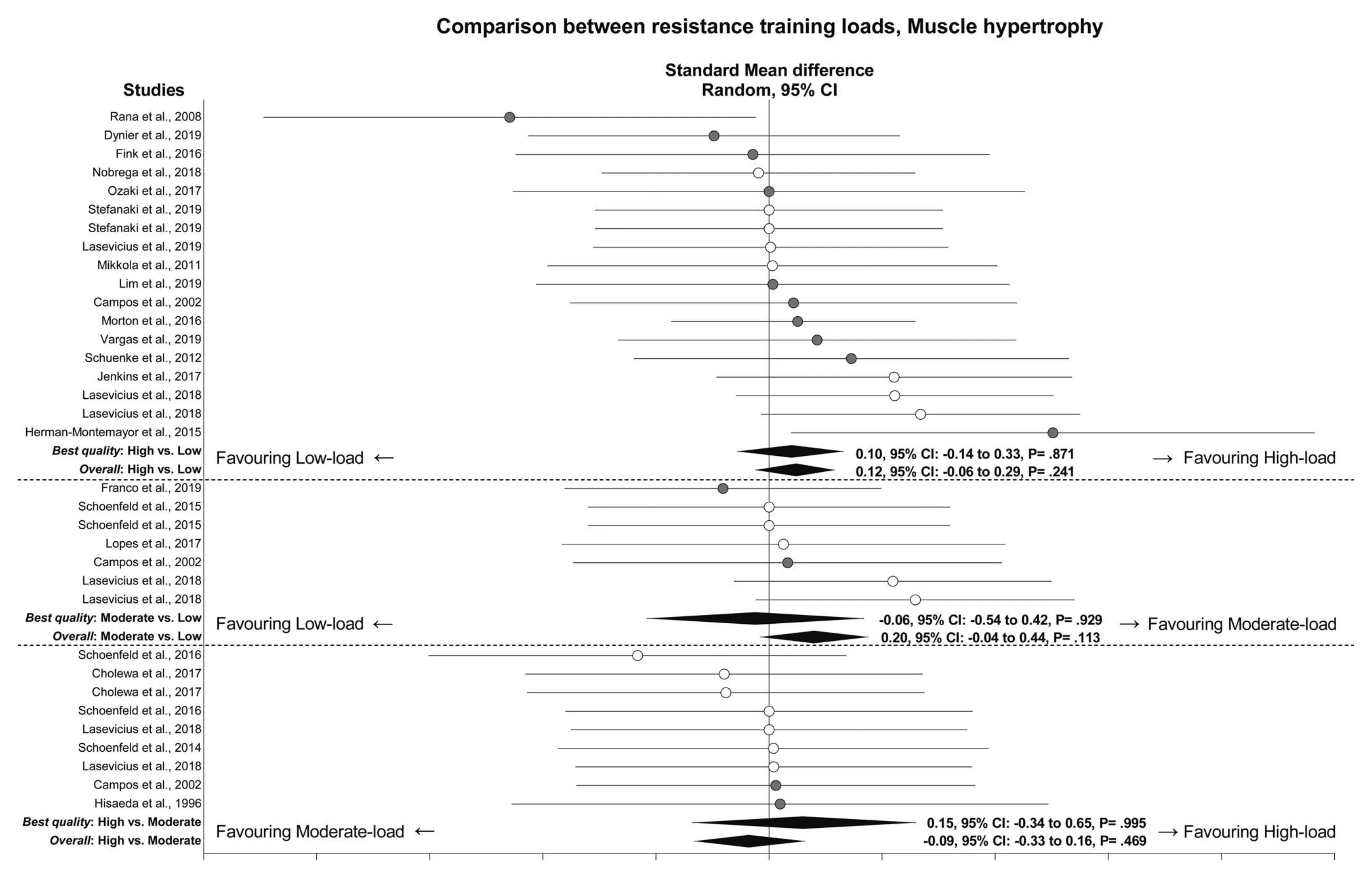
Figure 3 from Lopez and colleagues (2021). Each row is one comparison; the diamonds at the bottom of each block are the pooled answers. Every diamond sits across the zero line, which is what “load did not decide it” looks like.
Table of Contents
- How heavy should you lift to build muscle, and what the weight buys you
- What the study did: three load ranges, one shared condition
- How heavy should you lift to build muscle? The load did not decide it
- Strength is the other story, and there load decides almost everything
- The condition that makes this true: every set went to failure
- What did change the growth results: training age and number of sessions
- Where this sits in the wider evidence
- The limits of this evidence
- How heavy should you lift to build muscle: the practical answer
- Common Questions About Training Load and Muscle Growth
- How Pick It Up Helps
- Further Reading & References
What the study did: three load ranges, one shared condition
Pedro Lopez and colleagues searched five databases for training studies comparing different loads in healthy adults, and sorted every training group into one of three bands:
| Band | As a percentage of your one-rep max | As reps to failure |
|---|---|---|
| Light | under 60% | more than 15 |
| Moderate | 60% to 79% | 9 to 15 |
| Heavy | 80% or more | 8 or fewer |
Your one-rep max is the heaviest single lift you can manage, and the outcome they used to measure strength.
Twenty-eight studies met the bar, covering 747 healthy adults averaging about 23 years old. The programs ran seven to eleven weeks, with 16 to 48 sessions. Two-thirds of the studies used male participants, three-quarters untrained ones. Two outcomes were tracked: muscle growth — hypertrophy, measured as muscle size — and strength, measured as a one-rep max test.
Every set in every included study was taken to volitional failure, which holds effort constant so that the only variable left is the weight on the bar.
It is a network meta-analysis, not an ordinary one. Most studies compared only two of the three bands; a network analysis lets one that compared light against heavy inform the moderate-versus-heavy question too, through the studies they share. That is why 28 studies can answer all three comparisons.
How heavy should you lift to build muscle? The load did not decide it
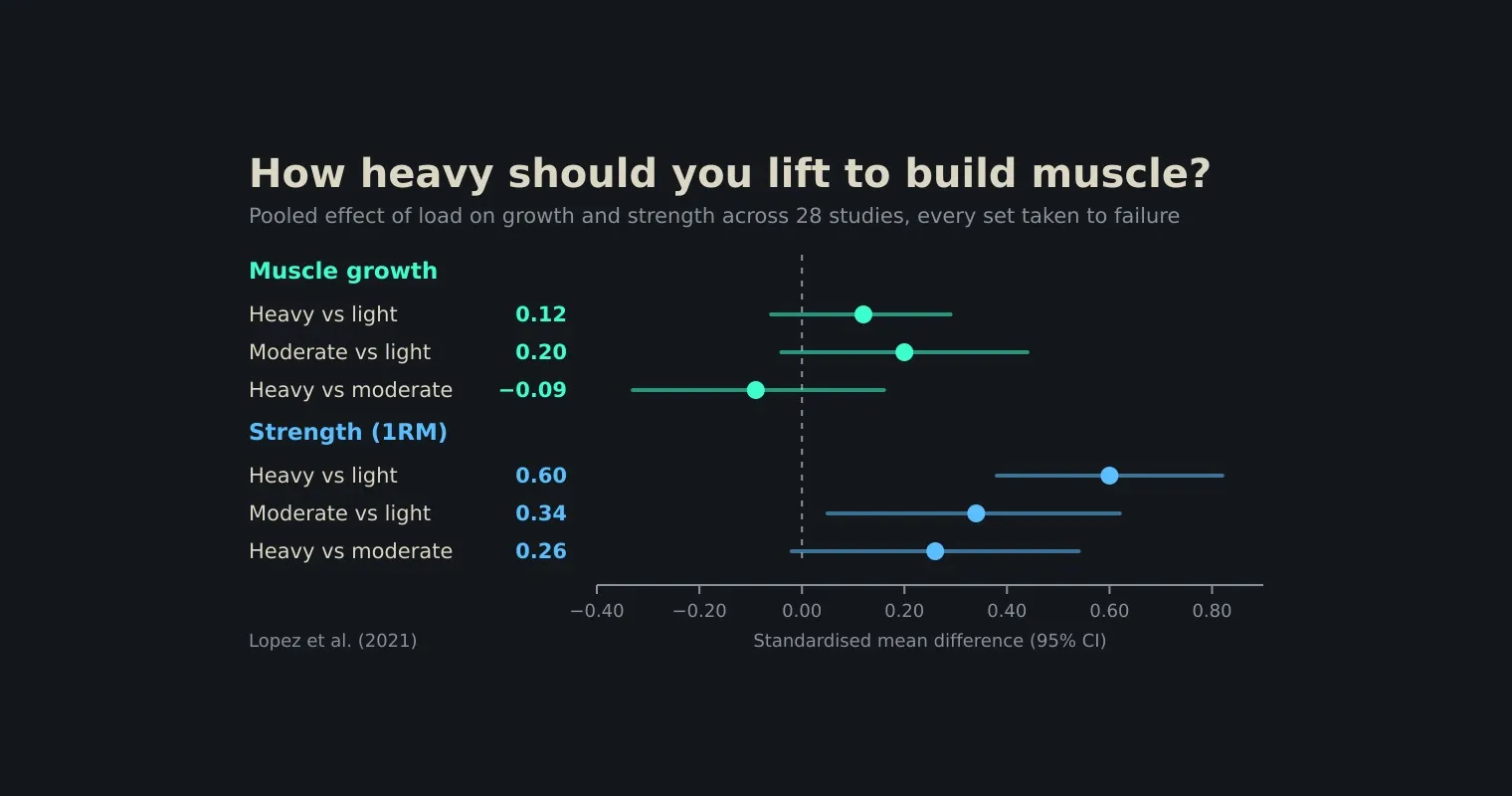
For muscle growth, none of the three comparisons found a difference. Heavy beat light by 0.12, moderate beat light by 0.20, and heavy trailed moderate by 0.09 — every one of those ranges runs through zero, meaning the data are consistent with no difference at all.
Those numbers are standardised effect sizes, a way of putting results measured in different ways — millimetres of muscle thickness, cross-sectional area from a scan — onto one scale. Under 0.5 counts as small on the rule of thumb the paper uses, and the authors describe their own growth estimates as unlikely to be meaningful.
When the authors re-ran the analysis using only the studies they judged best designed, the answer did not move. And the studies agreed with each other unusually closely on this outcome — the heterogeneity statistic, which measures how much the individual studies disagree, came out at zero.
Strength is the other story, and there load decides almost everything
Twenty-four of the 28 studies measured muscle size; 23 measured a one-rep max. Run the analysis against strength and the picture inverts.
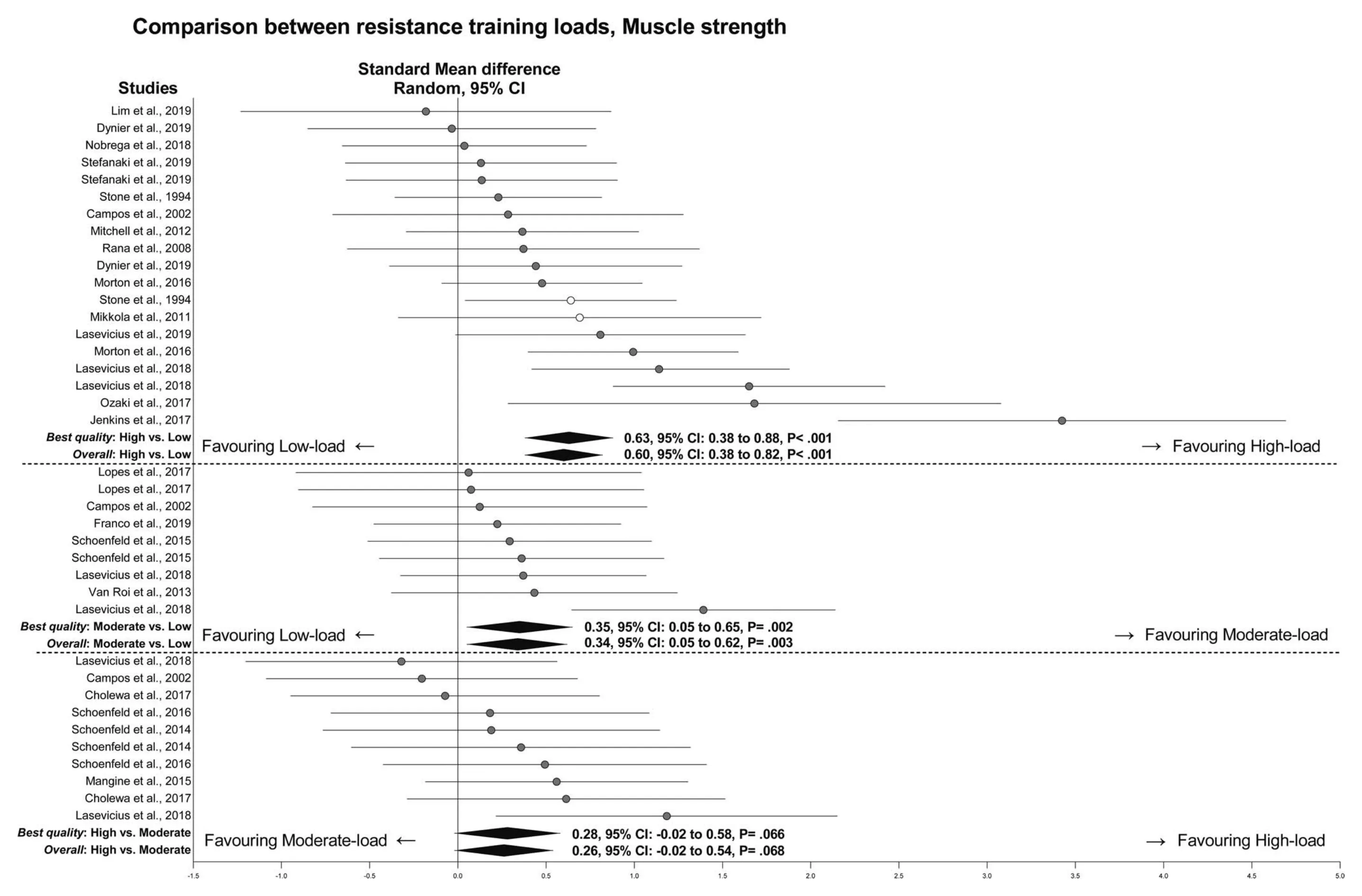
Figure 4 from Lopez and colleagues (2021). The same review, the same method, a different outcome — and now the pooled diamonds have moved off the zero line.
Heavy training beat light training by 0.60, a medium-sized and statistically clear advantage. Moderate beat light by 0.34. Heavy against moderate came out at 0.26, favouring heavy but not clearly enough to call — the range still touches zero. Across the network, heavy loading came out best for strength with a probability of 98%.
Why the split? A one-rep max test is itself a heavy single, and training resembles what you test. A lifter grinding out sets of five spends the block rehearsing the skill of moving a near-limit weight — bracing, staying tight, holding position under load. A lifter doing sets of twenty-five builds the same muscle and rehearses none of it. The authors attribute the gap to specificity plus the nervous-system adaptations heavier work drives.
That is the mechanism behind many stalls on a main lift, and why our guide to breaking through a plateau spends its time on what your training rehearses rather than how hard it feels.
The condition that makes this true: every set went to failure
The finding is not “load doesn’t matter for muscle growth.” It is “load didn’t matter among sets that were taken to failure.” Light sets earn their result by running long enough that fatigue forces high-threshold muscle fibres into the work near the end — a different thing from a comfortable set of twenty. The authors are explicit that other routes to the same recruitment exist, outside what they reviewed.
So the lighter you go, the less margin you have: a set of eight left two reps short is still a good set, and a set of twenty-five left two reps short may not be. And taking light sets to failure costs more reps, more time under tension and more discomfort for the same result, as the authors raise themselves.
It is a boundary against how close to failure you need to train, which covers what happens when you stop short — a question this paper did not ask and designed out.
What did change the growth results: training age and number of sessions
The authors ran regressions across publication year, study design, sex, training status, number of sessions, upper versus lower body, and how the program was prescribed. Two came back significant, both about you rather than about the bar.
Training status. Untrained participants grew more than participants with prior training experience. The authors put this down to diminishing returns: a muscle that has already been trained has banked the easy adaptation. It is a reason to discount any load study run on beginners if you have been lifting for years.
Number of sessions. Among participants who already had training experience, more sessions produced more growth. That is a volume finding wearing a different hat, and it points at the variable that does have a dose-response curve for hypertrophy.
Where this sits in the wider evidence
This study sits with the consensus, which has firmed up over the last decade.
An earlier and much smaller meta-analysis by Schoenfeld and colleagues in 2016 pooled nine studies for strength and eight for growth and found trends favouring heavy loading for both outcomes, neither of which reached significance. Its conclusion blamed the null findings on too few studies. With three times the studies, the growth trend has not survived and the strength one has.
Refalo and colleagues published a systematic review in the Journal of Sports Sciences the same year, covering 45 studies and splitting them into two bands at 60% of a one-rep max rather than three. They reported the same shape: similar growth at every level they could measure — whole body, whole muscle and individual muscle fibre — and a clear advantage for heavier loads on one-rep max strength. Two teams, different inclusion rules, the same answer.
The question neither has answered is what happens to a lifter who is already strong. On that the consensus has not settled, and this study cannot settle it either.
The limits of this evidence
- Nobody in these studies was strong. The review checked for it: no included study involved participants meeting an elite standard, and the authors say the results cannot be extrapolated to bodybuilders, collegiate athletes or power and strength athletes.
- Nothing here runs past 14 weeks. The authors flag that no included study went longer and that reading the result into longer time frames needs caution; growth curves can separate late.
- Most of the studies had design concerns, mainly around randomisation reporting and the fact that nobody measuring muscle size or testing a one-rep max was blinded. The best-quality subgroup gave the same answer, but this is not a body of gold-standard trials.
- Repeated max testing may have shrunk the strength gap. Several included studies tested a one-rep max three to five times along the way, which the authors note could have masked an even bigger advantage for heavy loading, because everyone got repeated practice at the test.
- It only speaks to a one-rep max. Isometric strength, isokinetic testing and muscular endurance were excluded on purpose, so none of this transfers.
- Two-thirds of the studies used men, and where sex did show up in the regressions the effects went in different directions for different comparisons, on thin data.
How heavy should you lift to build muscle: the practical answer
- If your goal is muscle, audit the effort rather than the weight. Any of the three bands — eight reps or fewer, nine to fifteen, more than fifteen — built muscle at the same rate, provided the set went to failure. Pick the load that lets you do the exercise well — the one your elbows tolerate on triceps work, the one you can control on a lateral raise — then make sure the last few reps are the ones you would rather not do.
- If your goal is a bigger one-rep max, that flexibility disappears. Keep your main lifts at eight reps or fewer, roughly 80% of your max and up; light work still adds to your max in these studies, just less, by a medium-sized margin, for the same weeks spent. Most lifters want both, and the programming that follows is ordinary: main lifts in the heavy band, accessories in whatever range you can do them well. The main lifts buy the strength; everything you take to failure buys the muscle.
- Spend the flexibility where it saves you something. Heavier sets are shorter and less unpleasant for the same growth, which is the authors’ own argument for defaulting to moderate loads over light ones. It also means a cranky shoulder, a missing plate or a crowded rack costs you nothing — swap the load, keep the effort, move on.
- If you have trained for years and want more muscle, add sessions before you add weight. That was the one training variable here that predicted more growth in experienced participants, pointing at the same lever as the training frequency evidence.
Common Questions About Training Load and Muscle Growth
Can light weights make you stronger? Yes, just less so. This analysis reports the gap rather than each group’s own gain, and the gap favoured heavy loading by a medium-sized margin. The earlier Schoenfeld analysis, which does report within-group numbers, found loads at or below half of a one-rep max produced substantial strength gains on their own.
Does this apply to me if I have been lifting for five years? Partly. The recreationally trained participants in these studies had two to seven years of experience, so that part is in scope. What is not is anyone already strong — the review found no included study with elite-level participants.
How Pick It Up Helps
The awkward part of this finding is that it moves the burden from the number on the bar to something harder to judge: whether the set was hard enough. That is a call you make set by set, where a logbook leaves you on your own.
Pick It Up gives every set a target weight, a target rep count and a target difficulty on a simplified RPE scale, then updates the next set’s targets from what you reported. If a set was an unexpected grind, the next set adjusts; if sets are reliably too easy, the next block does. That keeps the variable this study says matters — effort — in the sweet spot as you develop.
Start a free trial and see what your targets look like.
Further Reading & References
- Lopez, P., Radaelli, R., Taaffe, D. R., Newton, R. U., Galvão, D. A., Trajano, G. S., Teodoro, J. L., Kraemer, W. J., Häkkinen, K., & Pinto, R. S. (2021). Resistance Training Load Effects on Muscle Hypertrophy and Strength Gain: Systematic Review and Network Meta-analysis. Medicine & Science in Sports & Exercise, 53(6), 1206–1216. PMID 33433148. The source of every training-load claim in this post; free full text at PMC8126497.
- Refalo, M. C., Hamilton, D. L., Paval, D. R., Gallagher, I. J., Feros, S. A., & Fyfe, J. J. (2021). Influence of resistance training load on measures of skeletal muscle hypertrophy and improvements in maximal strength and neuromuscular task performance: A systematic review and meta-analysis. Journal of Sports Sciences, 39(15), 1723–1745. PMID 33874848. Cited here from its abstract only, for where the wider evidence sits.
- Schoenfeld, B. J., Wilson, J. M., Lowery, R. P., & Krieger, J. W. (2016). Muscular adaptations in low- versus high-load resistance training: A meta-analysis. European Journal of Sport Science, 16(1), 1–10. PMID 25530577. Cited here from its abstract only, as the earlier and smaller analysis of the same question.
- Our own coverage of the neighbouring evidence: how close to failure to train, how many sets per week for hypertrophy, training frequency for strength, and breaking through a plateau.