Cardio vs weights for fat loss: the short answer
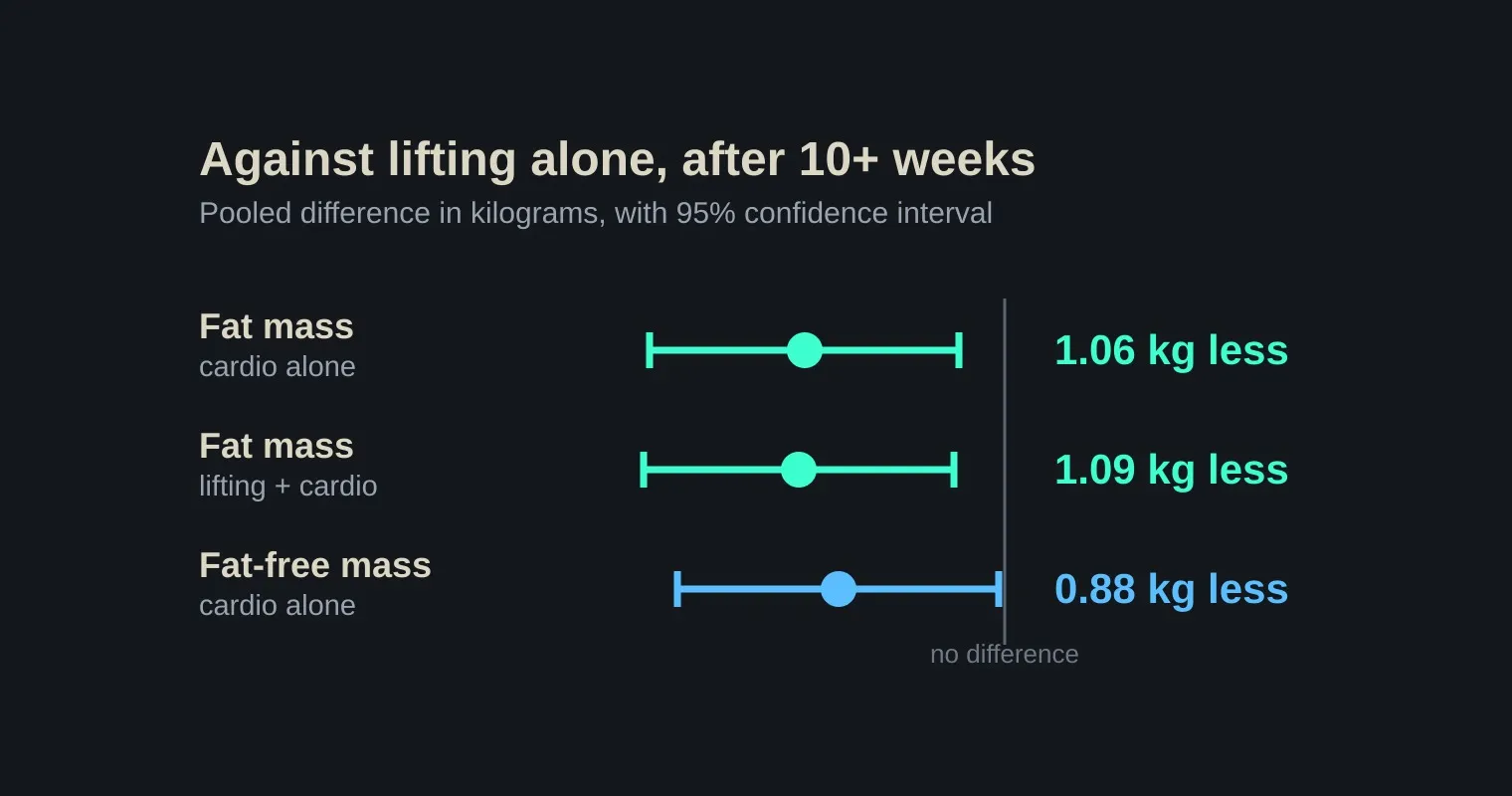
Do both. Adding cardio to a lifting program took about 1 kg — 2.2 lb — more fat off than lifting alone over a block of ten weeks or more, and cost nothing measurable in fat-free mass. Cardio on its own matched that fat loss but finished 0.88 kg lower in fat-free mass than lifting did, which is the reason not to drop the weights to make room for it.
A 2025 meta-analysis in the Journal of the International Society of Sports Nutrition pooled 31 randomised trials, 1,564 people in all, that ran aerobic training, resistance training and both against each other inside the same study. One caveat rides the whole thing: where the trials matched the groups for how much work a session involved, every difference disappeared — so this is a case for adding work, and cardio is the ordinary way to add it.
Table of Contents
- Cardio vs weights for fat loss: the short answer
- What the 31 trials compared
- How much fat cardio, weights and both moved
- Why body fat percentage did not move
- What lifting held on to
- Match the work and the gap closes
- Cardio and weights on the same day, or different days?
- What this study does not show
- Where this sits in the wider evidence
- What to do with this in your training
- Common Questions About Cardio vs Weights for Fat Loss
- How Pick It Up Helps
- Further Reading & References
What the 31 trials compared
Lafontant and colleagues searched three databases for randomised controlled trials published between 1980 and January 2023 that put one group on aerobic training, one on resistance training and one on both, inside a single study, in metabolically healthy adults, for at least four weeks. Thirty-six studies qualified. Thirty-one of them reported enough data to pool, and those hold 1,564 people between them.
Running the three arms inside one trial is what makes the comparison worth anything: a cardio study set beside a separate lifting study compares two different rooms of people eating two different diets.
Diet went unaccounted for, because the trials reported it too inconsistently to pool. Where a trial did impose a deficit it imposed the same one on every group, so the comparison between arms survives even where the absolute numbers do not.
Study quality was scored on a modified PEDro scale running from 0 to 7. One study came out poor; every other one scored moderate or better.
How much fat cardio, weights and both moved
Across the trials that measured fat mass and compared cardio against lifting, the cardio groups finished 1.06 kg lower, with a 95% confidence interval running from 1.88 kg down to 0.24 kg. Split by how long the programs ran, the difference lives entirely in the longer ones: 1.19 kg in trials of ten weeks or more, and 0.68 kg in trials under ten weeks, where the interval is wide enough to include no difference at all.
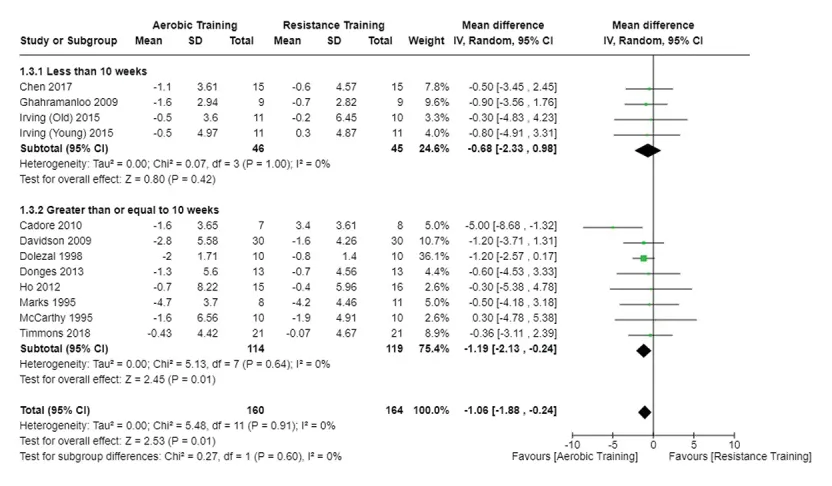
Aerobic training against resistance training for fat mass, split by program length. Figure 2 from Lafontant and colleagues (2025).
Adding cardio to lifting bought the same thing. The groups doing both finished 1.09 kg of fat below the groups that only lifted, with an interval from 0.27 to 1.91 kg, and again the whole of it came from the trials of ten weeks or more. Cardio alone and cardio-plus-lifting could not be told apart from each other.
So the two ways of getting aerobic work into a week — instead of lifting, or alongside it — were worth about the same kilogram.
Why body fat percentage did not move
None of the three came out ahead on body fat percentage. Pooled across 22 comparisons, cardio sat 0.45 of a percentage point below lifting, and that interval runs from 0.99 below to 0.09 above. It crosses zero.
A percentage has a denominator, which is how it can disagree with a mass. Cardio took more total body weight off than lifting did — 1.82 kg more — and some of what came off was fat-free mass rather than fat. Shedding both at once moves the ratio between them less than shedding fat on its own.
What lifting held on to
The cardio groups ended with 0.88 kg less fat-free mass than the lifting groups, with an interval from 1.73 kg down to 0.03 kg. The groups doing both landed in between and could not be separated from either side.
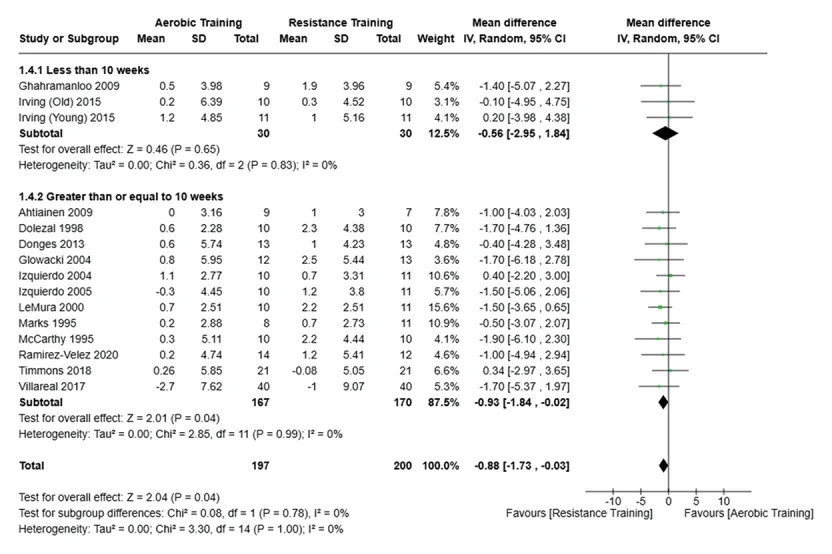
Aerobic training against resistance training for fat-free mass. Figure 11 from Lafontant and colleagues (2025).
One caveat on that number comes from the authors themselves. They re-ran every pool leaving one study out at a time, and this was the fragile result: dropping any one of six individual studies stops the lifting advantage for fat-free mass reaching statistical significance. The direction held through all of it. The significance did not.
Fat-free mass is also not a measurement of muscle. It carries water and stored glycogen with it, both of which shift with training, and the authors flag that as a reason their fat-free mass numbers cannot settle whether cardio interferes with muscle. They ask for four- and five-compartment body composition models before anyone treats it as settled.
Match the work and the gap closes
Twelve of the trials tried to equate how much work each group did — nine by holding session length constant, three by estimating the energy cost. Inside that subset nothing differed: not fat mass, not body fat percentage, not body weight, not fat-free mass.
The authors’ explanation is the obvious one. A lifting session has rest periods in it and a continuous cardio session does not, so an hour on a bike spends more energy than an hour in a rack. Equate the energy and the advantage disappears.
Their own caution travels with it: only 12 studies matched work, they did it three different ways, and the authors want it done by calorimetry before anyone leans on the result.
Cardio and weights on the same day, or different days?
The review split the concurrent-training trials by whether the two sessions fell on the same day or on different days, and checked each against cardio alone and lifting alone. Body weight and body fat percentage came out the same either way. The one comparison that reached significance — same-day concurrent training losing more fat mass than lifting — rests against a different-day arm drawn from a single study, which the authors say is too little to power the comparison.
Their conclusion is that scheduling does not appear to change what concurrent training is worth, so put the sessions where you will keep doing them.
What this study does not show
Almost nothing about people who already lift. Three of the 36 studies recruited participants with resistance training experience, too few for the training-status analysis the authors planned. The rest describe people new to the training they were handed.
Nothing about diet. What people ate could not be pooled across studies, so nothing here says how the choice of exercise interacts with a calorie deficit — only that where a trial imposed one, it imposed the same one on every arm.
Nothing about muscle, measured directly. Fat-free mass is the outcome here, and the authors are explicit that it is not the same thing.
Nothing shorter than seven weeks. That was the shortest included program, so the paper cannot speak to what any of this does over a few weeks.
Sex differences are unresolved. Seven studies enrolled only women and showed no significant differences between modes. The authors ran sex sub-analyses on no more than four studies apiece and left them out of the manuscript as too thin to be meaningful.
Where this sits in the wider evidence
This study sits with the consensus around it rather than against it. The authors note that earlier reviews comparing concurrent training with resistance training for muscle growth found no difference between them, and read their own fat-free mass results as consistent with that.
Our own summary of the fibre-level evidence reaches the same place from a different direction: adding endurance work to a lifting program did not measurably shrink the growth of either muscle fibre type. What this review adds is the fat side of the ledger, which those reviews did not measure.
The neighbouring question — whether you can add muscle while fat is coming off — has its own evidence, and we covered it. Nothing here contradicts it: that paper asks what a deficit does to lean mass and strength, this one asks which mode of exercise moves fat.
What to do with this in your training
- Run both. Lifting plus cardio is the one arm this review never found behind: about 1 kg more fat off than lifting alone, and no measurable fat-free mass cost against lifting alone or against cardio alone. Cardio on its own matched it on fat and finished 0.88 kg lower on fat-free mass than lifting.
- Expect about 1 kg over ten weeks or more, and only over ten weeks or more. Under that, the trials could not separate any of the three. That is the size of the prize before diet enters the picture.
- Count the work, not the mode. Where the trials matched groups for session length or energy cost, every difference vanished.
- Schedule cardio wherever it fits. Same day as lifting or a different day landed in the same place, so the choice belongs to whatever you will keep doing.
- Watch more than the scale. Body weight moved most under cardio and body fat percentage did not move differently at all, because fat-free mass came off alongside the fat. One number will not tell you which happened.
- Know which half of that rests on this paper. Both beating lifting alone on fat is this review’s own result. Both beating cardio alone on lean mass is not — that comparison came back null here, and the case for keeping the weights in leans on the separate evidence that resistance training is what drives muscle growth.
Common Questions About Cardio vs Weights for Fat Loss
Does the kind of cardio matter?
This review cannot say. Any form of aerobic exercise qualified a study for inclusion, and the authors did not analyse running against cycling against rowing. The comparison here is aerobic training as a category against resistance training as a category.
On a same-day session, should cardio come before or after lifting?
Not answered here either. The sub-analysis split trials by same day against different days, not by the order within a day. Nothing in this paper speaks to which half of a session should come first.
Does this hold for someone already lean?
Unknown from this evidence. Participants had to be metabolically healthy adults, and starting body fat was not one of the moderators the authors tested. The pooled numbers are averages across whatever mix of starting points the 31 trials happened to recruit.
How long before any of this is visible?
Longer than most of the short trials ran. Every difference the review found came from programs of ten weeks or more, and the shortest program in the pool was seven weeks — so there is no evidence here about the first month either way.
How Pick It Up Helps
This post has a measurement problem sitting inside it. Body weight moved most under cardio, body fat percentage did not move differently at all, and the gap between those two facts was fat-free mass. A scale on its own cannot tell those apart.
The nutrition side of Pick It Up is built around that gap. You set a goal — cut, bulk, maintain, or recomp, which is converting fat into muscle while keeping total body weight roughly steady — and then spend about 30 seconds each morning: weigh in, and answer two multiple-choice questions about last night’s sleep and yesterday’s hunger. No calorie counting, no macro counting.
What the app does with those entries is the part this post ran into. It reads the daily weight trend alongside every set you have logged, so when the scale is barely moving and the lifts are climbing it says the cut is working and to change nothing. Where something does need to change, the guidance arrives as something you can act on — decrease by about 250 calories a day, the equivalent of one large slice of bread with butter — along with a protein floor in grams to clear.
Start a free trial and set the goal first.
Further Reading & References
- Lafontant K, Rukstela A, Hanson A, Chan J, Alsayed Y, Ayers-Creech WA, Bale C, Ohigashi Y, Solis J, Shelton G, Alur I, Resler C, Heath A, Ericksen S, Forbes SC, Campbell BI. “Comparison of concurrent, resistance, or aerobic training on body fat loss: a systematic review and meta-analysis.” Journal of the International Society of Sports Nutrition, 2025;22(1):2507949. doi:10.1080/15502783.2025.2507949 · PMID 40405489
- Our own summary of what endurance training does to muscle fibre growth: Does cardio kill gains?
- Our own summary of muscle and strength during a deficit: Can you build muscle in a calorie deficit?