Does caffeine make you stronger? The short answer
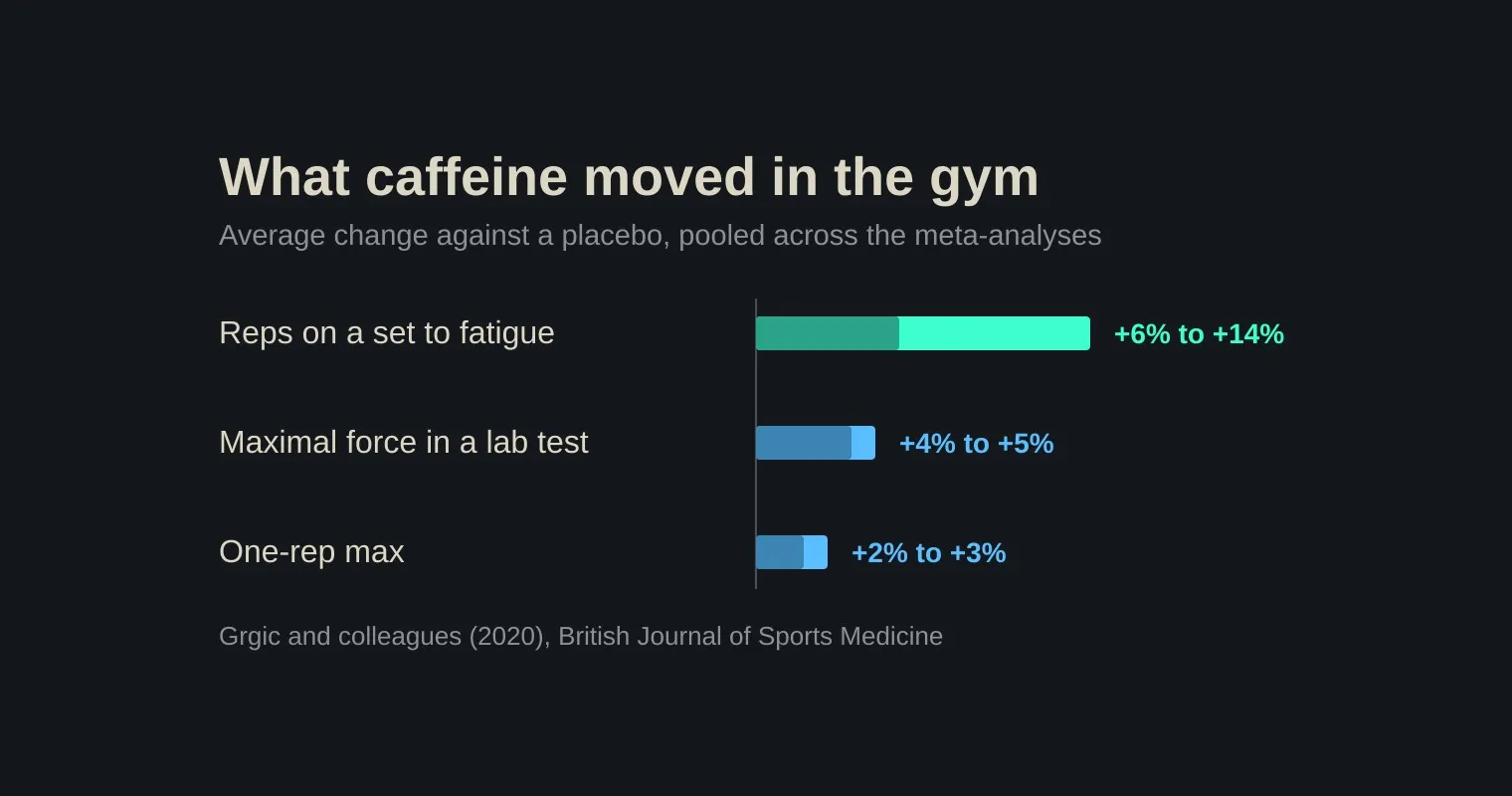
A little, and it does more for your reps than for your max. Caffeine added 2% to 3% to a one-rep max, and 6% to 14% to the reps completed on a set taken to fatigue — on a set of ten, about one extra rep. If you already have coffee before you train, that is the whole protocol: the authors’ rule of thumb is two cups about an hour out.
A 2020 umbrella review in the British Journal of Sports Medicine collected every published meta-analysis of caffeine and exercise performance it could find — 11 reviews carrying 21 separate meta-analyses — scored how well each one was built, and set their results side by side.
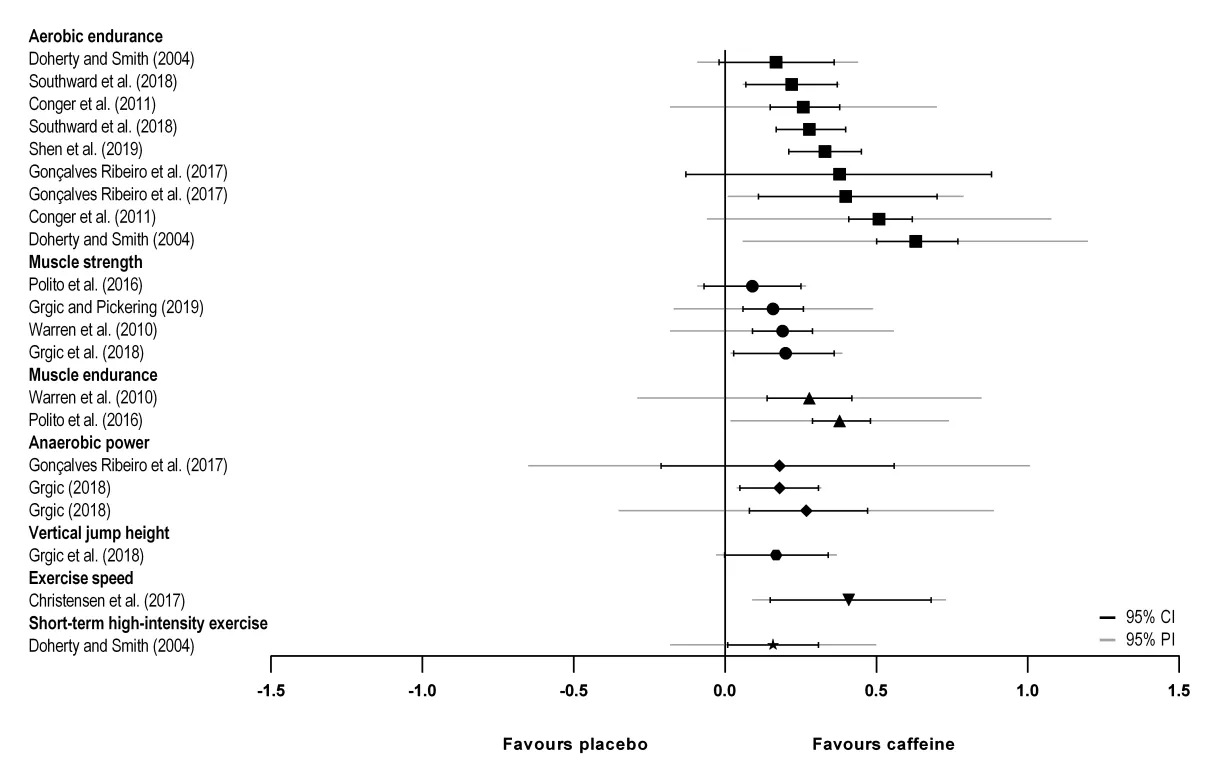
Figure 2 from Grgic and colleagues (2020). Each row is one meta-analysis. The black bars are 95% confidence intervals, the grey bars 95% prediction intervals.
Table of Contents
- Does caffeine make you stronger? The short answer
- What an umbrella review of 21 meta-analyses pooled
- Does caffeine make you stronger, or just better at reps?
- How much caffeine before lifting, and when
- What this review does not show
- Where this sits in the wider evidence
- What to do with this in your training
- Common Questions About Caffeine and Lifting
- How Pick It Up Helps
- Further Reading & References
What an umbrella review of 21 meta-analyses pooled
An umbrella review pools meta-analyses the way a meta-analysis pools studies, which makes this a summary of a field rather than of one experiment.
Grgic and colleagues searched 12 databases up to September 2018 for every meta-analysis of caffeine and exercise performance. Eleven reviews qualified, between them reporting 21 separate meta-analyses published from 2004 to 2018. The median review pooled 19 studies; the smallest pooled 2 and the largest 44.
They scored each review on AMSTAR 2, a checklist for how well a review was built: three came out high quality, eight moderate, none poor. They also calculated a 95% prediction interval for every analysis. A confidence interval says how tightly the average has been pinned down. A prediction interval says where the next study on the question would most likely land, and it is always the wider of the two.
In every one of those 21 analyses, between 72% and 100% of the pooled participants were men, and most were young adults.
Does caffeine make you stronger, or just better at reps?
Both, by different amounts.
Four of the 21 analyses measured muscle strength — how much you can lift, or how hard you can push. Three of the four found caffeine ahead:
- One-rep max, 10 studies and 149 people: +3%.
- Peak torque on an isokinetic machine, which drives the limb at a fixed speed and measures force, 10 studies and 133 people: +5%.
- Maximal voluntary contraction — pushing as hard as you can against something that does not move — 27 studies and 576 people: +4%.
The fourth, which pooled only three studies on the one-rep max, came out at +2% and did not clear chance.
Two analyses measured muscular endurance, meaning reps completed before the set ends. Both found caffeine ahead, and by more: +6% across 16 studies and 239 people, and +14% across 23 studies and 388 people.
To quantify this: six to fourteen per cent of a ten-rep set is 0.6 to 1.4 reps, or about one more rep.
A 3% change in a one-rep max is smaller than the error on the test that measures it. Repeating a one-rep max a week later lands the two scores an average of 3.3% apart for lifters with training experience. Pooling 149 people cancels that noise, which is how a 3% average gets measured confidently. A single before-and-after max cannot resolve a difference that size.
The prediction intervals say the same thing from another direction. In three of the four strength analyses, the interval covering where the next study would land crossed zero — the averages are positive, the next result is not guaranteed to be. Only the 10-study one-rep max analysis kept its whole prediction interval on the caffeine side, and on muscular endurance only one of the two did.
How much caffeine before lifting, and when
The authors are direct that the optimal dose “remains elusive.” What they can say is what the studies underneath them used: most gave a single dose, most commonly 6 mg per kilogram of body weight, about 60 minutes before exercise.
Pushing the dose higher is a weak lever. One of the pooled reviews tested the dose-response on muscular endurance and found each extra 1 mg/kg raised the effect by 0.10 in standardised units — but dose explained only 16% of the variation between studies, so most of what separates one result from another is something else.
Coffee is the practical version of this, and the authors devote a section to it. Their reading is that caffeine from coffee has to land in the 3–6 mg/kg range to do anything, and that an average cup carries about 100 mg. Two cups is therefore about 200 mg, which for someone weighing 70 kg (154 lb) is about 3 mg/kg — the bottom of the useful range. They flag the catch themselves: caffeine content swings with bean, brew, cup size and brand, and even within one brand over time, so nobody knows what is in the specific cup in front of them. Their rule of thumb survives that anyway: two cups of coffee about 60 minutes before exercise should work for most people.
What this review does not show
Nothing about muscle growth, or about anything that takes weeks. Every analysis here pooled acute studies: caffeine taken once, performance measured that day. Whether a slightly better session turns into more muscle or a bigger max three months later is untested, and the authors list it among the open questions.
Almost nothing about women. Between 72% and 100% of the participants in every included analysis were men. The authors say the findings generalise “mostly to men,” and note that caffeine clearance shifts across the menstrual cycle in a way that could change the result.
Almost nothing about older lifters. Most of the primary studies recruited young adults, and several of the reviews are limited to them outright.
Whether a daily coffee habit blunts it is unresolved. The included reviews could not test it, because the primary studies are not there. The authors call the wider evidence on habituation “limited and equivocal.”
Training experience is unresolved too, and the one direct test points the opposite way from the folklore. Caffeine is often said to work better in trained people. The authors call that evidence “scarce and conflicting,” and the single study in these reviews that compared trained and untrained participants head to head found an effect in the untrained group and not the trained one. That is one study inside one review, not a finding of this paper.
The evidence quality is middling, not high. Grading all 21 analyses, 11 came out moderate, 7 low and 3 very low. Publication bias was strongly suspected in three. In one review the unpublished studies averaged an effect of 0.13 against 0.32 for the published ones — the pattern you get when small studies that found nothing never reach print.
Nothing about side effects, sleep, or what caffeine costs you later. Performance on the day was the only outcome.
Where this sits in the wider evidence
This paper is itself a survey of the consensus. Eleven reviews, 21 analyses, and every one of them reported an improvement in at least one measure of performance; none found caffeine worse than a placebo. On direction, this is about as settled as sports nutrition gets. On size it is not settled at all, which is what the prediction intervals and the low-to-moderate grades are saying.
The authors do correct one long-standing framing. Caffeine has historically been treated as an endurance aid, and these analyses show it helps anaerobic work too. The old view was too narrow rather than wrong, though: the effect sizes for aerobic tests generally sat further from zero than the ones for anaerobic tests, which is visible in the figure above as the aerobic block sitting to the right of the muscle strength block.
Caffeine and creatine file under one heading and answer different questions. Creatine is taken daily for weeks and shows up as roughly 4 kg on an upper-body max and 11 kg on a lower-body max. Caffeine is taken once and shows up as a rep. Neither result argues with the other.
What to do with this in your training
- Keep the pre-training coffee if you already have one. Two cups about an hour before is the authors’ rule of thumb, and for most body weights it lands at the bottom of the 3–6 mg/kg range they say is needed.
- Expect it where the reps are. The largest pooled effects were on sets taken to fatigue, +6% to +14%, which comes to about one extra rep on a set of ten.
- Do not expect to see it on a max. Two to three per cent is smaller than the gap between two one-rep max tests of the same lifter a week apart, so a single before-and-after cannot resolve it.
- Do not chase the dose. Each extra 1 mg/kg bought 0.10 of an effect size on muscular endurance, and dose accounted for only 16% of what separated one study from another.
- Keep it in proportion to the programming. One rep on a set is a small effect. How many sets you run each week and how close to failure you take them move more than this does, and both have their own evidence behind them.
Common Questions About Caffeine and Lifting
Does caffeine work as well from gum, gels or a pre-workout powder?
This review cannot say. Most of the primary studies underneath it used caffeine anhydrous in a capsule, with a smaller group using energy drinks, bars and gels. The authors list alternate forms — chewing gum, mouth rinsing, gels — among the things that remain unclear and point to a separate review of them.
Does it help jumping and sprinting?
Modestly, on thinner evidence. One analysis of 10 studies and 145 people found vertical jump height up 3%, with a prediction interval that crossed zero. One analysis of 9 studies found maximal speed in running, cycling or rowing up about 2%, and that one’s prediction interval stayed on the caffeine side.
Does the review say anything about side effects or sleep?
No. It pooled performance outcomes only, so nothing in it speaks to jitteriness, stomach upset, or what a dose taken before an evening session does to the night after it. This is not the paper that answers them.
How Pick It Up Helps
As of September 2026, Pick It Up does not track supplements and has no opinion on what you take. What it does is adjust the targets around the sets you log.
Every set in the app carries a target weight, a target rep count and a target difficulty. As you log what you hit, the targets for the sets that follow update during the session. If reps are harder one day, Pick It Up automatically adjusts for you so you don’t burn yourself out. Consistency and weekly volume — the number of sets taken relatively close to failure — matter more than burning yourself out on any one set.
Pick It Up also tracks the patterns from week to week and month to month, updating targets with each monthly block.
Start a free trial and see what your next session says.
Further Reading & References
- Grgic J, Grgic I, Pickering C, Schoenfeld BJ, Bishop DJ, Pedisic Z. “Wake up and smell the coffee: caffeine supplementation and exercise performance—an umbrella review of 21 published meta-analyses.” British Journal of Sports Medicine, 2020;54(11):681–688. doi:10.1136/bjsports-2018-100278 · PMID 30926628. Every number in this post comes from this review, including its Table 1 and Figure 2.
- The four analyses quoted above, as that review cites them: Grgic J, Trexler ET, Lazinica B, et al., Journal of the International Society of Sports Nutrition 2018;15:11 (one-rep max, vertical jump); Grgic J, Pickering C., Journal of Science and Medicine in Sport 2019;22:353–60 (isokinetic peak torque); Polito MD, Souza DA, Casonatto J, et al., Science & Sports 2016;31:119–28 (one-rep max, muscular endurance); Warren GL, Park ND, Maresca RD, et al., Medicine & Science in Sports & Exercise 2010;42:1375–87 (maximal voluntary contraction, muscular endurance).
- Our summary of how far apart two maximal strength tests land: How accurate is a 1 rep max test?
- Our summary of what creatine adds over weeks, for the contrast: Does creatine make you stronger?