Key Takeaways
- For muscle, a protein shake after a workout does more than BCAAs. In comparable trials, whey protein raised muscle building more than BCAAs did, and in trials lasting weeks, BCAAs did little or nothing for muscle size.
- Eat enough protein first: about 1.5 to 1.6 g per kg (0.7 g per lb) of body weight a day. Past that, more protein added no further strength or lean mass in two reviews of protein trials.
- Six reviews that combined the trials found BCAAs reduced muscle soreness after hard exercise, though the one limited to trained lifters found a clear effect only in the first few hours. Feeling less sore didn’t mean recovering faster: in a review of 25 studies, muscles performed no better in tests a day or two later.
- We don’t recommend BCAAs, but if you take them for soreness, use about 0.2 to 0.25 g per kg (0.09 to 0.11 g per lb) of body weight every day, starting several days before hard training rather than after it. Two reviews favored starting before exercise, and larger daily doses went with bigger drops in soreness.
- Most of these trials studied young men, and most didn’t record how much protein people ate. So it isn’t known whether BCAAs add anything for people who already eat enough protein.
Table of Contents
- What Are BCAAs?
- Do Post-Workout BCAAs Build Muscle?
- Do BCAAs Reduce Muscle Soreness?
- Do BCAAs Help You Recover Faster?
- Should You Take BCAAs Before or After a Workout?
- How Much BCAA to Take
- How Strong Is the Evidence?
- Common Questions About BCAAs
- How Pick It Up Helps
- Further Reading & References
What Are BCAAs?
BCAAs, or branched-chain amino acids, are three of the nine essential amino acids: leucine, isoleucine and valine. Essential means the body can’t make them, so they have to come from food, according to a 2024 review of BCAAs and muscle building.
Protein foods already contain them. BCAAs make up about 15% to 25% of the amino acids in common protein foods, and about 26% of those in milk protein, the same review notes. A BCAA supplement contains the three on their own, without the other six essential amino acids.
Do Post-Workout BCAAs Build Muscle?
Not much. After lifting, BCAAs raised the rate of muscle building for a few hours, but less than whey protein did, and trials lasting weeks found little or no extra muscle.
Muscle protein synthesis is the process that builds new muscle protein, and lifting speeds it up. In a 2017 trial, 10 men who lifted regularly did the same one-leg workout twice. After one session they drank 5.6 g of BCAAs, the amount in about 20 g of whey protein. After the other, they drank a placebo. Over the next 4 hours, muscle protein synthesis was 22% higher after the BCAAs than after the placebo.
Whey protein did more. In an earlier trial by the same research group, measured the same way, 20 g of whey protein raised muscle protein synthesis by 37% over a placebo. The two were separate trials, which the 2024 muscle-building review sets side by side. Not every trial found a rise from BCAAs at all: in another that the review describes, they did no better than a placebo.
The review’s explanation is that BCAAs switch muscle building on, but muscle also needs the other essential amino acids to build with, so BCAAs on their own raise it only briefly. Whole protein, which supplies all nine, raises it more.
Trials that ran for weeks measured muscle itself, and found little or no effect:
- In a 2022 review of 24 studies in athletes and people who train regularly, BCAAs made almost no difference to lean mass or fat. Its authors add that when people eat enough protein, it is doubtful that BCAAs add anything to strength or muscle growth.
- In a 2025 review, 1 of the 5 trials that measured body composition found more muscle with BCAAs than with a placebo.
What to do instead: eat enough protein. In a 2022 review of 82 protein trials, people who lifted gained more strength as their daily protein rose, up to about 1.5 g per kg (0.7 g per lb) of body weight, and no further. In a 2018 review of 49 trials, gains in lean mass stopped past about 1.6 g per kg (0.7 g per lb). Our post on how much protein it takes to get stronger covers both.
Do BCAAs Reduce Muscle Soreness?
Yes, somewhat. Six reviews that combined the trials found less soreness with BCAAs after hard exercise, most of them over the following one to four days. The one limited to trained lifters found a clear effect only in the first few hours.
- A 2024 review of 18 soreness trials and 331 people found less soreness 24, 48, 72 and 96 hours after exercise, but not right after it.
- A 2021 review of 25 studies and 479 people found less soreness at 24 and 48 hours.
- A 2021 review of 10 trials found that 7 of them showed less soreness from 24 to 72 hours.
- A 2019 review found less soreness overall, and a 2020 review found less soreness at 24, 48 and 72 hours.
- A 2021 review limited to trained men who lifted found less soreness in the first few hours after lifting, measured up to 4 hours later. At the 24-hour and 48-hour marks, the results leaned the same way, but the trials disagreed too much to be sure. Only 5 of its 9 trials measured soreness; the rest measured only blood markers of muscle damage.
None of the reviews gives the difference as points on a standard soreness scale, and the effect varied a lot from one trial to the next (2024 soreness review). So there is no plain figure for how much less sore people felt.
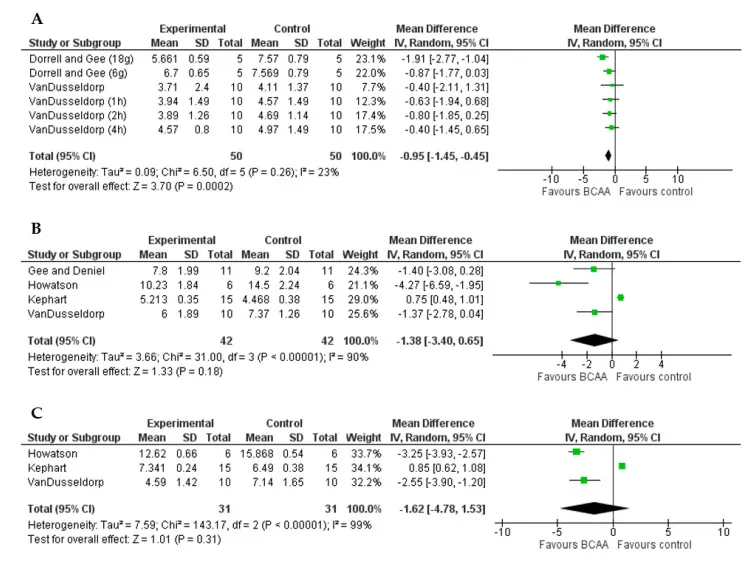
Figure 5 from Khemtong and colleagues (2021), reproduced under the paper’s open licence (CC BY 4.0). Each row is one trial, and the black diamond at the bottom of each chart is the combined result. Left of the centre line means less sore with BCAAs. Under 24 hours (A), the diamond stays clear of the line. At 24 hours (B) and 48 hours (C), the combined results lean the same way, but the trials disagreed too much to be sure.
If soreness is the problem, there is also a free option. In a 2023 review, people who did an easy session of an exercise a few days before a hard session of the same exercise were less sore after the hard one. Those studies were in untrained people, and the authors rate their certainty as very low. In practice, that means doing a new exercise light once, a few days before you load it. Our post on what causes muscle soreness covers it.
Do BCAAs Help You Recover Faster?
Not in the largest review that tested it. Muscles performed no better in tests 24 and 48 hours after hard exercise with BCAAs than with a placebo, and other reviews found the effects on performance small or inconsistent.
In the 2021 review of 25 studies, blood markers of muscle damage, substances that leak from damaged muscle into the blood, were lower with BCAAs at 48 hours. Even so, muscle performance recovered no faster. The 2022 review of 24 studies found BCAAs had minimal effects on performance, and the 2025 review found the evidence on strength inconsistent.
Should You Take BCAAs Before or After a Workout?
For soreness, start them several days before hard training, not just after it. If you train hard most days, that means taking them every day. For muscle building after a workout, whey protein did more than BCAAs.
- Every trial in the 2024 soreness review started BCAAs before exercise, and some continued after. None tested taking them only after a workout.
- The 2021 review of 10 trials concluded that BCAAs “should not be administered only after” the exercise.
- A 2017 review of 11 studies found BCAAs limited muscle damage mostly when people took them for more than 10 days, starting at least 7 days before the hard session. That finding rests on only two of its 11 studies.
- In a small 2018 trial, 15 young men were split into three groups for an arm workout. One group took 9.6 g of BCAAs a day for the three days before it and just before it. Another took the same amount just after it and for the three days after. The third took a placebo. The group that took BCAAs before was less sore than the placebo group. The group that took them after saw a weaker effect, and the study’s summary doesn’t say whether it beat the placebo.
For muscle building after a workout, whey protein does the job better than BCAAs (see above).
How Much BCAA to Take
We don’t recommend BCAAs. The evidence suggests you are better off with a protein supplement, which raised muscle building more than BCAAs did and contains them anyway. If you want BCAAs regardless, instead of protein or on top of it, take about 0.2 to 0.25 g per kg (0.09 to 0.11 g per lb) of body weight a day, or 2 to 2.5 g for every 10 kg (22 lb) you weigh. That is where the reviews that give doses by body weight saw benefits:
- The 2017 review found BCAAs limited muscle damage mostly above 0.2 g per kg (0.09 g per lb) a day, taken for more than 10 days.
- The 2021 review of 10 trials found that doses of up to about 0.25 g per kg (0.11 g per lb) a day eased soreness. It had too little evidence to judge higher doses.
- The trials in the 2024 soreness review used 3 to 29 g a day, for 1 to 28 days. Larger daily doses went with bigger drops in soreness 24 hours after exercise, and the authors suggest more than 5 g a day. The 2021 review of 25 studies also found that larger doses did more.
For any adult, 0.2 to 0.25 g per kg (0.09 to 0.11 g per lb) comes to well over 5 g a day, the amount the 2024 soreness review’s authors suggest going beyond.
How Strong Is the Evidence?
For soreness, the direction is consistent: six reviews found less soreness with BCAAs. How much less, for whom, and on top of what diet are less certain.
- The reviews overlap. Some trials appear in more than one of them, so six reviews are not six separate tests (trained-men review; 2024 soreness review).
- Results varied a lot between trials (2024 soreness review).
- Some trials may be missing. At 96 hours, the published results in the 2024 soreness review were lopsided in a way that often means small trials showing no effect went unpublished. If so, the drop in soreness at 96 hours is smaller than it looks.
- Most trials didn’t record how much protein people ate (trained-men review; 2022 review of 24 studies; 2024 soreness review). So it isn’t known whether BCAAs reduce soreness in people who already eat enough protein.
- Most trials studied young men. In the 2021 review of 25 studies, the average age was 24, and about three in four people were men. The trained-men review covered ages 21 to 25, and 14 of the 2024 soreness review’s 18 trials included only men (25-study review; trained-men review; 2024 soreness review).
- For muscle, the evidence is thinner: a few trials that ran for weeks, with mixed results (2022 review of 24 studies; 2025 review).
Common Questions About BCAAs
Do I need BCAAs if I already take whey protein?
Probably not. Adding BCAAs to protein doesn’t stand in for more protein. In a trial that the 2024 muscle-building review describes, a small 6.25 g dose of whey with BCAAs added raised muscle protein synthesis less than a full 25 g dose of whey, at rest and after lifting. Most BCAA trials didn’t record how much protein people ate, so it isn’t known whether BCAAs add anything on top of enough protein.
Are essential amino acids better than BCAAs for muscle protein synthesis?
Not clearly. Few trials have compared them directly. In one that the 2024 muscle-building review describes, a drink of all nine essential amino acids, a BCAA drink and a placebo all led to the same muscle protein synthesis after lifting. The review notes that this result runs partly against the trials above, where BCAAs raised muscle protein synthesis and whey raised it more, so one trial can’t settle the question.
Do BCAAs work for women?
Less is known. Of the 18 trials in the 2024 soreness review, 2 studied only women and 2 studied women and men, and soreness dropped more in the trials of men. The trained-men review left women out on purpose, because estrogen affects the blood markers of muscle damage it measured.
How Pick It Up Helps
Pick It Up, our strength training and nutrition app, gives you a daily protein floor in grams: a number to clear, not a target to hit. It doesn’t require counting calories or macros. The rest of its nutrition guidance runs on a 30-second morning check-in: your weight, how you slept, and how hungry you were yesterday. The protein floor is part of Pro, the paid plan.
Protein on its own doesn’t build muscle: in the 2022 review of 82 protein trials, extra protein raised strength only in people who also lifted. A good training program sets how many sets each muscle gets a week, with a target weight, reps and difficulty for every set, and adjusts those targets during a session when needed and after each monthly block. Pick It Up does all of that for you, so you get the most from both your training and your nutrition.
Start a free trial today.
Further Reading & References
- Kaspy MS, Hannaian SJ, Bell ZW, Churchward-Venne TA. “The effects of branched-chain amino acids on muscle protein synthesis, muscle protein breakdown and associated molecular signalling responses in humans: an update.” Nutrition Research Reviews, 2024;37(2):273–286. doi:10.1017/S0954422423000197 · PMID 37681443.
- Jackman SR, Witard OC, Philp A, Wallis GA, Baar K, Tipton KD. “Branched-Chain Amino Acid Ingestion Stimulates Muscle Myofibrillar Protein Synthesis following Resistance Exercise in Humans.” Frontiers in Physiology, 2017;8:390. doi:10.3389/fphys.2017.00390 · PMID 28638350.
- Martinho DV, Nobari H, Faria A, Field A, Duarte D, Sarmento H. “Oral Branched-Chain Amino Acids Supplementation in Athletes: A Systematic Review.” Nutrients, 2022;14(19):4002. doi:10.3390/nu14194002 · PMID 36235655.
- Julea M, Saleh SN. “The Effect of Oral Pure Branched-Chain Amino Acid Supplementation on Exercise Performance and Body Composition: A Systematic Review.” Cureus, 2025;17(11):e96017. doi:10.7759/cureus.96017 · PMID 41346907.
- Tagawa R, Watanabe D, Ito K, Otsuyama T, Nakayama K, Sanbongi C, et al. “Synergistic Effect of Increased Total Protein Intake and Strength Training on Muscle Strength: A Dose-Response Meta-analysis of Randomized Controlled Trials.” Sports Medicine – Open, 2022;8(1):110. doi:10.1186/s40798-022-00508-w · PMID 36057893.
- Morton RW, Murphy KT, McKellar SR, Schoenfeld BJ, Henselmans M, Helms E, et al. “A systematic review, meta-analysis and meta-regression of the effect of protein supplementation on resistance training-induced gains in muscle mass and strength in healthy adults.” British Journal of Sports Medicine, 2018;52(6):376–384. doi:10.1136/bjsports-2017-097608 · PMID 28698222.
- Salem A, Ben Maaoui K, Jahrami H, et al. “Attenuating Muscle Damage Biomarkers and Muscle Soreness After an Exercise-Induced Muscle Damage with Branched-Chain Amino Acid (BCAA) Supplementation: A Systematic Review and Meta-analysis with Meta-regression.” Sports Medicine – Open, 2024;10(1):42. doi:10.1186/s40798-024-00686-9 · PMID 38625669.
- Doma K, Singh U, Boullosa D, Connor JD. “The effect of branched-chain amino acid on muscle damage markers and performance following strenuous exercise: a systematic review and meta-analysis.” Applied Physiology, Nutrition, and Metabolism, 2021;46(11):1303–1313. doi:10.1139/apnm-2021-0110 · PMID 34612716.
- Weber MG, Dias SS, de Angelis TR, et al. “The use of BCAA to decrease delayed-onset muscle soreness after a single bout of exercise: a systematic review and meta-analysis.” Amino Acids, 2021;53(11):1663–1678. doi:10.1007/s00726-021-03089-2 · PMID 34669012.
- Fedewa MV, Spencer SO, Williams TD, Becker ZE, Fuqua CA. “Effect of branched-Chain Amino Acid Supplementation on Muscle Soreness following Exercise: A Meta-Analysis.” International Journal for Vitamin and Nutrition Research, 2019;89(5–6):348–356. doi:10.1024/0300-9831/a000543 · PMID 30938579.
- Rahimlou M, Ahmadi AHR, Palimi E, Mahdipour M, Poodeh BM. “Reduction of Muscle Injuries and Improved Post-exercise Recovery by Branched-Chain Amino Acid Supplementation: A Systematic Review and Meta-Analysis.” Journal of Nutrition, Fasting and Health, 2020;8:1–16. doi:10.22038/jnfh.2019.38666.1177.
- Khemtong C, Kuo C-H, Chen C-Y, Jaime SJ, Condello G. “Does Branched-Chain Amino Acids (BCAAs) Supplementation Attenuate Muscle Damage Markers and Soreness after Resistance Exercise in Trained Males? A Meta-Analysis of Randomized Controlled Trials.” Nutrients, 2021;13(6):1880. doi:10.3390/nu13061880 · PMID 34072718.
- Boyd L, Deakin GB, Devantier-Thomas B, Singh U, Doma K. “The Effects of Pre-conditioning on Exercise-Induced Muscle Damage: A Systematic Review and Meta-analysis.” Sports Medicine, 2023;53(8):1537–1557. doi:10.1007/s40279-023-01839-8 · PMID 37160563.
- Fouré A, Bendahan D. “Is Branched-Chain Amino Acids Supplementation an Efficient Nutritional Strategy to Alleviate Skeletal Muscle Damage? A Systematic Review.” Nutrients, 2017;9(10):1047. doi:10.3390/nu9101047 · PMID 28934166.
- Ra SG, Miyazaki T, Kojima R, et al. “Effect of BCAA supplement timing on exercise-induced muscle soreness and damage: a pilot placebo-controlled double-blind study.” The Journal of Sports Medicine and Physical Fitness, 2018;58(11):1582–1591. doi:10.23736/S0022-4707.17.07638-1 · PMID 28944645.
- Our summary of the protein research: How much protein to get stronger
- Our summary of the soreness research: What causes delayed onset muscle soreness