How long to rest between sets, and what the answer costs you
Rest is the one training variable that is pure time. Add a set and you add work; add thirty seconds between sets and you add nothing but minutes on the clock. So the question of how long to rest between sets for muscle growth is a question about what those minutes buy.
For years the answer from the strength-and-conditioning textbooks was that short rest — 30 to 90 seconds — is what you want for size, on the theory that the metabolic stress and the hormone spike do the work. A 2024 Bayesian meta-analysis in Frontiers in Sports and Active Living pooled every randomised training study that has tested this, and it does not support the bottom half of that range. Resting more than 60 seconds came out slightly ahead. Past about 90 seconds, the analysis could not find any further benefit at all.
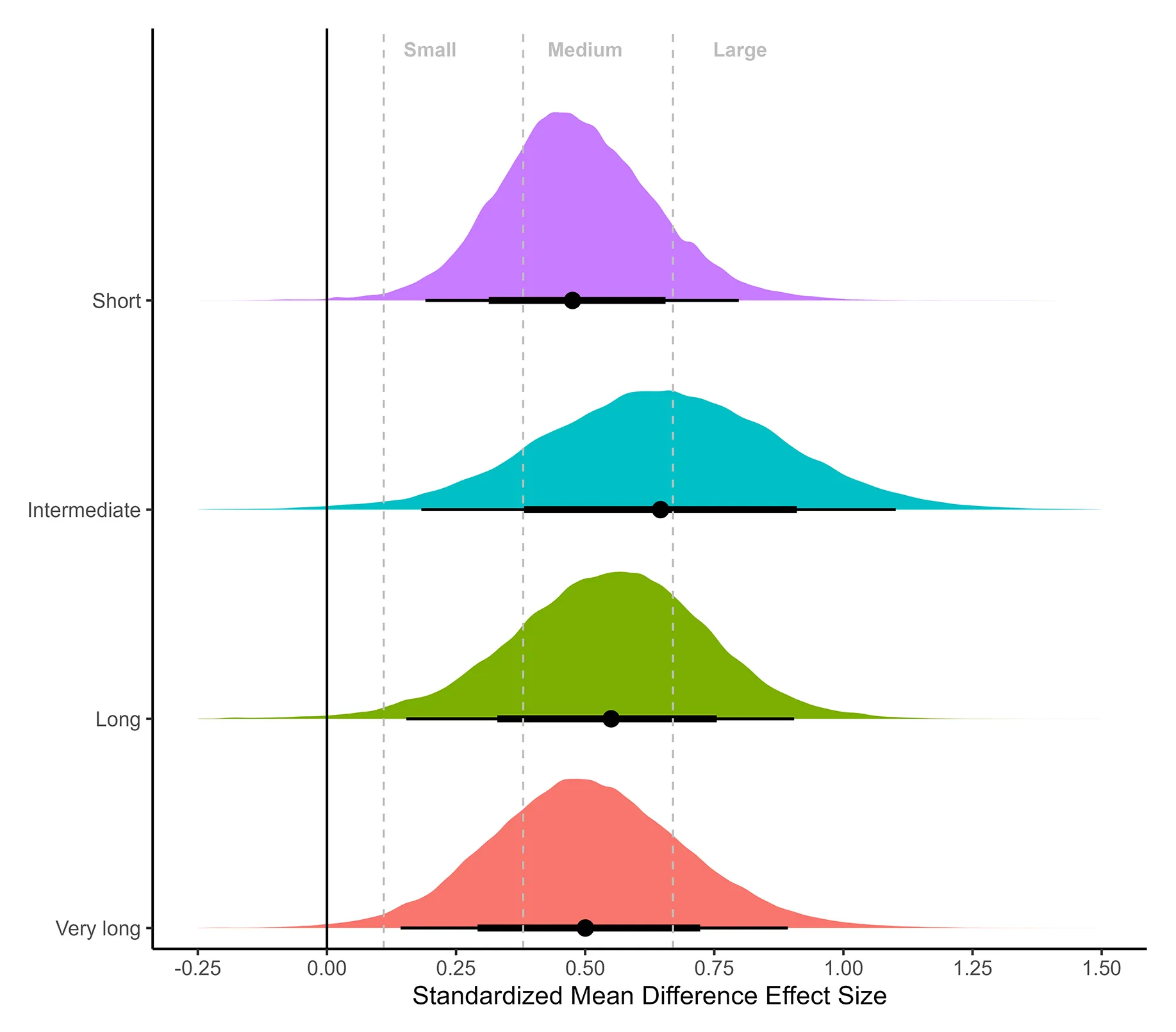
Figure 3 from Singer and colleagues (2024), reproduced under CC BY 4.0. Short is 60 seconds or less, intermediate 61 to 119, long 120 to 179, very long 180 or more. Every category produced substantial growth, and they overlap almost completely.
Table of Contents
- How long to rest between sets, and what the answer costs you
- What this meta-analysis compared
- How long to rest between sets for muscle growth: the numbers
- Why longer rest helps: it is the reps, not the rest
- Where this sits against the textbook advice
- How long to rest between sets for muscle growth, in practice
- The limits of this evidence
- Common Questions About Rest Between Sets
- How Pick It Up Helps
- Further Reading & References
What this meta-analysis compared
Singer and colleagues searched for every randomised study that put one rest length against another, held every other training variable constant, and measured muscle growth — hypertrophy — with an objective, quantifiable method: MRI, ultrasound, DXA, CT, a biopsy, or a tape measure around a limb. Studies had to run at least four weeks at two sessions a week or more.
Nine studies cleared the bar, giving 19 separate measurements — ten at the thigh, six at the arm, three whole-body. The programs ran 5 to 10 weeks, with groups of 12 to 28 people.
Six of the nine studies used untrained participants and three used resistance-trained ones. Six used men only, one women only, one both, and one did not say. Eight used people aged roughly 18 to 35 and one used men over 65.
The rest lengths were sorted two ways. The simple split was short, meaning 60 seconds or less, against everything longer. The finer split was four bands: 60 seconds or less, 61 to 119, 120 to 179, and 180 or more.
How long to rest between sets for muscle growth: the numbers
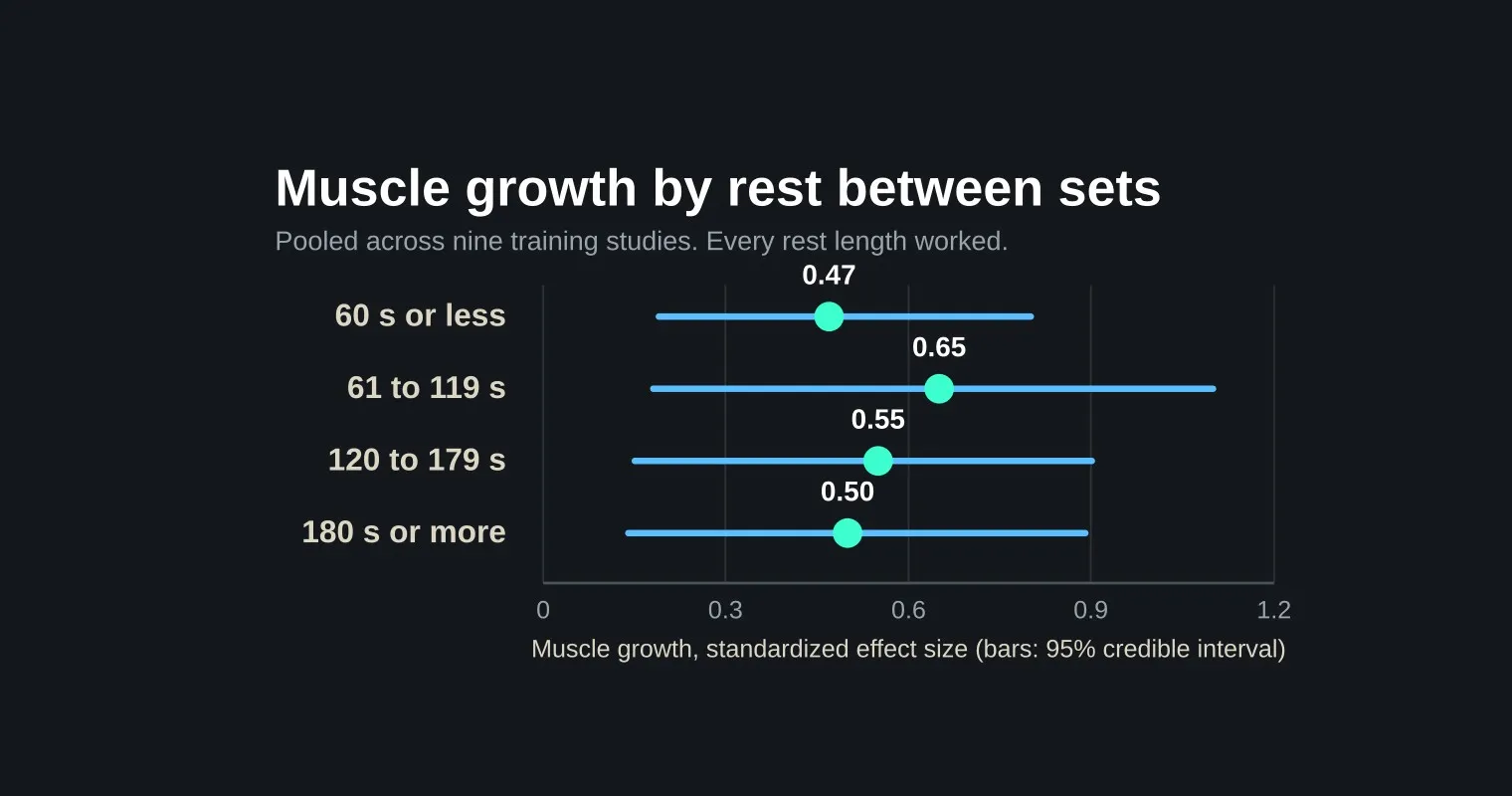
Every rest length built muscle. Across the four bands, the pooled growth effect sizes were 0.47 for 60 seconds or less, 0.65 for 61 to 119, 0.55 for 120 to 179, and 0.50 for 180 or more. The authors describe those as medium to large, and their intervals overlap so heavily that the chart above is mostly one shape drawn four times. Nobody in these studies failed to grow because of their rest timer.
The finer question is what happens when short is compared against longer inside the same study, where the randomisation earns its keep.
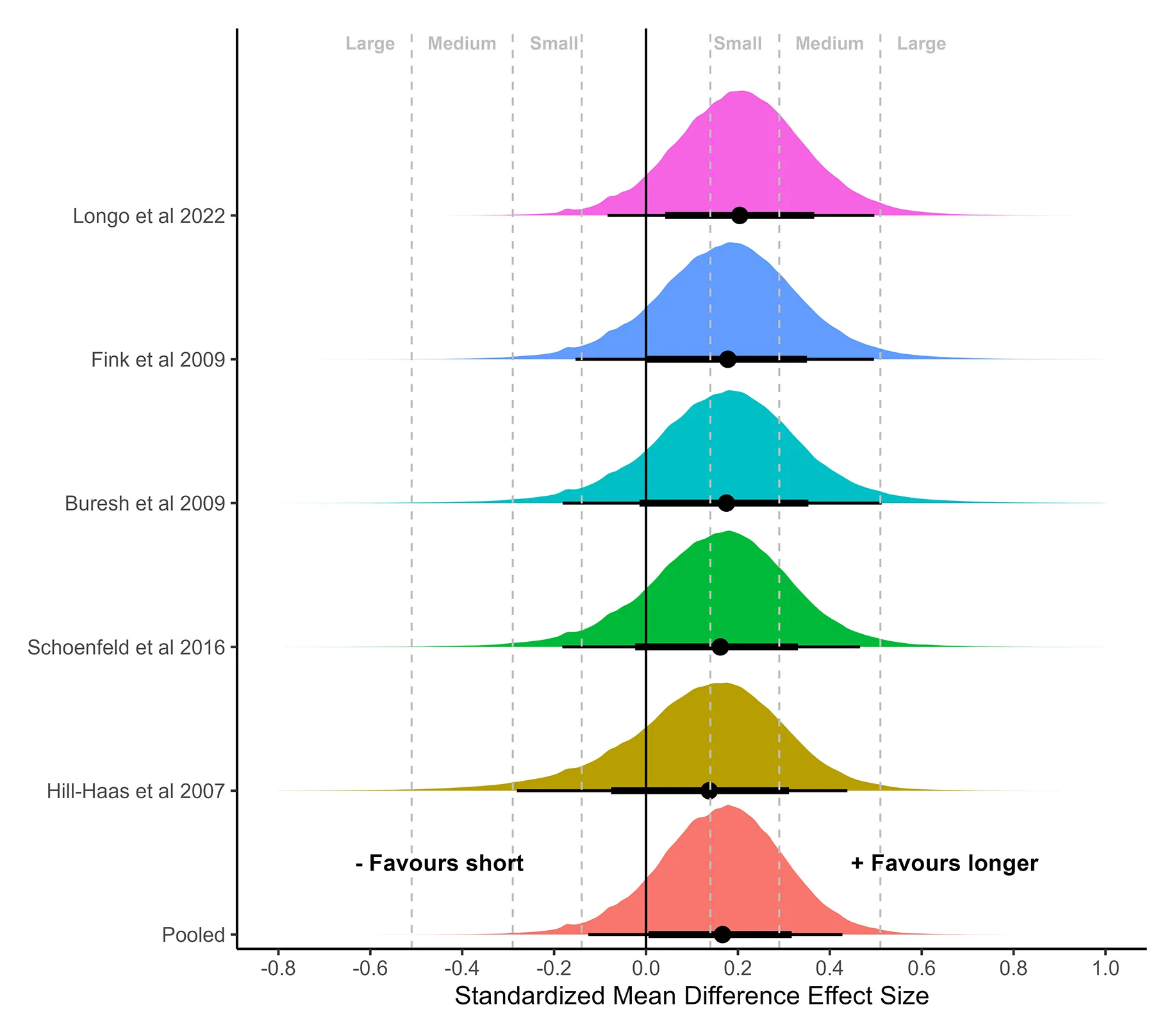
Figure 5 from Singer and colleagues (2024), reproduced under CC BY 4.0. Each row is one study’s direct comparison at the thigh; the bottom row is the pooled answer. It sits on the “favours longer” side, and its interval still crosses zero.
At the thigh, longer rest came out ahead by a standardised 0.17. The Bayesian framing is more useful than the number: there was an 88% chance that longer rest is better, and only a 54% chance the difference is even as big as “small.” At the arm the lean was the same direction and weaker — a 74% chance longer is better, a 45% chance the difference reaches small. The probability that the gap is medium or larger was 15% at the thigh and 18% at the arm.
Whole-body measures leaned the other way, very slightly favouring short rest, but that came from three studies using fat-free mass estimates — DXA, bioelectrical impedance, underwater weighing — which the authors say should be read with caution: those instruments measure everything that is not fat, not muscle specifically.
Taking sets to failure did not change any of this. Whether the studies trained to momentary failure or stopped short of it, the thigh result stayed in the same place, so training closer to failure does not let you get away with a shorter rest.
Why longer rest helps: it is the reps, not the rest
Short rest does not harm you directly. It harms you by taking reps off your later sets. Come back after 60 seconds and you cannot repeat what you did on set one; come back after three minutes and you mostly can. Over three or four sets that gap compounds into a smaller amount of work done — what the literature calls “volume load”, and what you might call “weight times reps”.
The clearest illustration comes from one included study: Longo and colleagues trained one leg with 60 seconds of rest and the other with 180 over ten weeks. The long-rest legs grew 13.1% in quadriceps cross-sectional area against 6.8% for the short-rest legs. The reps tell the story: across three sets, the short-rest condition managed an average of 9.8 repetitions against 16.1 for the long-rest condition.
When extra sets were added so that both conditions completed the same total volume load, the growth came out similar. The rest interval was never the active ingredient. The work was.
That is one study inside a nine-study review and should be held loosely. But it lines up with what the wider evidence says about total hard sets per week being the dial that drives growth: cutting your rest is not a separate lever, it is a quiet way of turning the volume dial down.
It also explains why the benefit stops. The authors note that the difference in volume load between rest lengths tends to level off somewhere between two and three minutes: by then you have recovered most of what you are going to recover, and adding more rest adds nothing but standing around. Their network analysis hinted that very long rest might do slightly better still at the thigh, but they dismiss it themselves: the uncertainty was high and the pattern across the four bands was U-shaped rather than rising, which is not what a dose-response looks like.
Where this sits against the textbook advice
The National Strength and Conditioning Association’s textbook recommends 30 to 90 seconds of rest for hypertrophy goals. This study’s authors say plainly that their findings are inconsistent with that and that the guideline “warrants reconsideration.”
Not all of it is in question. The paper’s dividing line is 60 seconds, so the top half of the NSCA range — 60 to 90 seconds — sits comfortably inside what this analysis supports. What it does not support is the bottom half, and the reasoning behind it: the idea that short rest is preferable because it drives a bigger hormonal response. The authors’ own framing is that the hormone theory has been eroding since work in 2016 and 2018 found those transient elevations do not track with muscle growth, and that this paper is another weight on the same side.
This is not a lone result. The earlier systematic review on this question, by Grgić and colleagues in 2017, concluded that both short and long rest were viable for untrained lifters while longer might favour trained ones. Singer and colleagues land in the same place with better methods and five more years of studies. The direction of the evidence is fairly consistent; what remains unsettled is the size of the effect, and whether it matters more for people who have been training a while.
One thing this paper does not cover: strength. It measured size only. A heavier one-rep max is a separate literature — Grgić and colleagues reviewed it in Sports Medicine in 2018.
How long to rest between sets for muscle growth, in practice
- Treat 60 seconds as a floor, not a target. That is the only cut-point this analysis identifies, and every comparison it ran sits on the same side of it.
- Rest 90 seconds to two minutes on most work. That clears the floor and sits where the evidence runs out. Going longer is not wrong — the studies using three minutes grew plenty of muscle — but the differences between 90 seconds, two minutes and three are smaller than the measurement noise.
- Rest by whether you can repeat the set, not by the clock. The mechanism is reps, so the signal is reps. If set three came in three reps below set one, you may have rested too little. Heavy compound work on big muscle groups will want longer rest; a cable lateral raise will not.
- Count the cost before you cut it. Say you do 20 working sets in a session: trimming rest from 90 seconds to 60 saves 30 seconds a set, which is 20 × 30 = 600 seconds, or 10 minutes off the session. The question is whether it is worth shaving reps off your back half to get it.
- If time is the problem, do not solve it with the rest timer. Supersets and drop sets both compress a session without cutting the work you do, and both have direct evidence behind them. Resting less is the one time-saving method that appears to cost you something.
- Keep the effect in proportion. Every rest length in these studies built muscle. The lean toward longer rest is an 88% chance of being better at the thigh, and a 54% chance the difference is even as big as “small.”
The limits of this evidence
Nine studies, and most of them on untrained people. Six of the nine used untrained participants. The authors wanted to analyse trained lifters separately and could not — there were not enough studies. Lifters who already train are the group the data covers least.
Nobody has studied your chest, back or shoulders. Every measurement here is arm, thigh, or whole body, and the authors flag that no study has looked at rest intervals and the torso muscles. They think it unlikely to behave differently. Nobody has checked.
Moderate volumes only. The included programs used moderate set counts, so the review cannot say whether rest matters more at higher set counts. It plausibly does — more sets means more chances for the fatigue to compound.
Five to ten weeks. These are short studies measuring small differences. The authors point out that a difference too small to detect over eight weeks could still accumulate into something visible over a year. It could also stay invisible; nothing here settles that.
Mixed methods and mixed exercises. Growth was measured by MRI in some studies and by a tape measure in others, and exercise selection varied from machine circuits to free-weight compounds, across which fatigue behaves differently.
Quality was fair, not excellent. On the review’s own 20-point scale the studies averaged 15, ranging from 12 to 17: four good, four fair, one poor.
The review received no funding. One author discloses having formerly served on the scientific advisory board of a fitness equipment manufacturer.
Common Questions About Rest Between Sets
Should I rest longer on squats than on curls? This review cannot answer that directly — it did not compare exercises. The authors list exercise heterogeneity as a limitation and suggest rest prescription may need to vary by exercise type.
How Pick It Up Helps
The finding here is a measurement problem in disguise. Rest matters because of what it does to your later sets, so the thing to watch is whether set three still looks like set one — not whether the timer hit 90. That is hard to track across ten exercises while catching your breath.
Pick It Up gives every set a target weight, a target rep count, and a target difficulty on a simplified RPE scale, then updates the next set’s target from what you reported during the session. If your reps are falling off, the targets respond while you are still standing there. At the end of a block it re-evaluates your one-rep maxes from the whole block and builds the next one from that, so a phase where you were rushing between sets shows up in the programming rather than quietly costing you.
Start a free trial and have all the science taken care of for you, so you can get back to building a better you.
Further Reading & References
- Give it a rest: a systematic review with Bayesian meta-analysis on the effect of inter-set rest interval duration on muscle hypertrophy — Singer A, Wolf M, Generoso L, Arias E, Delcastillo K, Echevarria E, Martinez A, Androulakis Korakakis P, Refalo MC, Swinton PA, Schoenfeld BJ. Frontiers in Sports and Active Living, 2024; 6: 1429789. PubMed. The review this article summarises and the source of every number in it. Published open access under CC BY 4.0, which is also the licence on Figures 3 and 5 above.
- The effects of short versus long inter-set rest intervals in resistance training on measures of muscle hypertrophy: A systematic review — Grgić J, Lazinica B, Mikulić P, Krieger JW, Schoenfeld BJ. European Journal of Sport Science, 2017; 17(8): 983–993. PubMed. The earlier review on the same question, cited here only to place the new one against it.
- Effects of Rest Interval Duration in Resistance Training on Measures of Muscular Strength: A Systematic Review — Grgić J, Schoenfeld BJ, Skrepnik M, Davies TB, Mikulić P. Sports Medicine, 2018; 48(1): 137–151. PubMed. The strength side of the question, which this post does not cover.
- How Many Sets Per Week for Hypertrophy: Where Returns Diminish — the volume evidence, and why cutting rest is a quiet way of cutting volume.
- How Close to Failure Should You Train for Muscle Growth? — the other effort variable, which this review found does not interact with rest.
- Do Supersets Build Muscle? Supersets vs Traditional Sets — a way to shorten a session that does not cost you work.
- Do Drop Sets Build Muscle? Same Growth, Less Gym Time — the other one, answered the same way.