Does stretching build muscle? The short answer
Stretching as a way to build muscle is a live research question, and the reason is animal work. A meta-analysis of chickens and quails whose wings were held under load for up to 24 hours a day found muscle mass up by as much as 319% and maximal strength by as much as 95%. Whether anything of that kind happens in people has been the open question ever since.
A 2024 meta-analysis in Sports Medicine - Open pooled every randomised trial that has put static stretching against a control group and measured what came of it. So: does stretching build muscle? Yes, by a small amount — and only at a dose the authors themselves describe as of limited practical relevance.
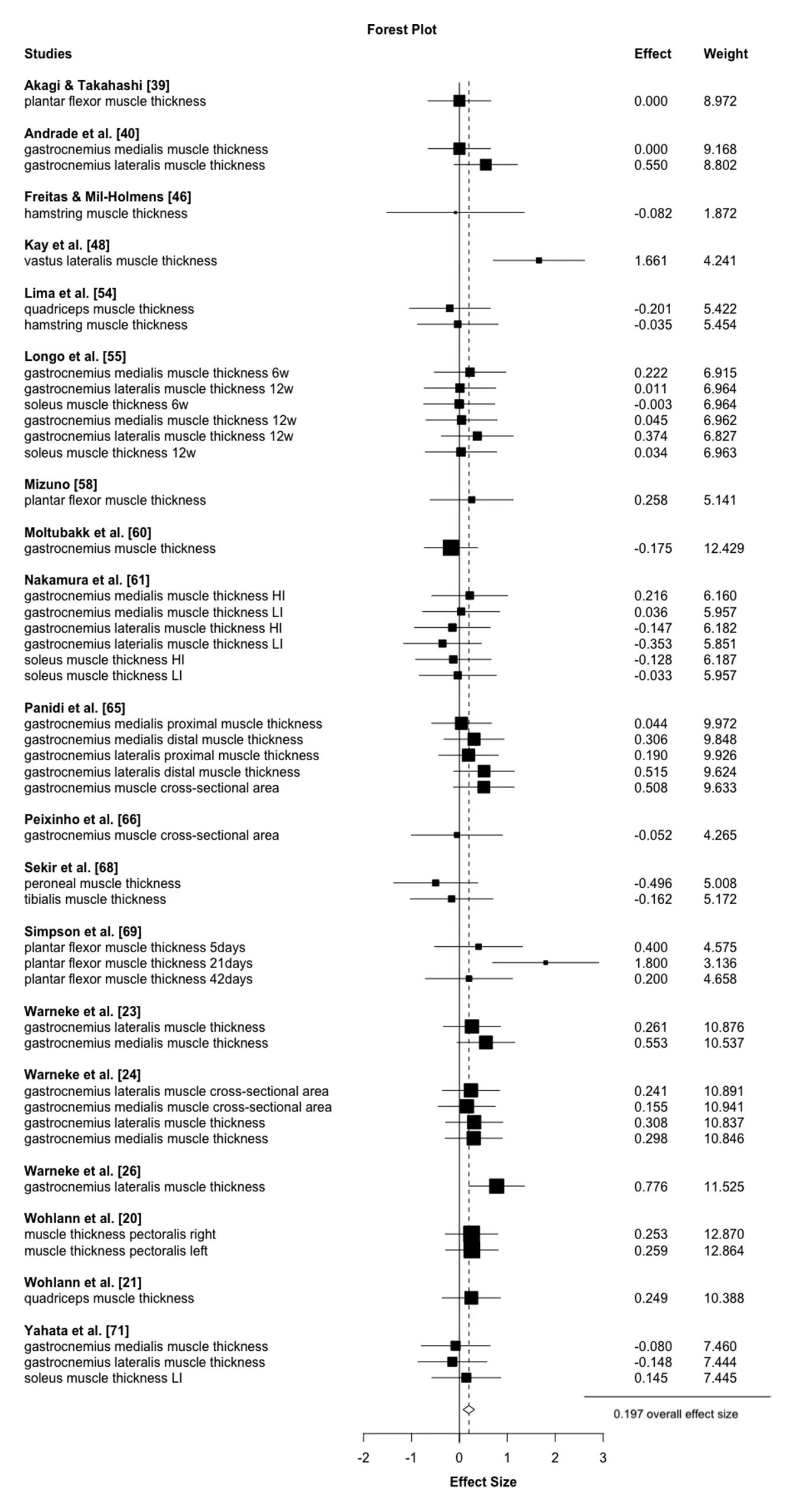
Figure 4 from Warneke and colleagues (2024), reproduced under CC BY 4.0. Every muscle-size measurement in the review, with the pooled estimate of 0.197 at the bottom. Read the study labels down the left: gastrocnemius, soleus, plantar flexor — this is mostly a literature about calves.
Table of Contents
- Does stretching build muscle? The short answer
- What this meta-analysis tested
- Does stretching build muscle: what the numbers say
- The dose is the finding
- Where this sits against lifting
- What this evidence cannot tell you
- Does stretching build muscle enough to change your week
- Common Questions About Stretching and Muscle Growth
- How Pick It Up Helps
- Further Reading & References
What this meta-analysis tested
Warneke and colleagues searched three databases for randomised controlled trials in which people performed static stretching for at least two weeks and somebody measured either maximal strength — how much you can lift, captured here as a one-rep max or as peak torque on a dynamometer — or muscle size, by cross-sectional area or muscle thickness. Forty-two studies cleared the bar, with 1,318 participants between them.
One inclusion rule shapes everything that follows: studies that combined stretching with resistance training were excluded. So were studies using proprioceptive neuromuscular facilitation, and studies of patients. What is left is stretching on its own, against people doing nothing, in participants the authors describe as partly untrained to recreationally active.
Nearly every number below is an effect size, which puts measurements in different units — millimetres of muscle thickness, newton-metres of torque — on one scale. The authors use the conventional reading: under 0.2 is trivial, 0.2 to 0.5 small, 0.5 to 0.8 moderate, above 0.8 large.
Does stretching build muscle: what the numbers say
Across everything the review found, static stretching produced a small increase in maximal strength (0.30, 95% confidence interval 0.14 to 0.46) and a smaller one in muscle size (0.20, 0.08 to 0.32). Both were statistically significant. Both sit at the bottom of the scale the authors themselves set out.
The review rates its own certainty in both of those numbers as low. The included studies scored an average of 4.17 out of 10 on the PEDro scale for trial quality, with a range of 2 to 8, which the authors call fair; between that and the spread of study designs, the evidence was downgraded two full levels from where a body of randomised trials would normally start.
The dose is the finding
The pooled numbers hide the part a lifter can act on. Split the studies by how long each stretching session lasted, and the effect separates cleanly.
| Sessions under 15 min | Sessions of 15 min or more | |
|---|---|---|
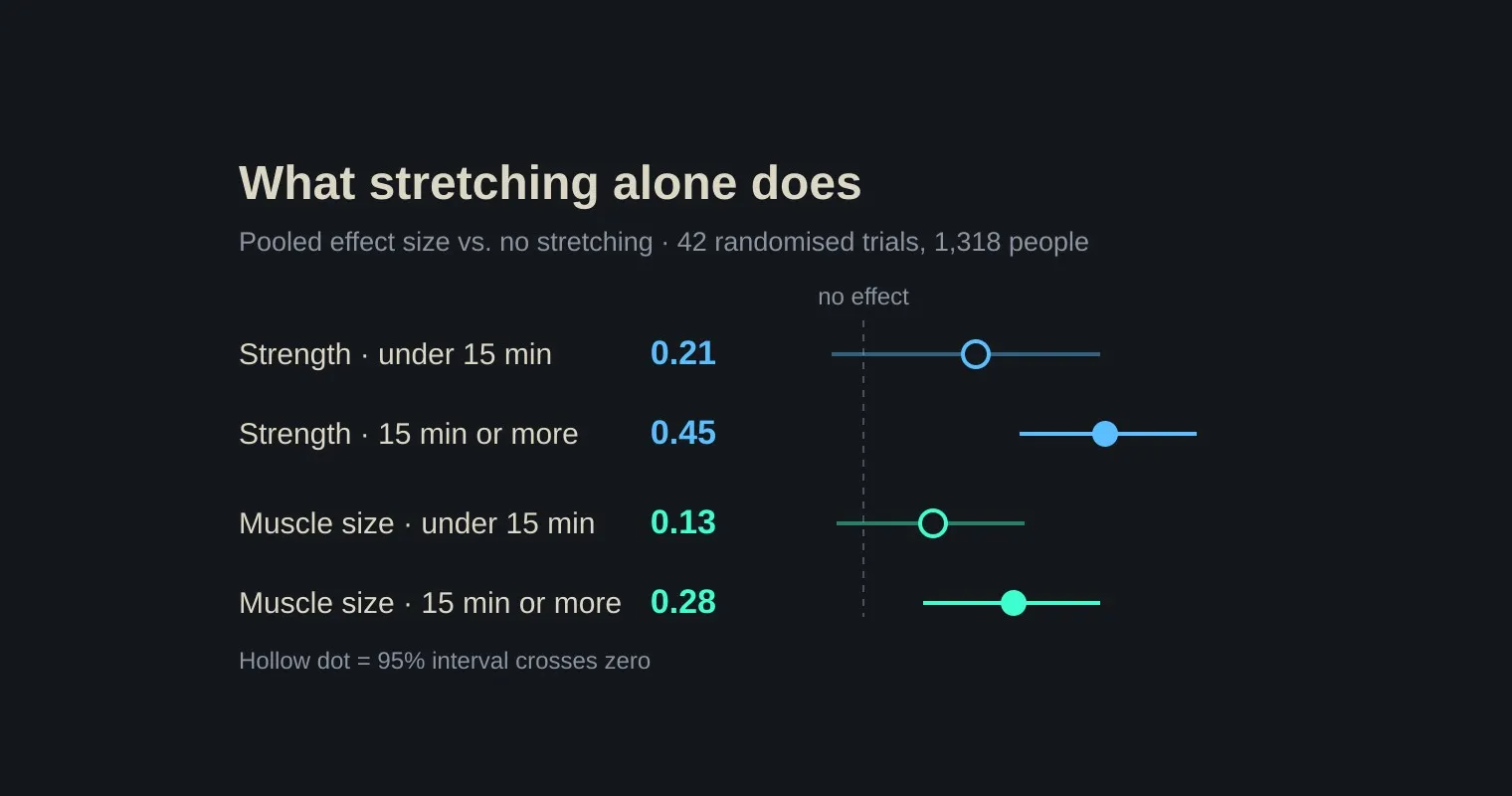
| Maximal strength | 0.21 (not significant) | 0.45 |
| Muscle size | 0.13 (not significant) | 0.28 |
Both short-session estimates have confidence intervals that cross zero, meaning the data are consistent with stretching doing nothing at all. The long-session estimates do not. The same pattern shows up on the other two dials: programs running six weeks or longer moved strength 0.36 and size 0.26, while shorter programs gave 0.16 for strength and, for size, −0.05 — nothing. Stretching five or more times a week moved size 0.27; fewer than five sessions gave 0.09, again indistinguishable from nothing.
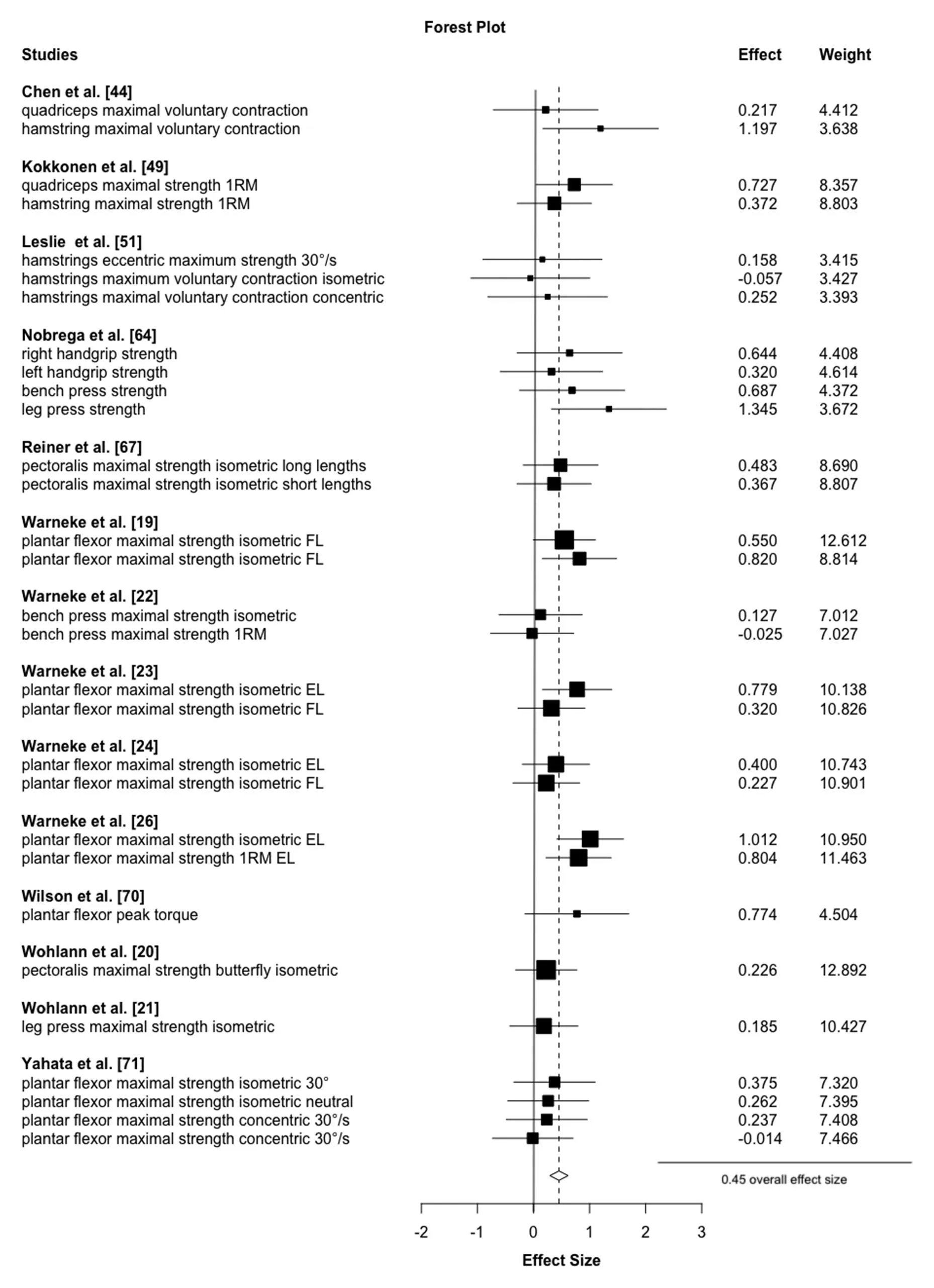
Figure 2 from Warneke and colleagues (2024), reproduced under CC BY 4.0. The studies using sessions of 15 minutes or more, which is where the strength effect lives.
Put the three together and you have the protocol that worked: at least 15 minutes of stretching per session, at least five sessions a week, for at least six weeks — on one muscle group. Fifteen minutes five times a week is 75 minutes a week for one muscle. Give six muscle groups the same treatment and it is 450 minutes, or seven and a half hours a week.
In the discussion the authors go past their own subgroup cut. Their read of what it would take for meaningful muscle growth is “about one hour of stretching on one isolated muscle” — which, in their words, “seems, on the one hand, of limited practical relevance.”
Where this sits against lifting
This study is not an outlier, and it does not overturn anything. It sits at the generous end of a small, consistent literature.
Arntz and colleagues pooled 41 studies in Sports Medicine the year before and found the same shape of answer for strength: 0.21 overall, trivial to small. They also split their results by training status. Sedentary participants gained 0.58 from stretching. Recreationally active participants gained 0.16. The fitter the people, the less there was to find — and a lifter training several times a week is past the point where the larger of those two numbers applies.
For scale, put that beside the lifting. Currier and colleagues ran a Bayesian network meta-analysis in the British Journal of Sports Medicine over 178 strength trials and 119 hypertrophy — muscle growth — trials. It ranked heavier-load, multi-set, thrice-weekly training top for strength at 1.60 against no exercise, and heavier-load, multi-set, twice-weekly training top for muscle growth at 0.66. Warneke and colleagues make this comparison themselves and draw the conclusion it points to: stretching is “less effective compared to resistance training.”
Across the three reviews we found, the picture is consistent. Passive stretching does something, lifting does considerably more for the same time, and none of these authors argue otherwise.
What this evidence cannot tell you
The authors are direct about the holes, and three of them bear on whether any of this reaches you.
It was never tested as an addition to training. Studies combining stretching with resistance training were excluded by design. Every number in this post is stretching instead of nothing, not stretching on top of a program. Whether 15 minutes of calf stretching adds anything to a week that already contains squats and calf raises is a question this review did not ask.
The high-dose result is thin. The muscle-size effect for long sessions rests on seven studies, and the authors note that the largest effects came from a single research group — their own. They flag several individual results as “unreasonably high”: a 29% strength gain in one trial, 24% in another, muscle growth of up to 23% in a third, numbers that would be respectable for a year of lifting.
It is mostly a literature about calves. Read the study labels down the left of the forest plot above and the pattern is hard to miss: gastrocnemius, soleus, plantar flexors, over and over, with a scattering of hamstring, quadriceps and pectoralis work. Whether a calf stretched for an hour generalises to a lat is not something these 42 studies can answer.
Does stretching build muscle enough to change your week
- Do not trade lifting time for stretching time. The dose that moved the needle is 15 minutes a day per muscle group. Set the two sets of numbers side by side: 0.28 for muscle size from long-duration stretching here, 0.66 for muscle size from the top-ranked lifting prescription in Currier.
- Keep stretching for what it reliably does. In the Arntz review, flexibility improved 0.96 — moderate to large, and several times anything measured for strength or size. If you stretch for range of motion, that is a use the evidence supports.
- If you want growth at long muscle lengths, get it from the lift. Training through a full range loads the muscle where it is stretched and progresses like everything else you do. Our post on full range of motion versus partial reps covers what that is worth.
- Anything under about 15 minutes a session is not a growth stimulus. Two minutes of hamstring stretching after a session is fine. It is not in the range anything in this review detected.
- If you cannot lift, this is where stretching earns its place. Injury, immobilisation, a contraindication to loading — that is where the authors themselves put it.
The one thing that would change this advice is evidence that stretching adds to a training program rather than substituting for one. We could not find a trial that has tested it.
Common Questions About Stretching and Muscle Growth
Does stretching between sets count? This review cannot say. Intra-set and between-set stretching are performed inside a lifting session, and studies combining stretching with resistance training were excluded from the analysis. The 42 trials here all stretched in isolation.
Should I stop stretching in my warm-up, then? That is a separate question from this paper’s, and about a separate timescale. The review’s background notes that current evidence questions static stretching in warm-ups because of its short-term effect on performance in the session that follows — an acute effect, distinct from the weeks-long adaptations measured here. This paper tested the second and not the first.
Does this apply to my chest and back? Cautiously at best. The forest plots are dominated by calf muscles, with a few studies on hamstrings, quadriceps and the pecs, so the evidence base for an upper body muscle is a handful of trials rather than a literature.
Some of these studies report gains above 20%. Should I believe them? The authors raise the same doubt about their own included trials, calling several of the increases “unreasonably high” when set beside what strength training produces, and asking for work on why some people respond strongly and others not at all. Treat the pooled estimates as the finding and the headline percentages as outliers waiting to be explained.
Is more than 15 minutes better still? Unknown past the range tested. Session lengths in the high-dose group ran from three five-minute bouts up to a full hour, and the authors could not separate session length from frequency or program length, because the longest protocols also ran most often and for the most weeks.
How Pick It Up Helps
As of September 2026, Pick It Up does not program stretching or mobility work — if you want a flexibility routine, this is not the app that writes it. What it does is make the training hours count, which is where this paper’s own conclusion points.
Every set the app prescribes comes with a target weight, a target rep count and a target difficulty on a simplified RPE scale, and those targets adjust during the session based on what you report. At the end of each block it re-evaluates your 1RMs from what you lifted and builds the next block from that. It is the part of the week the evidence says is doing the work.
Start a free trial and see what your next block looks like.
Further Reading & References
- Warneke K, Lohmann LH, Behm DG, Wirth K, Keiner M, Schiemann S, Wilke J.
Effects of Chronic Static Stretching on Maximal Strength and Muscle
Hypertrophy: A Systematic Review and Meta-Analysis with
Meta-Regression. *Sports Medicine
- Open*, 2024;10(1):45. PMID 38637473. Open access under CC BY 4.0. The source of every number in this post except where stated.
- Arntz F, Markov A, Behm DG, Behrens M, Negra Y, Nakamura M, Moran J, Chaabene H. Chronic Effects of Static Stretching Exercises on Muscle Strength and Power in Healthy Individuals Across the Lifespan: A Systematic Review with Multi-level Meta-analysis. Sports Medicine, 2023;53(3):723–745. PMID 36719536. Cited for the training-status subgroup and the flexibility result.
- Currier BS, McLeod JC, Banfield L, Beyene J, Welton NJ, D’Souza AC, et al. Resistance training prescription for muscle strength and hypertrophy in healthy adults: a systematic review and Bayesian network meta-analysis. British Journal of Sports Medicine, 2023;57(18):1211–1220. PMID 37414459. Cited for the resistance-training comparison.
- Panidi I, Donti O, Konrad A, Dinas PC, Terzis G, Mouratidis A, et al. Muscle Architecture Adaptations to Static Stretching Training: A Systematic Review with Meta-Analysis. Sports Medicine - Open, 2023;9(1):47. PMID 37318696. The earlier review of the same question, which Warneke and colleagues extend with the long-duration studies.
Related reading on this site: how close to failure you should train, how many sets per week for hypertrophy, and how heavy you should lift to build muscle.