Do drop sets build muscle, and what you gain
You have forty minutes and eight exercises. Somewhere in there, someone has told you to strip the weight and keep going rather than sit down for another two minutes of rest. So: do drop sets build muscle, or do they just make the session hurt more?
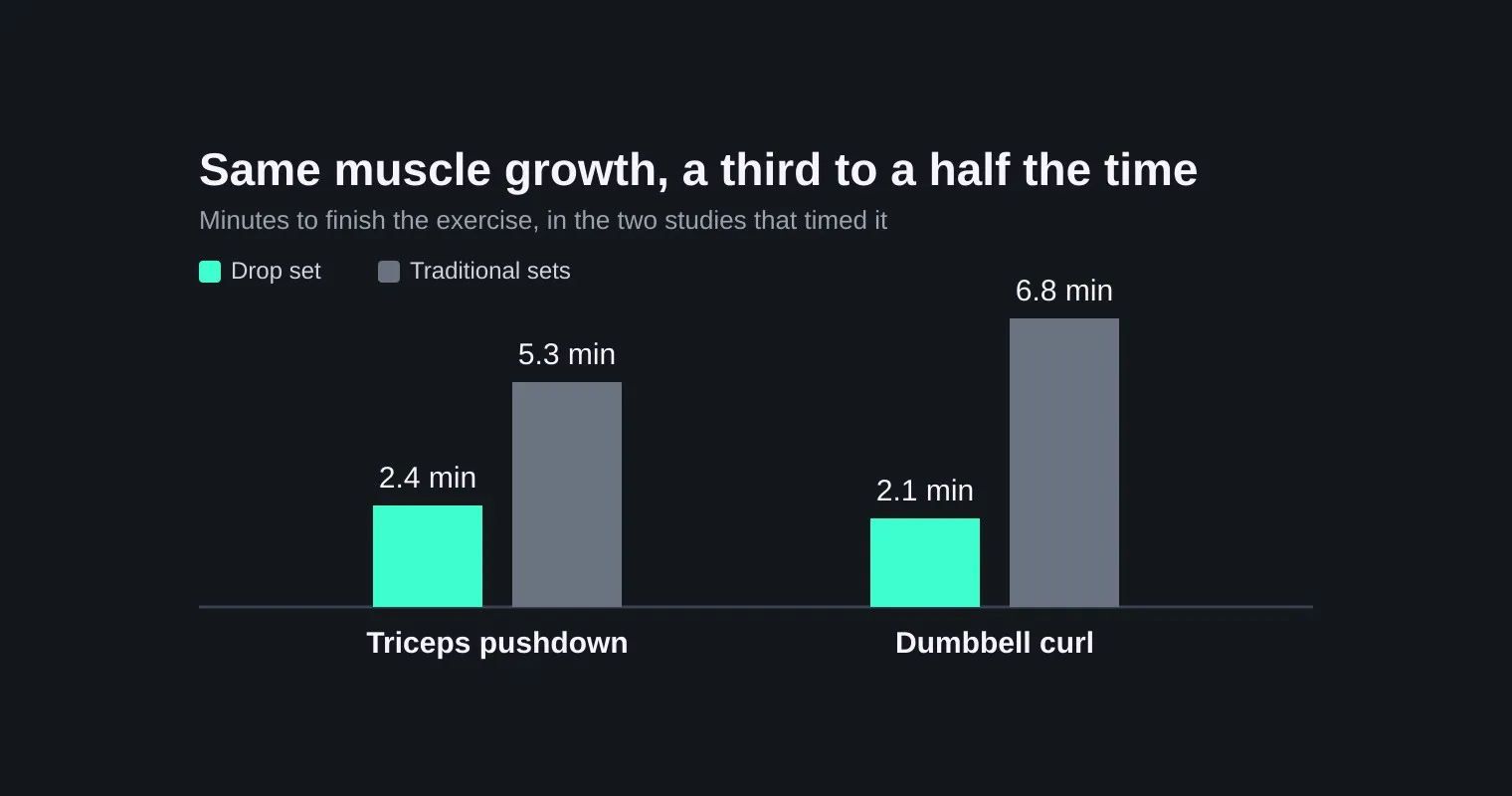
A systematic review and meta-analysis in Sports Medicine - Open is the best attempt we have found to pool the evidence. It found five usable training studies. The conclusion is drop sets did not build more muscle than ordinary sets. They also did not build less — and in the two studies that put a stopwatch on it, they did it in a third to a half of the time.
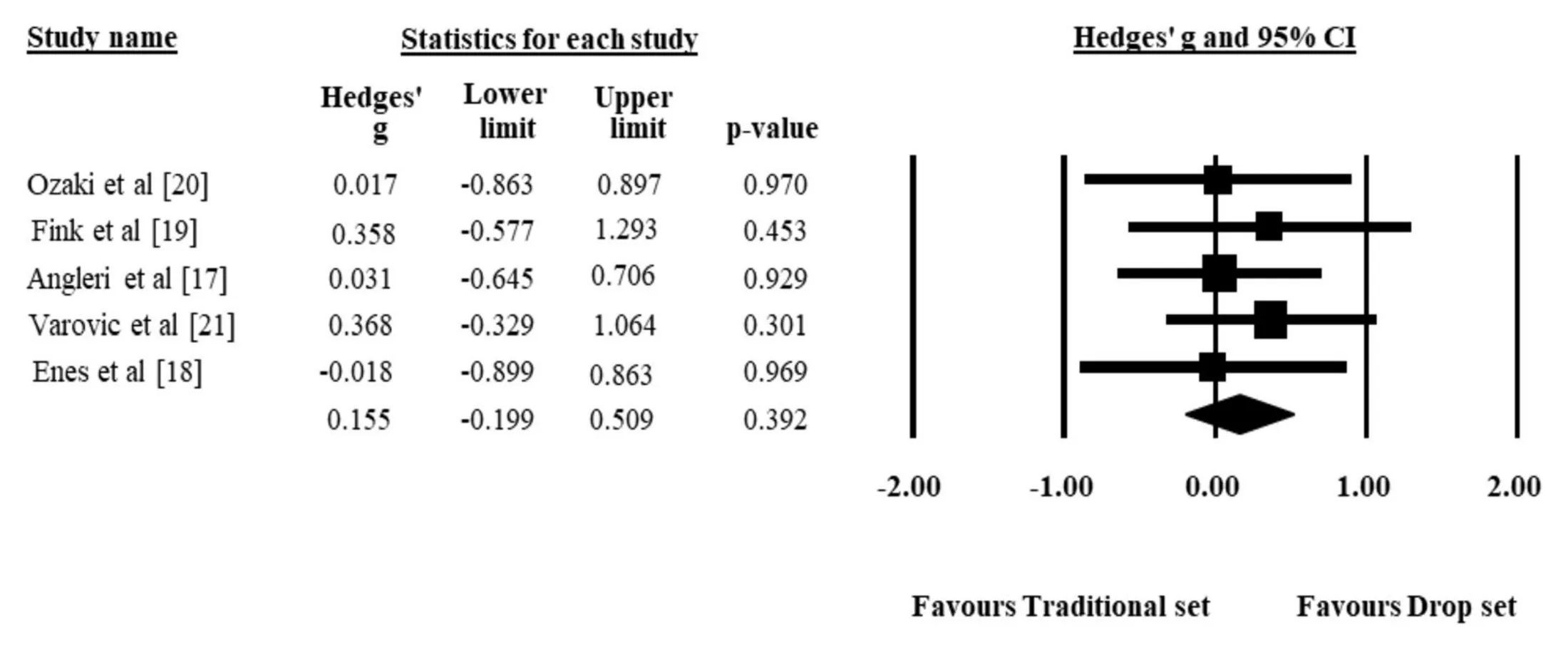
Figure 3 from Sødal and colleagues (2023), reproduced under CC BY 4.0. Each row is one study; the diamond at the bottom is the pooled answer. Everything crosses the zero line, which is the finding.
Table of Contents
- Do drop sets build muscle, and what you gain
- What a drop set is, and what this review compared
- Do drop sets build muscle better than straight sets?
- The time is the finding
- What has to be true for a drop set to work
- Where this sits in the wider evidence
- What to do with this in your own training
- The limits of this evidence
- Common Questions About Drop Sets
- How Pick It Up Helps
- Further Reading & References
What a drop set is, and what this review compared
A drop set is one set taken to the point where you cannot push the weight up again — concentric failure — followed immediately by stripping some load off and going straight back to failure, with no rest in between. In the studies pooled here the load came down by about 20 to 25% per drop, and protocols used anywhere from one drop to four.
Sødal and colleagues searched for every training study that ran a drop-set group against an ordinary straight-set group and measured muscle growth — hypertrophy — with an imaging method rather than a tape measure. Studies had to run at least six weeks, use healthy adults, and clear a methodological quality threshold.
Six studies met the bar and five reported enough detail to pool: 142 people, 28 of them women, aged roughly 19 to 27, in groups of 9 to 41, training for 6 to 12 weeks. Five of the six used trained or active lifters.
The exercises tell you the scope — dumbbell curls, triceps pushdowns, leg press, leg extension, back squat, and a chest-press-and-pulldown circuit. Drop sets have been tested on isolation work and machines, not on a heavy barbell deadlift.
Do drop sets build muscle better than straight sets?
No — and both approaches worked.
Every group in every study got bigger from start to finish. Pooled across the five studies, the drop-set groups grew by a standardised 0.555 and the traditional groups by 0.437. Both are comfortably significant increases.
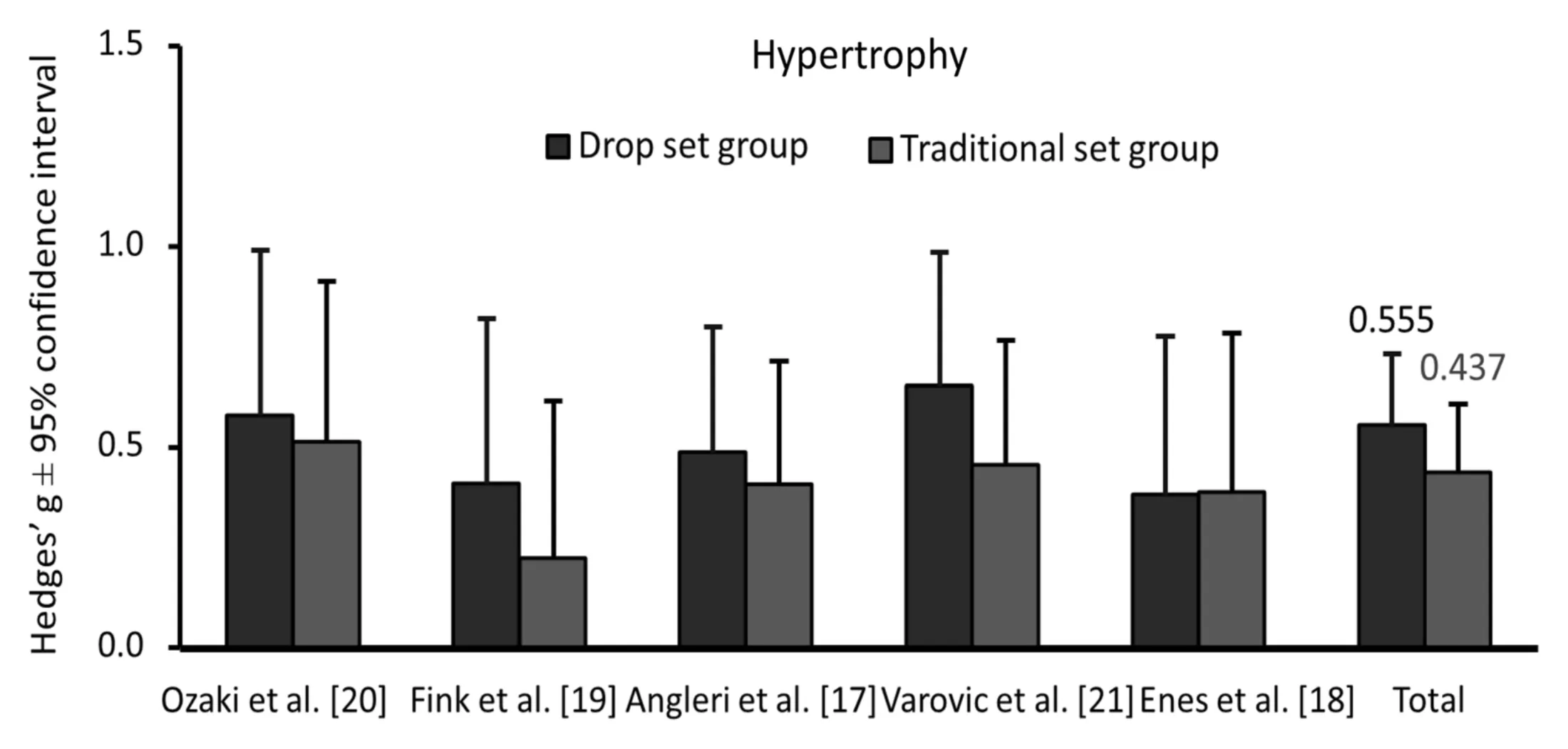
Figure 2 from Sødal and colleagues (2023), reproduced under CC BY 4.0. Drop-set groups in black, traditional groups in grey. The error bars on every pair overlap.
Compare the two directly and the gap disappears. The pooled difference was 0.155 in favour of drop sets, with a range running from 0.199 against them to 0.509 for them, and a p-value of 0.392. The analysis cannot distinguish the two methods.
Four of the five studies pointed in the drop-set direction, though none reached significance alone — with groups of nine to forty-one, none had the power to. But when the authors removed the one study that had not matched training volume between groups, the difference shrank to 0.08. The tidying moved the result toward “no difference”, not away from it.
The studies also agreed with each other unusually well: the heterogeneity statistic came out at zero, and a test for publication bias found nothing. For a body of five small studies, that is about as clean as this gets.
The time is the finding
Only two of the five studies timed the sessions, and both found the same thing.
In the triceps pushdown study, one drop set took 145 seconds against 316 seconds for three traditional sets. In the dumbbell curl study, the drop-set protocol took 2.1 minutes against 6.8 minutes for three straight sets at the same load. The authors’ summary is that the drop-set protocols took half to a third of the time.
That is the trade the evidence supports. Not more growth for the same time — the same growth for a third to a half of it.
It opens a second use the authors point to: adding a drop buys extra hard volume without adding much to the clock. Since volume is the dial that most reliably drives growth, a technique that adds some cheaply is worth having.
What has to be true for a drop set to work
The review turns up one condition, and it is about effort rather than weight.
In five of the six studies, participants took every set to concentric failure — the rep where the weight stops moving. In the sixth, sets were taken “to or close to” failure instead. That was the only study in which the drop-set group did not come out ahead of the traditional group, and the authors’ reading is that going all the way to concentric failure is what makes the technique pay.
That is a speculation drawn from one study inside a small review, and it should be held loosely — though it is mechanically sensible. A drop set exists to carry on fatiguing a muscle past the point where a given load stops moving; stop the first set two reps early and there is less left to carry on from.
It has a cost the authors raise in passing: drop sets have been reported to hit neuromuscular performance harder than straight sets, which can mean a longer recovery and a lower training frequency for that muscle. Free time in the session is not free everywhere.
Machines suit drop sets, because you can go to failure on stable equipment and change the load in a second — also most of what these studies tested.
Where this sits in the wider evidence
This is the only meta-analysis of drop sets that we could find, and its authors call their own results preliminary. Five studies with an average of twenty-four people each is a starting point, not a settled question.
It lands in the same place as everything else we have covered about how you arrange your sets. Supersets came out the same way: no better for growth than traditional sets, but considerably faster. The consistent picture across these techniques is that set structure is a lever on your time, not on your results — and that the things that move muscle growth are total hard sets per week and how close to failure you take them, both of which rest on far more evidence than this paper does.
One loose thread the review flags is regional growth: in one study, drop sets grew specific parts of the rectus femoris — one of the quadriceps — more than traditional sets did, while the muscles overall grew the same amount. The authors suggest mixing both structures rather than picking one.
What to do with this in your own training
Drop sets build muscle about as well as straight sets — not better, but in less time. What that buys you in practice:
- Use drop sets when the constraint is time, not when you want more growth. That is what the evidence supports. If your session has to fit in thirty minutes, this is a way to fit it.
- Take the first set to concentric failure. The single conditional finding in the review is that stopping short appears to cost you the benefit. This is consistent with our review of how close you need to train to failure: close, especially for lighter weights where judging “close” is difficult, but not all the way to failure.
- Drop about 20 to 25% and go again immediately. That is what the studies used. The lack of rest is the entire mechanism and the entire time saving.
- Put them on machines and isolation work. That is where they were tested, where changing the load takes a second, and where going to failure is safest. A drop set on a heavy barbell squat is neither supported by this evidence nor a good idea unsupervised.
- Do not put them on everything. Going to failure repeatedly has a recovery cost, which the authors note can reduce how often you train a muscle. Use drops on one or two exercises at the end of a session.
- If you have the time, you do not need them. Three straight sets built the same muscle in these studies. The reason to reach for a drop set is buying back minutes.
The limits of this evidence
Five studies, 142 people, and the authors call the results preliminary. On the review’s own 15-point methodological scale the studies scored 7 to 10, averaging 8.5 — fair to good, none excellent.
The individual studies were underpowered. Groups ranged from 9 to 41 people. Several reported differences favouring drop sets that came nowhere near significance, which is common with samples that small — and why “no significant difference” here means “could not tell”, not “proved identical”.
Almost all young men. 114 of the 142 participants were men, aged roughly 19 to 27. Only one study used untrained participants, so no trained-versus-untrained comparison was possible, and the authors flag women as a group worth studying separately.
Growth was measured three different ways — ultrasound in three studies, MRI in two, whole-body lean mass in one. Those are not equally precise instruments, and pooling them adds noise the review acknowledges.
Nobody compared drop sets with a volume-matched control at the same session length. These studies mostly asked “drop set versus three straight sets”, which is a question about time as much as about structure. What they cannot tell you is what happens if you keep the session length and add drops on top.
The review was funded by nobody, and its authors declare no competing interests.
Common Questions About Drop Sets
Are drop sets good for beginners? The review could not answer this — only one of the six studies used untrained participants. Given that going to failure repeatedly carries a recovery cost, there is no obvious reason for a newer lifter to reach for the technique before simply doing the sets.
Do drop sets work for women? Nobody knows yet. 28 of the 142 participants were women, only one study included any, and the authors call for research on women — noting a theoretical argument that they might respond better, which is a hypothesis and not a result.
Drop sets or rest-pause? This review compared drop sets against traditional sets, not against rest-pause, so it cannot rank them. One included study ran a rest-pause condition alongside, but the analysis does not pit the two against each other.
Should I add drop sets or just add a set? If you have the time, add the set — the volume research behind it is far stronger than this paper. Add the drop when time is what you do not have.
How Pick It Up Helps
The awkward part of a drop set may not be the effort but the arithmetic. At failure and out of breath, you have a couple of seconds to decide what 25% less looks like on that machine and how many reps to aim for on the second half.
Every set in Pick It Up arrives with a target weight, a target rep count, and a target difficulty on a simplified RPE scale, and as you report what you hit, the app updates the targets for the next set during the session. As of September 2026, Pick It Up does not program drop sets. It does support supersets, another time-saving technique that does not require going to failure. However you train, at the end of a block it re-evaluates your one-rep maxes from everything you lifted and builds the next block from how the previous month went as a whole.
Start a free trial and have all the science taken care of for you, so you can get back to building a better you.
Further Reading & References
- Effects of Drop Sets on Skeletal Muscle Hypertrophy: A Systematic Review and Meta-analysis — Sødal LK, Kristiansen E, Larsen S, van den Tillaar R. Sports Medicine - Open, 2023; 9(1): 66. PubMed. The review this article summarises and the source of every number in it. Published open access under CC BY 4.0, which is also the licence on Figures 2 and 3 above.
- Do Supersets Build Muscle? Supersets vs Traditional Sets — the other time-saving set structure, which the evidence answers the same way.
- How Many Sets Per Week for Hypertrophy: Where Returns Diminish — the volume evidence, which is the lever that moves muscle growth.
- How Close to Failure Should You Train for Muscle Growth? — what “to failure” costs and buys you, on far more evidence than this paper.
- How to Break Through a Plateau in Weightlifting and Strength Training — what to change when a lift stops moving, in the order worth changing it.