Finding the Right Strength Coach Shouldn’t Feel Like a Puzzle
You want to get stronger. Maybe you want to compete in a strength sport, pick up your grandkids without back pain, or simply look like you lift. So you start searching: “weightlifting coach near me” or “how to choose a strength coach.”
Suddenly you’re drowning in options. Olympic weightlifting coaches teaching snatches. Powerlifting coaches obsessed with squat depth. Personal trainers doing circuit training. Online strength coaches selling cookie-cutter programs. Strength and conditioning coaches you can’t afford. Fitness influencers with questionable credentials.
Each one claims to have the answer. Each one costs $100-250 per month for coaching services. And whether you’re looking to hire a strength coach or find a gym coach who understands your goals, none of them clearly explain whether they’re the right fit for YOU.
This guide cuts through the confusion. You’ll learn exactly what each type of strength coach and resistance training coach does, when you actually need one, and what alternatives exist that won’t drain your wallet.
Table of Contents
- Why Choosing the Right Coach Matters
- Understanding Different Types of Strength Coaches
- Weightlifting vs. Powerlifting Coaching
- Resistance Training Coaching: The Bigger Picture
- Nutrition Coaching vs. Training Coaching
- Fitness Coaching: The Hybrid Model
- How Strength Training Programs Work
- Linear Progression: The First Step
- Periodization: What Happens After Progress Slows
- What Are Your Goals?
- How to Choose the Right Coaching Approach for You
- How Pick It Up Helps
- Common Questions About Strength Coaching
- Further Reading & References
- Conclusion
Why Choosing the Right Coach Matters
Choosing the wrong type of coach isn’t just an inconvenience — it can derail your progress for months and cost you hundreds of dollars.
Work with an Olympic weightlifting coach when you just want general strength, and you’ll spend months perfecting snatch technique you don’t need. Hire a powerlifting coach when you’re training for a sport, and your program won’t transfer to on-field performance. Follow a general fitness coach when you need serious strength gains, and you’ll plateau quickly.
The financial cost alone is significant. In-person strength coaching typically ranges from $100-250 per month, while specialized Olympic weightlifting group classes can cost $100-250 monthly. If you’re with the wrong coach for even three months, that’s $300-750 wasted, plus the opportunity cost of slow or misdirected progress.
There’s also the injury risk. Each coaching specialty has different technical demands. An Olympic lifting coach can spot subtle form issues in a snatch. A powerlifting coach knows squat biomechanics inside and out. But put them in each other’s specialty, and they may miss important form breakdowns.
The good news: once you understand what each type of coach specializes in, the choice becomes obvious. The best strength coach for your needs isn’t necessarily the most expensive or the most certified—it’s the one whose expertise aligns with your specific goals.
Understanding Different Types of Strength Coaches
The confusion around coaching types stems from overlapping terminology and genuine differences in expertise. A weightlifting coach isn’t the same as a powerlifting coach or strength and conditioning coach, and neither is quite the same as a personal trainer, online strength coach, or fitness coach.
Whether you’re searching for a gym coach, an online strength coach, or an in-person specialist, understanding these distinctions will help you make the right choice. Each type of resistance training coach has specific training, certifications, and areas of focus. Understanding these distinctions will save you time, money, and frustration when deciding how to choose a strength coach. Let’s break down what each type actually does.
Weightlifting vs. Powerlifting Coaching
Weightlifting and powerlifting may sound similar — but the coaching approach and core movements are very different.
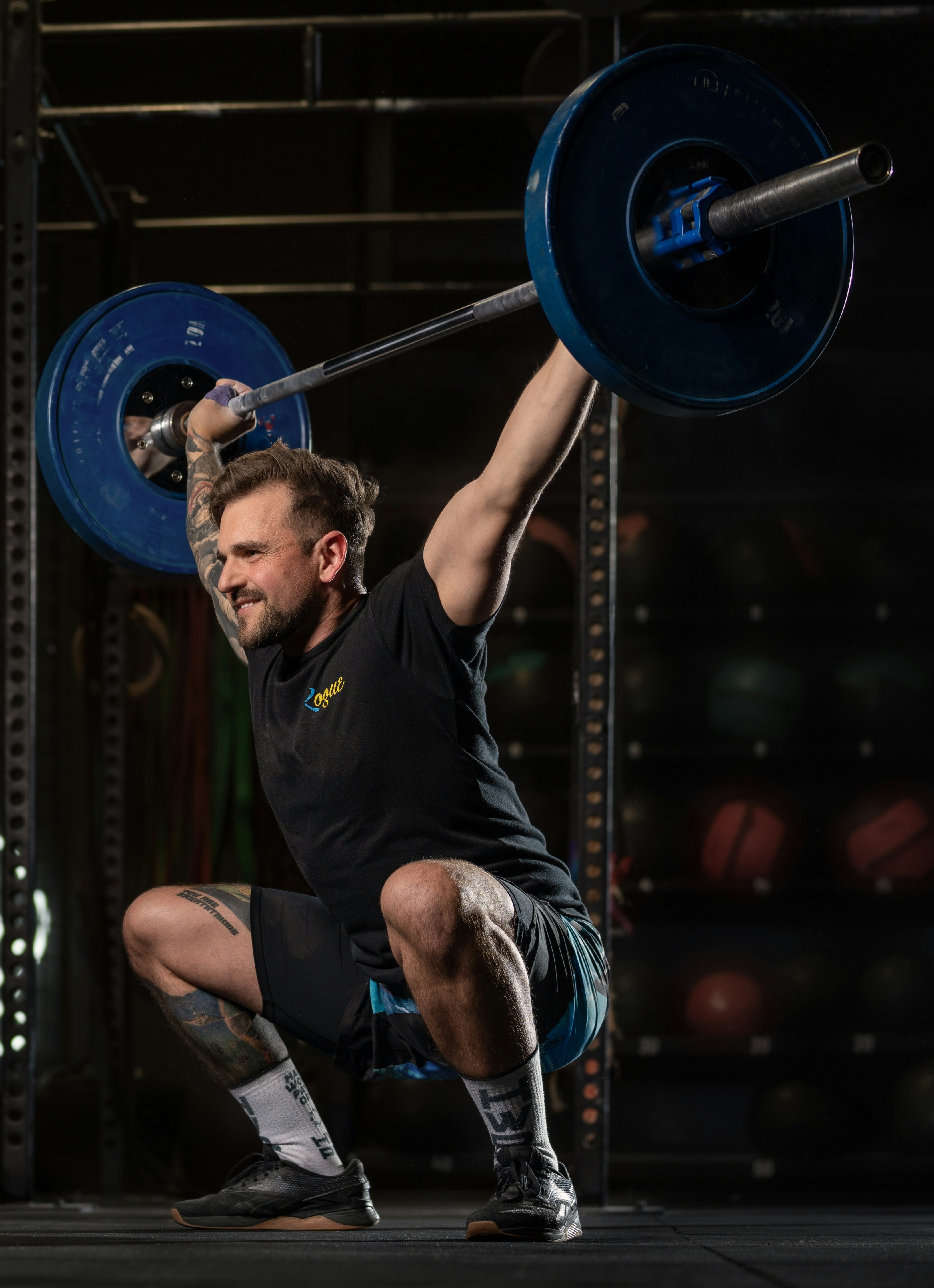
Olympic Weightlifting (Snatch / Clean and Jerk)
A weightlifting coach typically focuses on the two Olympic lifts:
- Snatch
- Clean and Jerk
These movements are technical, explosive, and skill-based. Coaching usually includes:
- Mobility work
- Barbell positions
- Speed and timing
- Technique drills and complex progressions
You’ll see accessory lifts like:
- Front squats
- Pulls
- Overhead squats
- Jerks from blocks
This style suits athletes who want power, explosiveness, or competition in the Olympic lifting world.
Most Olympic weightlifting coaches are USA Weightlifting (USAW) certified and typically charge $100-250 per month for group classes or $55-100 per private session. Sessions often run 90-120 minutes, with significant time devoted to mobility and technical drilling before heavy lifting. To find a weightlifting coach, look for USAW-certified professionals at dedicated Olympic lifting gyms.
Importantly, an Olympic weightlifting coach — sometimes shortened to simply “weightlifting coach” — focuses on helping lifters who want to pursue Olympic lifting competitively. These coaches specialize in technical Olympic lifts rather than general strength development for everyday athletes or fitness enthusiasts.
Powerlifting (Squat / Bench / Deadlift)
A powerlifting coach focuses on maximizing strength in three lifts:
- Squat
- Bench press
- Deadlift
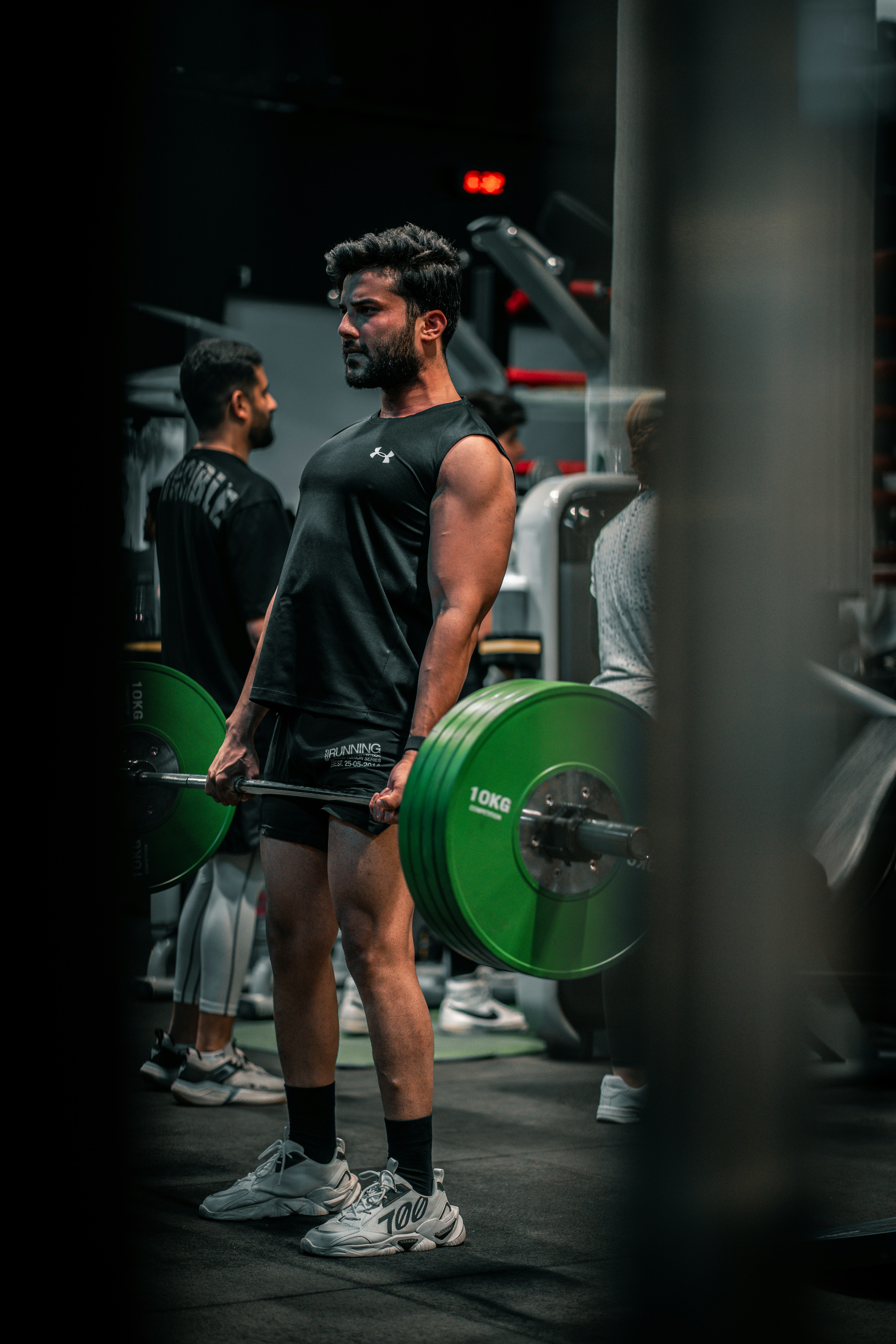
The programming is typically slower, heavier, and progression-focused. The goal is simple: lift more weight, with solid (not necessarily beautiful) technique.
Powerlifting coaches often have certifications from federations like USA Powerlifting (USAPL) or work with competitive lifters preparing for meets. Coaching costs typically range from $100-200 per month for online coaching with check-ins, or $150-250 for in-person training.
This approach works well for anyone wanting raw strength, especially beginners or intermediate lifters who respond well to structured progression models.
Resistance Training Coaching: The Bigger Picture
Both Olympic lifting and powerlifting sit under the broader umbrella of resistance training.
If your goals involve:
- General strength
- Lean muscle
- Healthy joints
- Aging well
- Sports performance
- Looking like you lift
— then you’re in this category.
A resistance training coach may pull from multiple disciplines and include:
- Compound lifts
- Machine work
- Dumbbells
- Hypertrophy sets
- Strength progressions
- Functional or corrective exercises
For most people — especially beginners, returning lifters, or those who have plateaued — this blended approach is the most practical.
Who Benefits Most from Resistance Training
General resistance training programs work particularly well for:
- Adults 30-60+ looking to maintain or rebuild strength and muscle mass
- Beginners with no specific sport or competition goals
- Athletes cross-training for sports that aren’t weightlifting or powerlifting
- Post-rehab individuals returning to strength training after injury
These individuals often get the best results working with a resistance training coach who can design progressive, goal-specific programs. The American College of Sports Medicine (ACSM) recommends that adults perform resistance exercises for each major muscle group 2-3 days per week, using loads corresponding to 8-12 repetitions for beginners and varying intensities for trained individuals.
What a Typical Program Looks Like
Most resistance training programs run 3-4 days per week, with sessions lasting 45-75 minutes. Beginners can expect noticeable strength gains within 4-6 weeks, with significant improvements in the first 3-6 months of consistent training.
For most people, this blended approach is the most practical and cost-effective path to strength.
Nutrition Coaching vs. Training Coaching
A common mistake: expecting a training coach to fix diet problems or a nutrition coach to fix strength problems.
They’re separate skill sets.
A nutrition coach typically helps with:
- Macro planning
- Fat loss
- Muscle gain fueling
- Recovery nutrition
- Habit development
A training coach helps with:
- Exercise selection
- Proper progression
- Technique and safety
- Workload and volume
- Intensity and fatigue management
Some coaches do both — but most specialize. Fitness coaching packages that combine both are available but require careful evaluation. If strength is your priority, you need resistance training programming first. If you’re not fueling properly or need to lose significant body fat, adding nutrition coaching makes sense. Just know they address different problems.
Fitness Coaching: The Hybrid Model
Then there’s the broad term: fitness coaching.
This typically mixes:
- Strength training
- Nutrition guidance
- Cardio
- Lifestyle habits
It’s the generalist version of coaching — good for people whose goals are broad (e.g., “I want to get in shape”).
Strength and conditioning coaches (like those in football programs) fall into this category too — except their priority is performance, not aesthetics or long-term progression. They design programs that improve athletic output: speed, power, agility, and sport-specific strength.
Pros and Cons of General Fitness Coaching
Pros:
- Fitness coaching offers a one-stop solution where one coach handles multiple aspects of health
- Convenient for people with broad, non-specific goals
- Often less expensive than hiring multiple specialists
Cons:
- May lack depth in any single area (strength, nutrition, etc.)
- Not ideal if you have specific strength or performance goals
- Program design may prioritize variety over progressive overload
If you’re training for a specific sport or want to maximize strength, a specialized strength coach will usually deliver better results than a general fitness coach.
How Strength Training Programs Work
Before diving into specific progression methods, it helps to understand how strength programs are actually structured.
All effective strength programs share common elements:
- Exercise selection based on your goals and movement patterns
- Progressive overload — gradually increasing the challenge over time
- Adequate recovery between sessions
- Tracking progress to know when to increase weight or volume
The difference between beginner and advanced programming isn’t complexity for its own sake — it’s matching the progression strategy to your current adaptation rate. Beginners adapt quickly and need simple progression. Advanced lifters adapt slowly and need more sophisticated planning.
This is where linear progression and periodization come in.
Linear Progression: The First Step
Almost every beginner — and many intermediate lifters who think they’re advanced — should start with linear progression.
The idea is simple:
You add small amounts of weight or reps each session.
It’s not glamorous, but it works — until it doesn’t.
What Linear Progression Looks Like in Practice
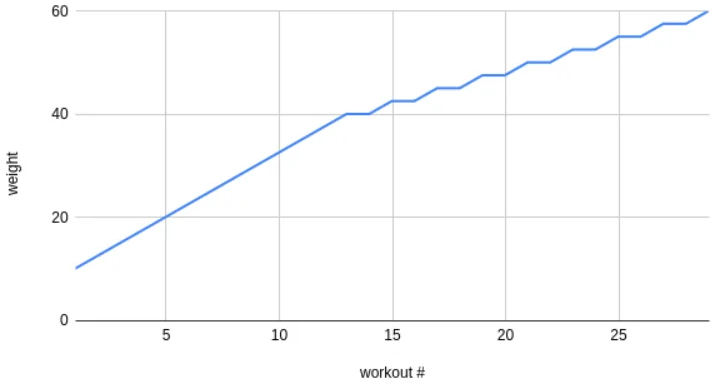
In practice, linear progression typically looks like this: Add 5 pounds to upper body lifts (bench press, overhead press) and 10 pounds to lower body lifts (squat, deadlift) each session. For a beginner, that might mean:
- Week 1: Squat 135lbs for 3 sets of 5 reps
- Week 2: Squat 145lbs for 3 sets of 5 reps
- Week 3: Squat 155lbs for 3 sets of 5 reps
This continues until you can’t complete all prescribed reps. At that point, you deload (reduce weight by 10-15%), then build back up.
How Long Linear Progression Works
Research on novice lifters shows this simple approach can produce significant strength increases within 12-16 weeks. A male beginner might progress from a 135lb squat to 225lb. A female beginner might go from 95lb to 155lb.
Once you’ve milked linear progression dry — meaning you’ve stalled, deloaded, and stalled again — it’s time for periodization.
Signs you’ve outgrown linear progression:
- You stall on lifts for weeks
- You feel constantly fatigued
- You can’t recover quickly enough
- Strength progress is unpredictable
That’s your cue to level up.
Periodization: What Happens After Progress Slows
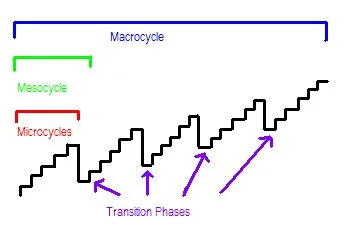
Once linear progression stops working, you need periodization — structured planning where intensity, reps, and exercises vary across:
- Weeks
- Blocks
- Training phases
This avoids plateaus by:
- Managing fatigue
- Cycling volume
- Building strength in waves
Most self-coached lifters get stuck because they never learn how to do this correctly. It’s not guesswork — it’s programming science.
Types of Periodization
Research published in Sports Medicine shows that periodized resistance training produces greater strength improvements than non-periodized training. Periodization comes in three main forms:
Block Periodization: You train in distinct phases, each lasting 3-6 weeks. First an accumulation phase (high volume, moderate weight, building work capacity). Then an intensification phase (moderate volume, heavy weight, building strength). Finally a realization phase (low volume, peak weights, expressing your new strength). This is popular in powerlifting for competition prep.
Wave/Undulating Periodization: Your volume and intensity wave up and down weekly or bi-weekly. Week 1 might be 4x8 at 70%, week 2 is 5x5 at 80%, week 3 is 5x3 at 87%, then back down to start another wave. This is what Pick It Up uses — it’s effective for continued progress without excessive fatigue.
Daily Undulating Periodization (DUP): You change rep ranges each session. Monday might be 5x5, Wednesday is 4x8, Friday is 6x3 — all for the same lift. This works well for advanced lifters training frequently.
A systematic review and meta-analysis found that periodization of training volume and intensity affects maximal strength when volume is equated, with undulating periodization showing particular effectiveness.
Which type is best? For most intermediate lifters, wave periodization offers the best balance of simplicity and effectiveness.
What Are Your Goals?
Before deciding on a coach or approach, get clear on what you care about:
Are you training for:
- Strength?
- Aesthetics?
- Sports performance?
- Weight loss?
- Longevity and mobility?
- Confidence?
Different goals require different strategies. A CrossFit generalist program won’t match a powerlifting hypertrophy block. A marathon training plan won’t support a muscle-building phase.
Once you know what matters, the right approach becomes obvious.
How to Choose the Right Coaching Approach for You
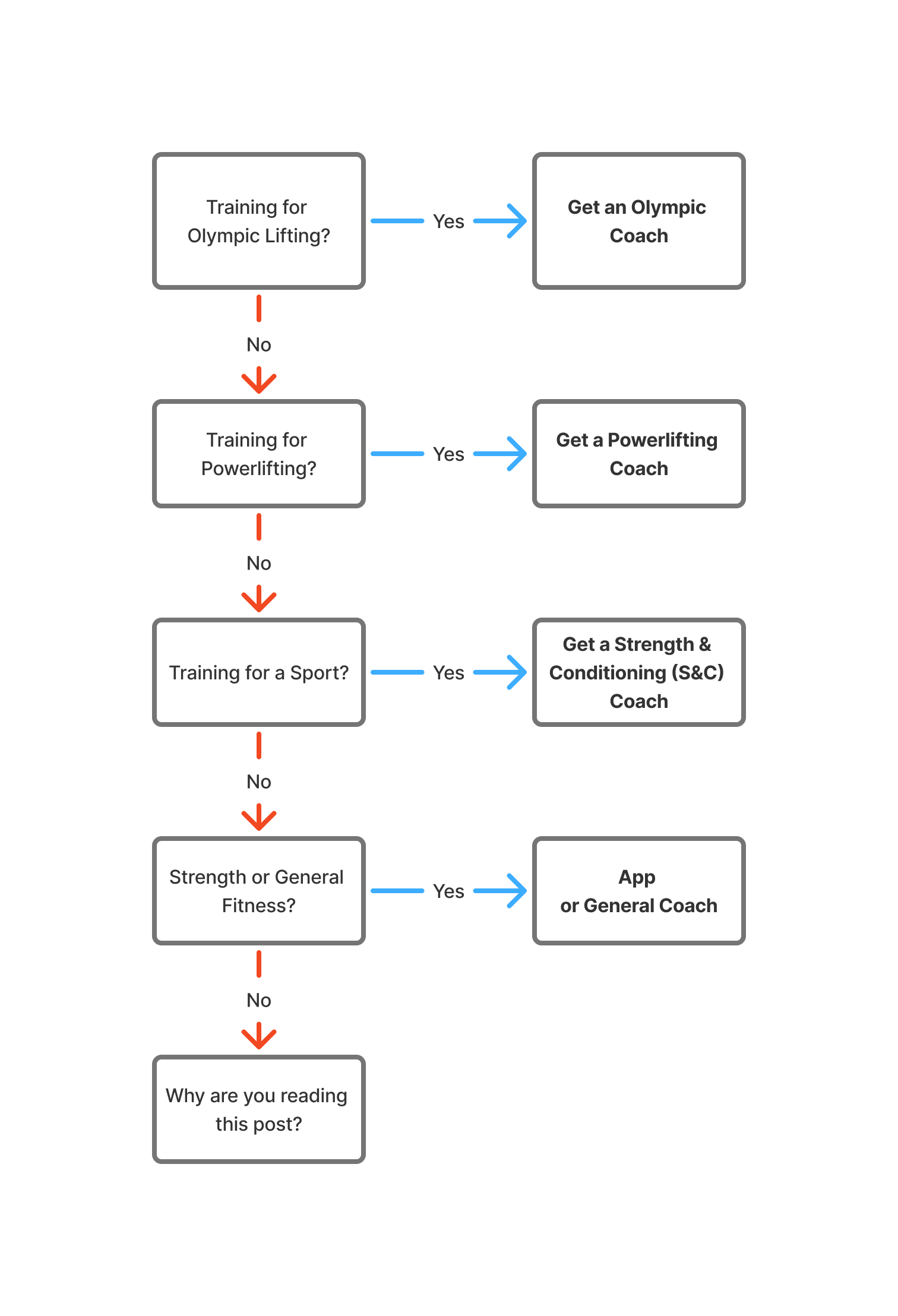
Here’s a simple decision framework:
If you’re competing in Olympic weightlifting: You need an Olympic weightlifting coach. The technical demands of the snatch and clean & jerk require in-person coaching with immediate feedback. Find a USAW-certified coach at a dedicated weightlifting gym.
If you’re competing in powerlifting: You need a powerlifting coach, at least for meet prep. Many successful powerlifters self-coach in the off-season using templates, then hire a coach 12-16 weeks before competition to dial in their peak. Look for coaches with USAPL or similar federation experience.
If you’re training for a sport (not lifting sports): You need a strength and conditioning coach who understands your sport’s demands. Your program should include Olympic lift variations for power, not because you’re becoming a weightlifter, but because explosiveness transfers to your sport.
If you want general strength, muscle, and health: You have the most flexibility here. When you hire a strength coach for general goals, you’re not looking for sport-specific expertise—you’re looking for solid programming fundamentals. Options include:
- Resistance training coach (in-person or online): $100-250/month
- Structured app with periodization: $5-20/month
- Hybrid approach: App for daily training + quarterly form checks with a coach ($15-50/month total)
Budget and Time Considerations
Budget comparison:
- In-person specialist coach: $150-250/month
- Online coaching: $100-200/month
- Group classes: $100-250/month
- App-based: $5-20/month
Time commitment: Most coaching requires 3-5 sessions per week, 45-90 minutes each. If you can’t commit to this consistently, even the best coach can’t help you.
Whether working with a certified strength coach in person or using structured programming, ensure the approach includes periodization and progressive overload.
The honest truth: the best strength coach isn’t always a $200/month specialist. They need a structured program they’ll actually follow. That might be an app, a template, or occasional coaching — whatever removes the guesswork and keeps you consistent.
Real-World Scenarios
Scenario 1 — The Confused Beginner: Meet Sarah, 32, who wants to “get strong” but doesn’t know where to start. She’s overwhelmed by Instagram coaches, each promoting different methods. Sarah doesn’t need an Olympic weightlifting coach teaching snatches. She needs a structured resistance training program that builds foundational strength across all major movement patterns. An app like Pick It Up or a general resistance training coach would serve her well for the first 6-12 months. Once she identifies specific goals (maybe powerlifting competition, or CrossFit), she can specialize.
Scenario 2 — The Plateaued Intermediate: John has been lifting for 18 months. He added weight to the bar every session for the first year, going from a 135lb squat to 275lb. But now he’s stuck. He’s been at 275lb for 8 weeks, and he’s frustrated. John has hit the wall where linear progression stops working. He needs periodization — planned variation in volume and intensity. Instead of trying to add weight every session, he needs to cycle through higher-volume phases (4x8 at 70%), moderate phases (4x5 at 80%), and lower-volume strength phases (5x3 at 87%). This is where coaching or a sophisticated app that understands exercise programming becomes valuable.
Scenario 3 — The Athlete: Marcus plays college baseball. He needs strength, but his main goal isn’t the weight room — it’s explosive power transfer to his swing and throw. He works with his team’s strength and conditioning coach who programs squats, Olympic lift variations, and plyometrics that specifically support baseball performance. Marcus doesn’t need powerlifting programming focused on maximal squat numbers. He needs functional strength that improves his sport.
How Pick It Up Helps
Remember Sarah, the confused beginner drowning in Instagram fitness coaching advice? Or John, the plateaued intermediate frustrated after months of no progress? If you’re unsure where you fit — beginner, comeback lifter, or stuck intermediate — hiring a strength coach may feel like overkill (or too expensive).
A simpler starting point: use a structured, adaptive resistance training tool.
What Pick It Up Does
Pick It Up was built for lifters who want the benefits of an online strength coach, without the learning curve or $200/month price tag.
The app uses AI to handle the complex parts of programming:
-
Goal-based exercise selection: You enter why you’re training and what equipment you have access to. The app chooses exercises that match your goals and available equipment.
-
Automated periodization: Pick It Up creates 4-week training blocks using wave periodization, cycling your volume and intensity systematically to avoid plateaus.
-
Real-time adaptation: As you complete each set, you report the weight, reps, and difficulty (using a simplified RPE system). The app immediately adjusts your targets for the next set based on your performance.
-
Block-to-block progression: At the end of each 4-week block, the app evaluates your performance across all exercises, updates your estimated 1RMs, and creates your next block with appropriate progressions.
It costs less than a protein shake: $5/month during beta—a fraction of what you’d pay for online coaching from a human coach ($100-200/month).
Who It’s Best For
Pick It Up works best for:
- Beginners who need structure but don’t know where to start
- Intermediate lifters who’ve plateaued on simple programs
- Self-coached lifters who want automated periodization
- Athletes cross-training for non-lifting sports
- Older adults returning to strength training
- Anyone on a budget who still wants intelligent programming
How It Compares to Traditional Coaching
Pick It Up excels at: tracking progress, providing structured programs, automating periodization, and adapting weights based on performance.
Pick It Up cannot: correct your form in real-time, account for subtle biomechanical issues, provide motivation and accountability (as effectively as humans), or make nuanced program adjustments for complex situations.
The honest limitations: Pick It Up doesn’t provide form checks or in-person supervision. If you’re learning complex movements like Olympic lifts, or if you have significant mobility restrictions or injury history, working with a human coach — at least initially — is valuable.
Best approach for many: Use Pick It Up for daily programming, with occasional form-check sessions with a coach (monthly or quarterly). This gives you intelligent, adaptive programming at $5/month, plus expert eyes on your technique when needed.
Try it, see how your body responds, and decide later if you need human coaching.
Common Questions About Strength Coaching
How much does a weightlifting coach cost?
Weightlifting coaches vary widely in price. In-person Olympic weightlifting coaches typically charge $100-250/month for group classes or $55-100 per private session. Powerlifting coaches range from $100-200/month for online programming. Online strength coaching is typically $100-200/month for personalized programming with check-ins. General resistance training coaches fall somewhere in between. Apps like Pick It Up offer structured programming for $5/month during beta but lack the personalized form feedback a human coach provides.
How do I find a weightlifting coach or strength coach near me?
To find a weightlifting coach, start by searching for gyms that specialize in Olympic lifting or have USAW-certified coaches. For general strength coaching, look for certified strength coaches at local gyms, ask for referrals from training partners, or consider online coaching options. Check credentials (USAW, USAPL, NSCA, or CSCS), read reviews, and ideally schedule a trial session to assess coaching style and compatibility with your goals.
What makes the best strength coach for my needs?
The best strength coach isn’t the one with the most certifications or highest price—it’s the one whose expertise aligns with your goals. For Olympic lifting competition, you need a specialized weightlifting coach. For general strength and health, a resistance training coach or structured program works well. Look for coaches who understand periodization, can explain their programming rationale, and have experience with clients similar to you.
Can I build strength without a coach?
Yes, absolutely. Many successful lifters are self-coached, especially in the beginner and early-intermediate phases. The key is following a structured resistance training program (not just “winging it” in the gym) and learning proper form through quality resources. Linear progression programs like Starting Strength or StrongLifts work well for beginners. As you advance, you’ll need periodization knowledge or tools (apps, templates, or eventually coaching) to continue progressing. Research shows that supervised training produces superior results, but the main risk of self-coaching is poor form going uncorrected, which can lead to injury.
What’s the difference between a personal trainer vs strength coach?
Personal trainers are certified to work with general population clients on fitness, weight loss, and basic strength. Many complete their certification in a few months. Strength coaches (also called strength and conditioning coaches) typically have bachelor’s or master’s degrees in exercise science and specialize in developing athletic performance or maximal strength. They understand advanced programming concepts like periodization. A personal trainer might have you doing circuit training for general fitness; a strength coach designs progression-based programs to maximize force production.
Do I need different coaches for different goals?
Not necessarily, but specialization helps at advanced levels. A general resistance training coach can help with multiple goals (strength, muscle gain, fat loss) simultaneously, especially if you’re a beginner. However, if you’re competing in a specific sport (Olympic lifting, powerlifting, CrossFit), you’ll benefit from a coach who specializes in that discipline. Think of it like medical specialists: your general practitioner handles most health issues, but you see a cardiologist for heart-specific problems.
How do I know if I need periodization?
You need periodization when linear progression stops working. Signs include: 1) Stalling on major lifts for 3+ weeks despite adequate sleep and nutrition, 2) Constant fatigue that doesn’t resolve with rest days, 3) Declining performance despite increasing effort, 4) You’ve been training consistently for 6-12+ months. Beginners don’t need periodization — simple progressive overload works. Intermediate and advanced lifters need structured variation in volume and intensity to continue progressing.
Can apps replace human coaches?
Apps can replace human coaches for structured programming and progression planning, but not for everything. Apps excel at: tracking progress, providing structured programs, automating periodization, and adapting weights based on performance. Apps cannot: correct your form in real-time, account for subtle biomechanical issues, provide motivation and accountability (as effectively as humans), or make nuanced program adjustments for complex situations. Best approach for many: use an app for daily programming, with occasional form-check sessions with a coach.
Further Reading & References
For those wanting to dive deeper into strength coaching and programming, here are authoritative sources:
-
ACSM Position Stand: Progression Models in Resistance Training for Healthy Adults - American College of Sports Medicine - Evidence-based guidelines for resistance training progression, including recommendations for novice, intermediate, and advanced lifters across different training goals.
-
NSCA Strength and Conditioning Professional Standards and Guidelines - National Strength and Conditioning Association - Comprehensive professional standards covering resistance training program design, safety considerations, and coaching qualifications.
-
Comparison of Periodized and Non-Periodized Resistance Training: A Meta-Analysis - Williams et al., 2017, Sports Medicine - Meta-analysis of 18 studies showing periodized training produces superior strength gains compared to non-periodized approaches.
-
Effects of Periodization on Strength and Muscle Hypertrophy - Moesgaard et al., 2022, Sports Medicine - Systematic review finding that undulating periodization shows effectiveness for 1RM strength when volume is equated.
-
The Role of Supervision in Resistance Training - Systematic review and meta-analysis demonstrating that supervised resistance training produces superior adaptations compared to unsupervised training.
-
ACSM Guidelines: Exercise for Developing and Maintaining Fitness - American College of Sports Medicine - Position stand on quantity and quality of exercise for developing cardiorespiratory, musculoskeletal, and neuromotor fitness in adults.
-
How to Price Personal Training Services - Hevy Coach, 2026 - Industry analysis of personal training pricing structures including in-person and online coaching rates across different experience levels and geographic markets.
-
Online Personal Training Pricing Guide - Hevy Coach, 2026 - Comprehensive breakdown of online strength coaching pricing models, covering monthly programming, check-ins, and specialized powerlifting and weightlifting coaching rates.
Conclusion
Choosing the right weightlifting coach, powerlifting coach, or strength training approach doesn’t have to be confusing. Once you understand the differences between powerlifting coaches, Olympic weightlifting coaches, general resistance training coaches, online strength coaches, nutrition coaches, and fitness coaching models, the options stop feeling overwhelming.
Most people don’t need the perfect coach — they need a realistic plan, consistency, and smart progression.
Whether you’re rebuilding strength, starting from scratch, or finally ready to break through a stubborn plateau, the right system makes training simpler, not harder. Match your coaching choice to your actual goals: compete in Olympic lifting, hire a weightlifting coach. Want general strength on a budget, use a structured resistance training app. Need sport-specific performance, find a strength and conditioning coach who knows your sport.
If you want a structured, adaptive place to start, you can join the Pick It Up beta, try programming built around your goals, and see how fast things change when the guesswork disappears.